This guide explains delirium, a sudden disturbance in consciousness, its symptoms, risk factors, and clinical assessment methods. It covers nursing interventions, pharmacological treatments like benzodiazepines and antipsychotics, and prevention strategies.
Delirium is a transient pathological disorder characterized by a rapid onset of impaired cognitive, perceptual, emotional, and behavioral alterations. Often manifesting within hours or a few days, it represents a state of disturbed consciousness and is considered a medical emergency. Notably, delirium is the most frequent complication encountered during hospitalization. Because it can stem from a wide variety of physiological stressors, rapid identification and intervention are critical to patient outcomes.
Understanding Delirium and Its Symptoms
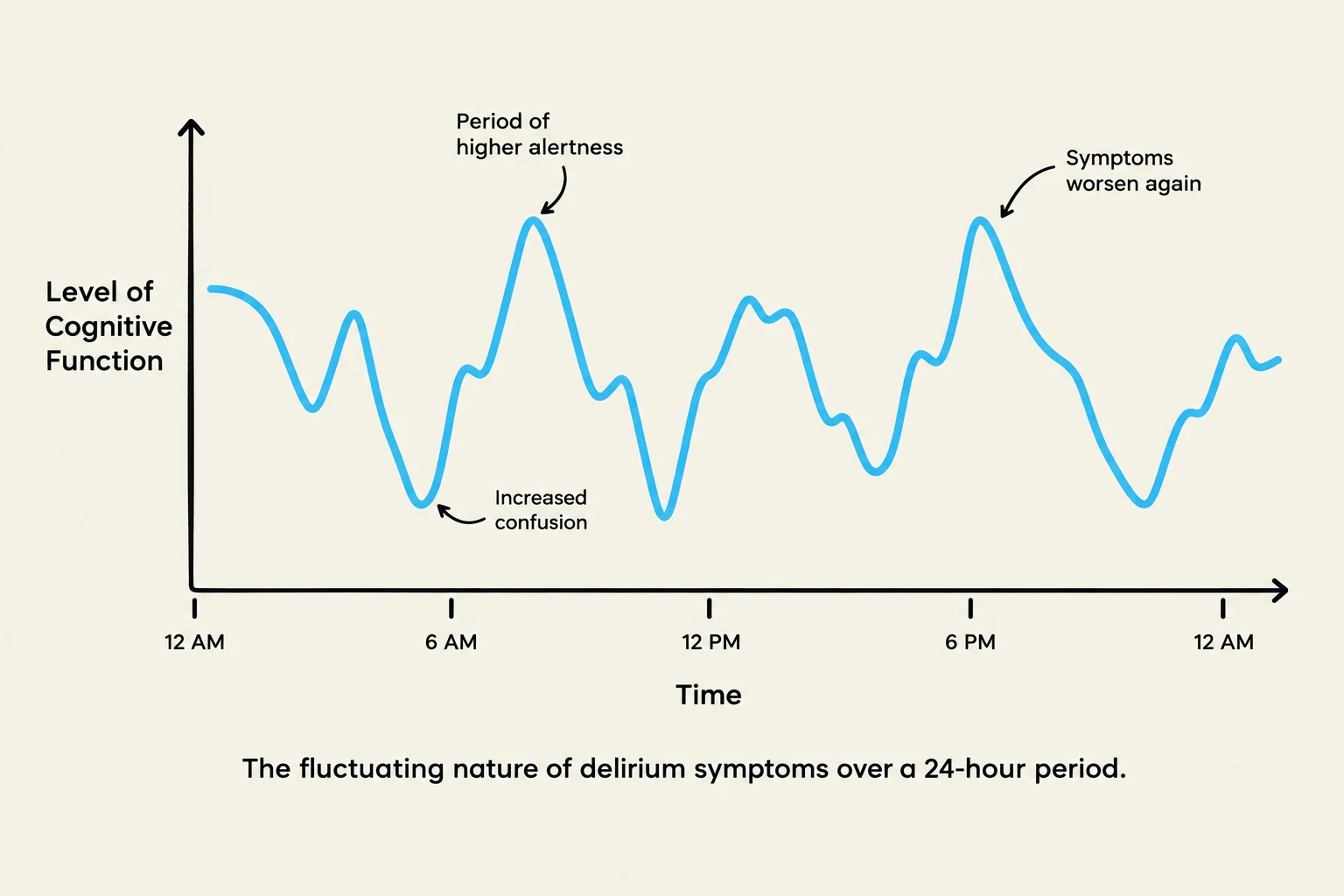
A graph illustrating the fluctuating nature of delirium symptoms over a 24-hour period, showing variations in the level of cognitive function.
Delirium is not a permanent state of cognitive decline, such as dementia, but rather a fluctuating disturbance. Patients experiencing delirium often present with a constellation of symptoms that may vary significantly over a 24-hour period.
Key clinical manifestations include:
Cognitive Alterations: Dulled awareness, reduced ability to focus or sustain attention, and impaired memory or judgment.
Perceptual Disturbances: Hallucinations and delusions.
Emotional and Behavioral Changes: Emotional swings, restlessness, tremors, and inappropriate or uncontrollable emotions, such as severe agitation or aggression.
Sleep-Wake Cycles: Disturbed sleep patterns and fluctuating levels of alertness.
Clinical Note: Cognitive dysfunction is not a normal or healthy part of aging.
Risk Factors and Pathophysiology
Several factors can predispose a patient to delirium. These include advanced age, brain trauma, and various diseases or disorders such as tumors, hypoxia, or stroke. Environmental exposures (e.g., lead), substance use disorders, genetic diseases, depression, and medications are also significant contributors. Furthermore, physiological imbalances—such as fluid and electrolyte disturbances—can trigger cognitive impairment.
Optimal brain function relies on the continuous perfusion of oxygenated, nutrient-rich blood. Consequently, any decrease in oxygen or glucose supply, or imbalances in electrolytes and acid-base status, can directly impair cognitive function.
Clinical Assessment
Effective assessment requires a systematic approach to establish a patient's baseline and identify the acute changes characteristic of delirium.
History and Neurological Examination
Clinicians must conduct a thorough health history. For adults, this includes reviewing age, education level, history of disease or trauma, substance abuse, and current medications. In infants and children, the focus shifts to prenatal/family history and whether developmental milestones have been met.
During a physical and neurological examination, clinicians should observe the patient's general survey. This includes monitoring for:
Posture and Movement: Slumped posture or slow, dragging movements.
Speech Patterns: Difficulty finding words, distorted speech, disconnected sentences, or confabulation (the fabrication of events to fill memory gaps).
Level of Consciousness (LOC): Observing if the patient is awake, responds to touch, or responds to painful stimuli (such as a sternal rub or trapezius pinch).
Assessing Level of Consciousness (LOC) and Orientation
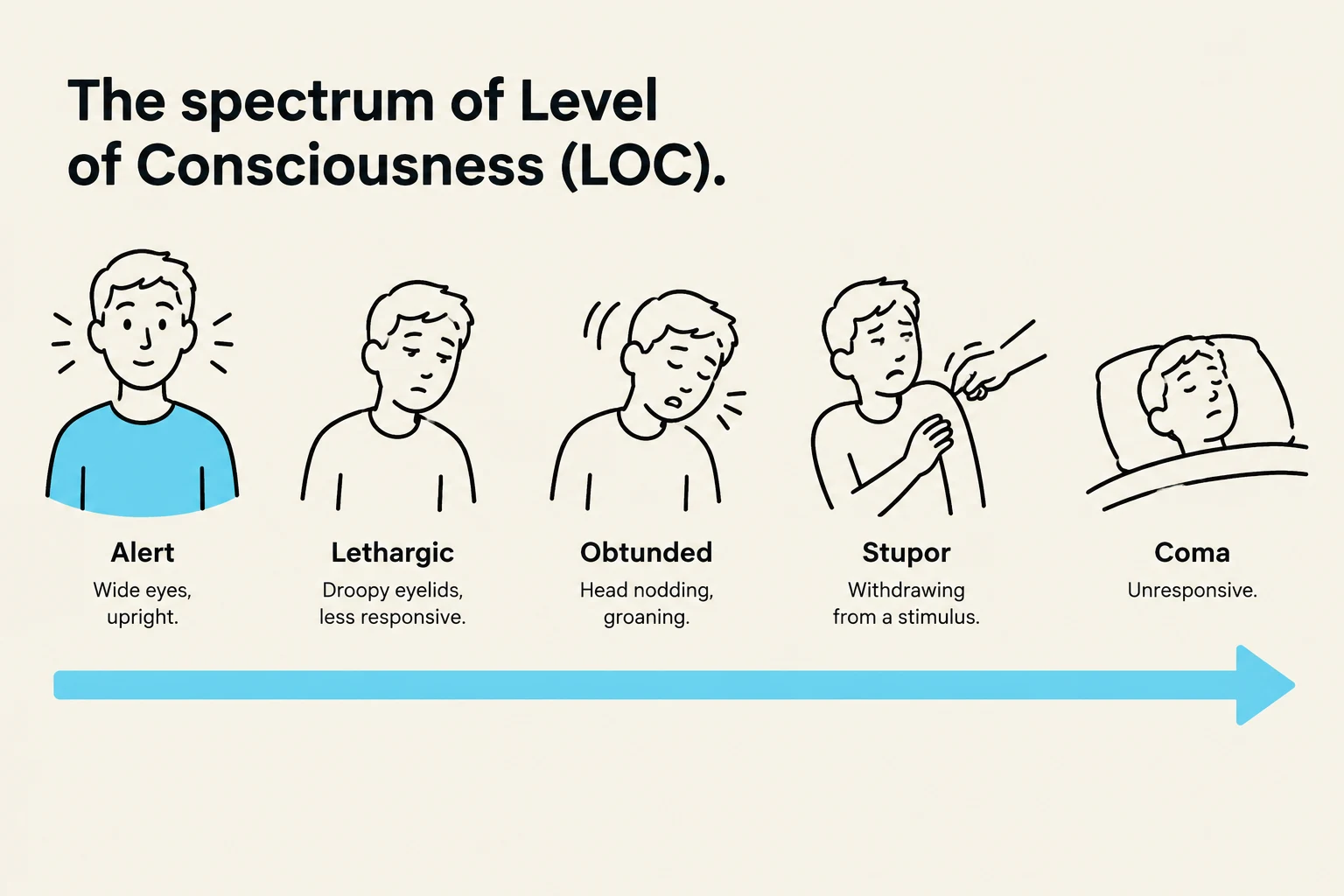
The spectrum of Level of Consciousness (LOC) illustrates different states from alert to coma, with descriptions and visual representations of each stage.
The Level of Consciousness is viewed as a spectrum:
Alert: Awake and readily aroused.
Lethargic/Somnolent: Drowsy, thinking is slow, and may drift off.
Obtunded: Difficult to arouse; requires persistent or vigorous stimuli; may groan or mumble.
Stupor: Responds only to vigorous pain; may withdraw from pain.
Coma: Unconscious with no response to stimuli.
Simultaneously, clinicians must assess orientation across four spheres: Person (name), Place (location), Time (date/time), and Context (reason for being there).
Screening Tools and Diagnostics
Several validated tools are used to quantify cognitive and neurological status:
Confusion Assessment Method (CAM): Specifically designed to screen for delirium.
Glasgow Coma Scale (GCS): Assesses eye-opening, verbal, and motor responses on a scale of 3 (unresponsive) to 15 (no deficits).
MMSE and MoCA: Used to screen for dementia and early cognitive impairment.
To identify the underlying cause, diagnostic testing is essential. Laboratory tests target electrolyte imbalances and signs of infection, while brain imaging (CT, MRI, or PET scans) is used to identify tumors, infarcts, or atrophy.
Management of Delirium
The cornerstone of management is to treat the underlying cause. For example, antibiotics are used for infection, fluids for dehydration, and oxygen for hypoxia.
Nursing Interventions and Non-Pharmacologic Support
Nurses play a vital role in monitoring and stabilizing the patient. Essential nursing tasks include monitoring vital signs, O2 saturation, blood glucose, fluid balance (intake and output), and ensuring proper elimination and pain control.
Non-pharmacologic strategies focus on safety and reorientation:
Environment: Maintain a quiet, predictable routine with a consistent caregiver and familiar objects.
Communication: Use simple instructions, maintain eye contact, and provide frequent reorientation.
Safety: Ensure sensory aids (glasses/hearing aids) are used, provide supervision for wandering, and involve patients in decisions where possible.
Pharmacological Interventions
This diagram illustrates the mechanism of action for benzodiazepines and antipsychotics, showing their effects on GABA and dopamine receptors, respectively.
When medications are required, they are typically used to manage specific symptoms like agitation or anxiety.
1. Benzodiazepines (CNS Depressants)
These drugs enhance the inhibitory effects of the neurotransmitter GABA. While they can reduce anxiety and seizures, they carry significant risks, particularly in the elderly, including respiratory depression, hypotension, and increased fall risks.
Diazepam: Long-acting; used for anxiety, seizures, and alcohol withdrawal.
Lorazepam: Intermediate-acting; used for anxiety and active seizures.
Midazolam: Short-acting; often used for procedural sedation or anesthesia.
Note:Flumazenil is the antidote for benzodiazepine overdose.
2. AntipsychoticsHaloperidol is often used in "Code White" situations to manage situational agitation or aggression by blocking dopamine neurotransmission. Clinicians must monitor for extrapyramidal symptoms (EPS) and cardiac concerns. Unlike benzodiazepines, there is no specific antidote for antipsychotics.
Prevention Strategies
Prevention is categorized into two levels:
Primary Prevention: Focuses on promoting healthy lifestyles, providing genetic counseling, and educating healthcare providers about the latest evidence-based practices.
Secondary Prevention: Focuses on early screening and rapid assessment to catch cognitive changes before they escalate into full-blown delirium.
Exam Tip: When monitoring a patient receiving sedating medications, always prioritize the assessment of respiration (depth and rate), oxygen saturation, and circulation (blood pressure) to prevent respiratory arrest or profound hypotension.
Keep reading for free.
Create an account to finish this reading and make it part of your study routine.