This article explores the concept of cultural competence (CC), its importance in a diverse society, and various methods for its development in professionals. It covers understanding CC, why it matters due to demographic shifts and disparities, and training approaches like didactic instruction, reflection, simulation, r
In an increasingly globalized and diverse society, the ability of professionals to interact effectively with individuals from different countries, languages, racial/ethnic groups, and cultural backgrounds is no longer just an advantage—it is a necessity. Whether in international business, healthcare, education, or applied psychology, "cross-cultural competency" is essential for meaningful human relationships and professional success.
This article explores the concept of cultural competence (CC), the justifications for its implementation, and the diverse pedagogical methods used to develop these critical skills in both preservice and in-service professionals.
Understanding Cultural Competence
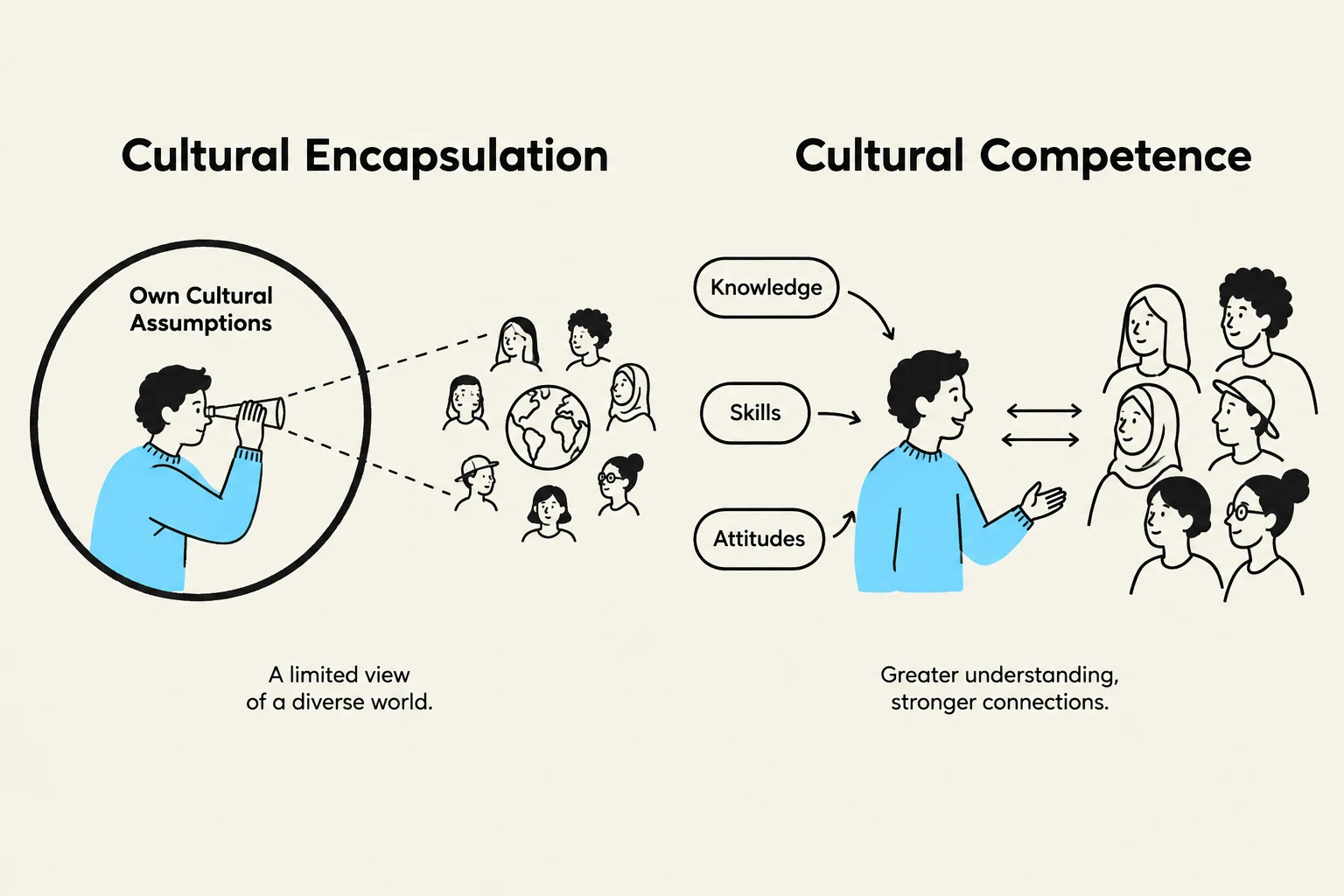
This illustration contrasts cultural encapsulation, where one's view is limited by their own cultural assumptions, with cultural competence, which involves knowledge, skills, and attitudes leading to greater understanding and stronger connections.
Cultural competence refers to the knowledge, skills, and attitudes required to increase a caregiver's effectiveness when serving clients who differ from themselves in significant ways. While the term "cultural competence" is the most widely recognized, the field uses various labels that reflect nuanced philosophical differences, such as cultural sensitivity, multicultural competence, cultural humility, and culturally responsive therapy.
At its core, CC involves moving away from "cultural encapsulation"—a state of ignorance where a professional defines reality solely through their own cultural assumptions and stereotypes. A culturally competent professional avoids the trap of applying a single set of diagnostic rules or psychological theories (often Western or Eurocentric) to all populations, which can lead to misdiagnosis and ineffective treatment.
Why Cultural Competence Matters
The drive for CC training is fueled by several critical factors in modern society:
1. Demographic Shifts
The population of non-white and non-English speaking individuals is growing rapidly. In the United States, it is predicted that ethnic and racial minorities will outnumber white populations in the coming decades, making it inevitable that professionals will interact with a diverse clientele.
2. Reducing Health and Service Disparities
Significant disparities exist in how mental health and medical services are delivered to racial and ethnic minorities. These disparities are often not due to differences in the need for care, but rather to "inaccessible and ineffective treatment" that fails to consider a client's lifestyle, language, or cultural background.
3. Ethical and Professional Obligations
Many professional organizations, such as the American Counseling Association, mandate multicultural competency as an ethical requirement. Failing to account for culture can lead to "cultural oppression," where a practitioner's Eurocentric values are imposed on a client, potentially causing harm.
Exam Tip: When discussing the necessity of CC, remember that it is framed not just as a "specialty" area, but as a fundamental requirement for ethical practice and the prevention of client harm.
Methods of Training and Development
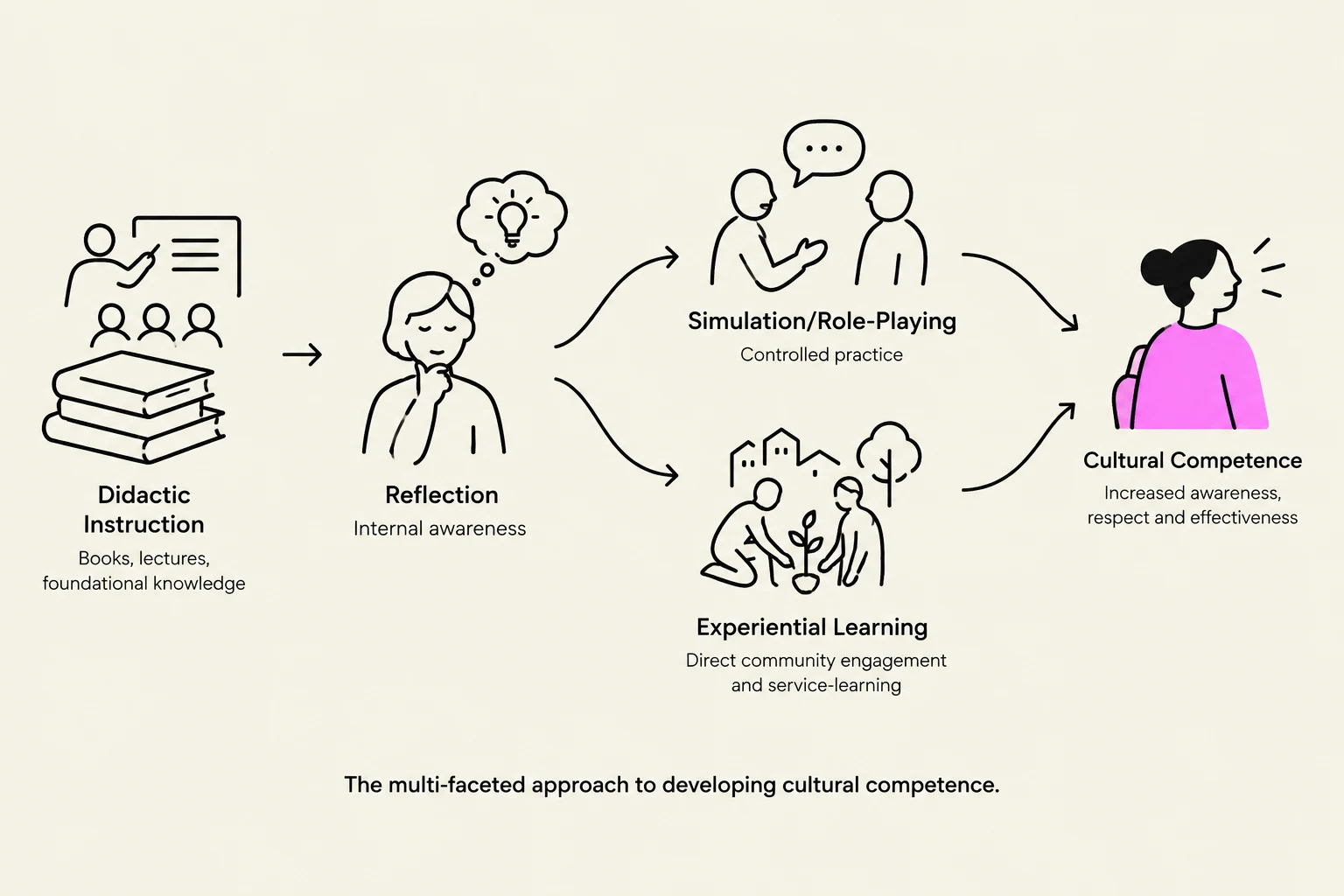
A diagram illustrating the multi-faceted approach to developing cultural competence, encompassing didactic instruction, reflection, simulation/role-playing, and experiential learning.
Developing cultural competence requires more than just reading a textbook; it necessitates a multi-faceted approach that targets awareness, knowledge, and practical skills.
Didactic Instruction and Reflection
The foundation of most training programs begins with didactic instruction, where students learn about the histories, values, and norms of various cultural groups. To move from passive learning to active awareness, professionals often use written reflection papers. These allow individuals to examine their own internal biases and how their personal background might influence their professional perceptions.
Simulation and Role-Playing
To bridge the gap between theory and practice, educators employ interactive methods:
Simulation Games: These allow learners to experience social dynamics and cultural nuances in a controlled, low-stakes environment.
Role-Playing: By acting out clinical or professional encounters, students can practice specific techniques for eliciting information from culturally different clients and navigating difficult communication barriers.
Experiential Learning
The most profound shifts in awareness often occur through direct contact and application:
Cultural Immersion Experiences: These involve engaging directly with different communities to increase awareness of diverse values and beliefs.
Service-Learning: This integrates community service with academic instruction, allowing students to apply cultural knowledge in real-world settings while serving diverse populations.
Laboratory Experiences: Controlled environments can be used to test psychological measurements and assessments to ensure they are culturally valid and do not produce biased results.
Case Conceptualization
This diagram illustrates a model for expanding case conceptualization beyond the individual, considering systemic factors, cultural context, and intrapsychic factors.
In clinical settings, professionals must master case conceptualization through a multicultural lens. This means moving beyond a purely intrapsychic view (focusing only on an individual's internal thoughts) to consider social and environmental causes of distress, such as systemic racism, discrimination, and differential socialization.
Evaluation and Continuous Growth
Cultural competence is not a destination but a continuous process. For professionals, this involves continuing education to stay updated on evolving cultural research and best practices.
Evaluation of competence often involves assessing a professional's ability to engage in social advocacy. Because many problems faced by minority clients reside in systemic issues—such as discriminatory organizational policies or environmental inequities—a truly competent professional must be able to advocate for social justice and systemic change.
By combining rigorous academic study with immersive, hands-on experience, professionals can move toward a model of care that is not only culturally sensitive but also ethically sound and clinically effective.
Keep reading for free.
Create an account to finish this reading and make it part of your study routine.