Understanding American Federalism: Power Distribution and Evolution
An overview of American federalism, explaining the division of powers between national and state governments, the historical evolution from dual to cooperative federalism, and the role of fiscal federalism and new federalism.
In the United States, the distribution of power is not concentrated in a single central authority, nor is it left entirely to individual states. Instead, the Constitution establishes a system of federalism, where sovereignty is shared between the national government and the state governments. This division was designed by the Framers to protect liberty and moderate the power of government by ensuring that no single level of government holds absolute control.
Over the centuries, however, the relationship between these levels of government has shifted dramatically. What began as a system of distinct, separate spheres has evolved into a complex web of interdependence, where the national government plays an increasingly significant role in areas once managed exclusively by the states.
The Architecture of Power: National, State, and Concurrent
To understand how federalism functions, one must first distinguish between the different types of powers assigned to each level of government. The Constitution provides a framework that defines what the national government can do, what the states can do, and where their responsibilities overlap.
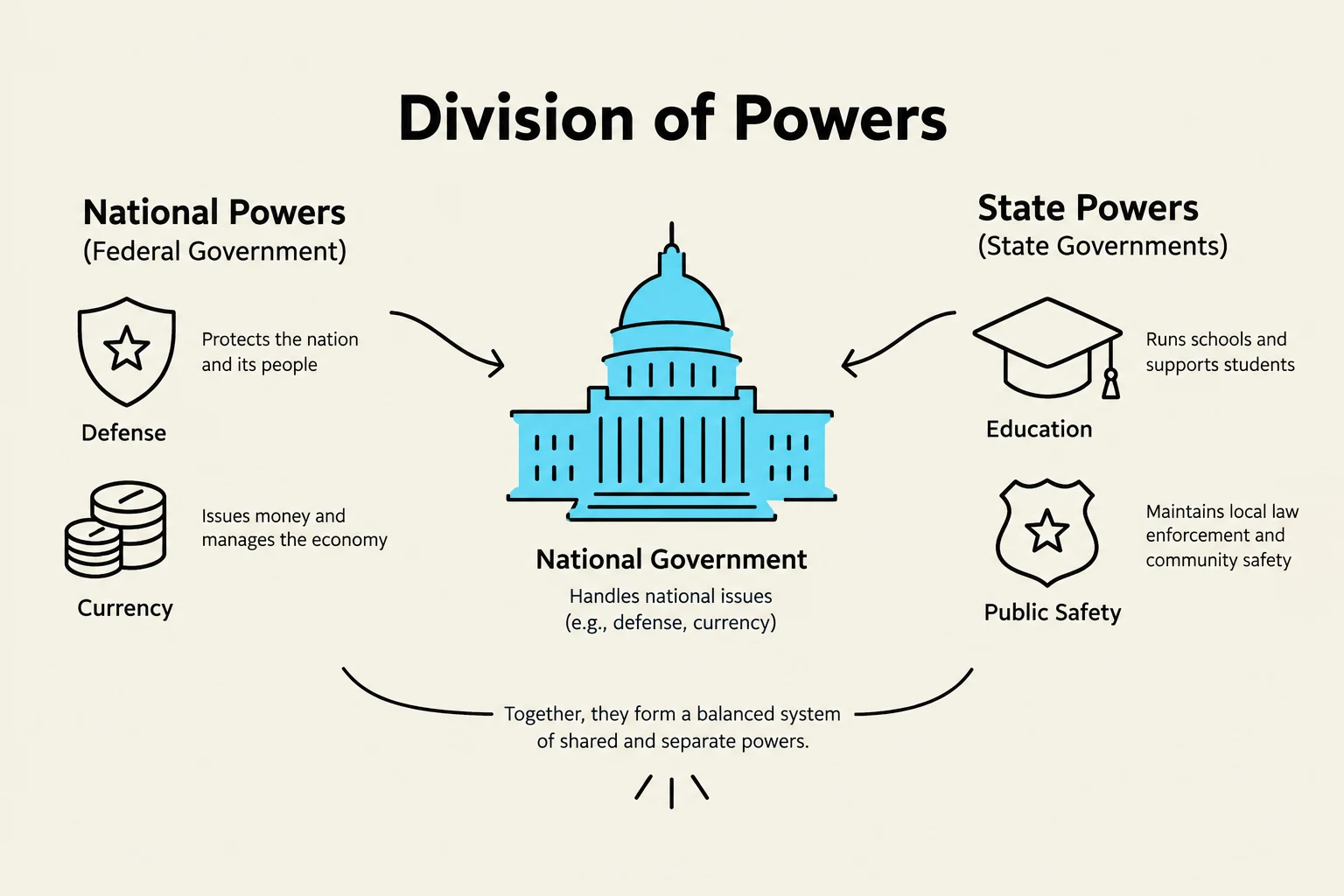
National Powers: These include enumerated (expressed) powers specifically granted to the federal government, such as managing national defense, coining currency, and regulating interstate commerce. Through the "necessary and proper" clause, the national government also possesses implied powers to support these expressed duties.
State Powers: Under the Tenth Amendment, powers not delegated to the United States are reserved to the states. This includes authority over education, public safety, and intrastate commerce.
Concurrent Powers: These are powers shared by both the national and state governments, such as the ability to tax, borrow money, and enforce laws.
This diagram illustrates the division of powers between the national (federal) government and state governments, outlining key responsibilities for each.
Exam Tip: If a question asks about the Tenth Amendment, look for the term "Reserved Powers." This amendment is the constitutional bedrock for state authority.
From Dual to Cooperative Federalism
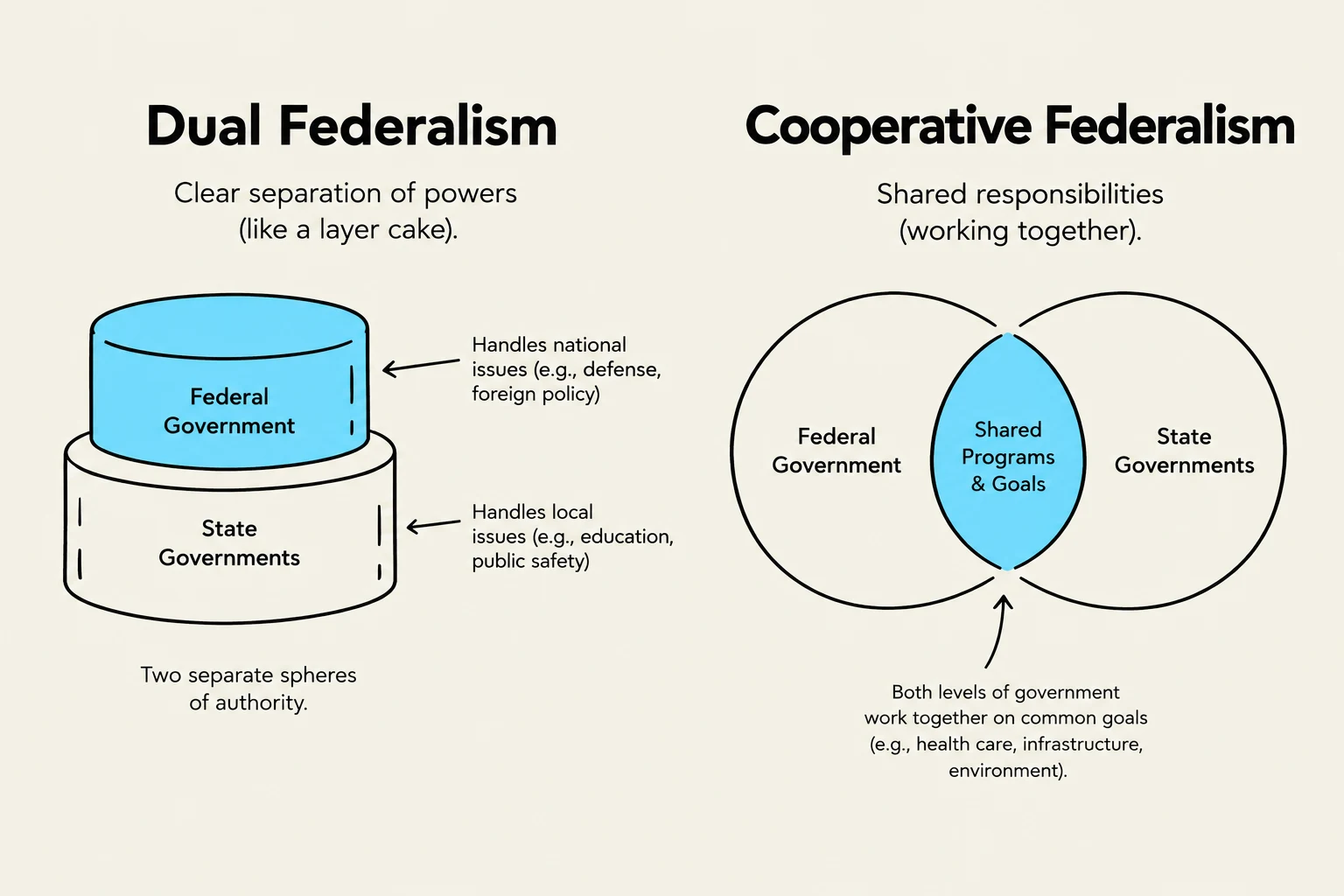
The history of American federalism is often described as a transition from "layer cake" to "marble cake" governance.
In the era of dual federalism (roughly 1865–1937), the national and state governments operated in separate spheres with little overlap. During this period, the Supreme Court generally upheld the idea that neither level of government could substantially regulate the business activities of the other.
However, the economic interdependency brought about by the industrial revolution and the Great Depression changed this dynamic. The rise of cooperative federalism saw the national, state, and local governments working together to solve complex problems. In this modern era, policy responsibilities are shared through joint funding and administration, such as in the case of Medicaid. While states still manage areas like education and roadways, the federal government's increased involvement has led to more uniform national policies.
This illustration contrasts Dual Federalism, characterized by a clear separation of powers between federal and state governments, with Cooperative Federalism, where both levels of government share responsibilities and work together on common goals.
Fiscal Federalism and the Power of the Purse
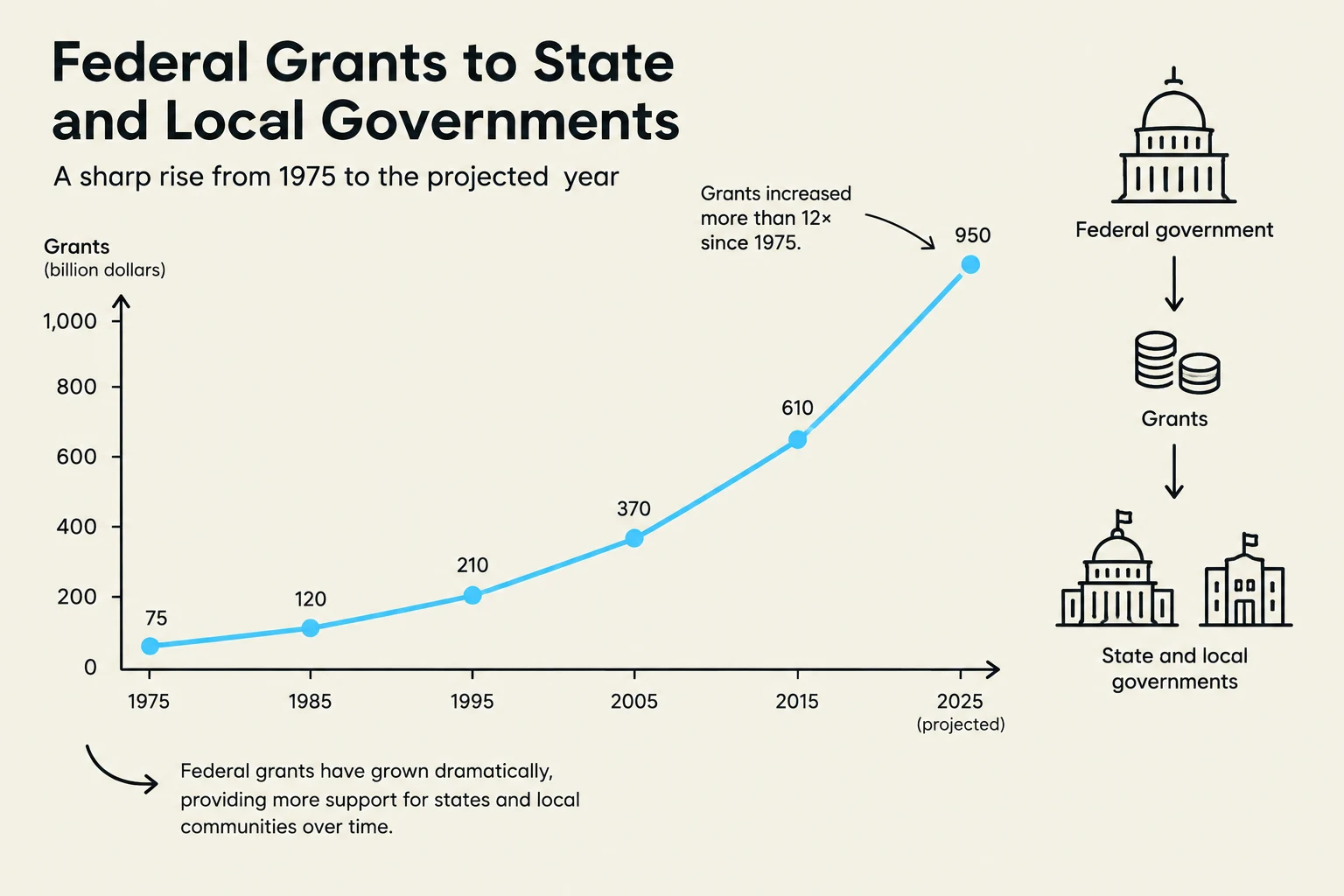
One of the most effective tools for the expansion of national authority is fiscal federalism. This refers to the use of federal funds to influence state and local programs. The primary mechanism for this is grants-in-aid—cash payments from the federal government to state and local entities.
While states can technically reject these grants, doing so often means losing out on essential funding for services they could not otherwise afford without raising taxes. Once a state accepts a grant, it must comply with federal requirements regarding how that money is spent.
Grants-in-aid are generally categorized into two types:
Categorical Grants: These are funds designated for a singular, specific purpose, such as a specific school lunch program. They offer the federal government high control over how money is used.
Block Grants: These are funds designated for a broad policy area, such as law enforcement. They allow states more discretion and flexibility in how they address the needs within that area.
This graph illustrates the significant increase in federal grants to state and local governments from 1975 to a projected 2025, showing a dramatic growth in financial support.
New Federalism and the Push for Devolution
Not all political movements have favored the expansion of national power. During the 1980s and 1990s, a movement known as new federalism emerged, championed by leaders like Ronald Reagan. The goal was to reduce federal regulations and spending in areas traditionally reserved for the states.
This era promoted devolution—the intentional shifting of power from the federal government back to state and local levels. A landmark example of this shift was the 1996 Welfare Reform Act, which replaced existing cash-assistance programs with TANF (Temporary Assistance for Needy Families), implementing stricter eligibility requirements and time limits on assistance.
The Ongoing Tug-of-War
Despite the efforts of the "new federalism" era to decentralize power, the long-term trajectory of American politics has leaned toward national involvement. Major historical shifts, such as Franklin Roosevelt’s New Deal and Lyndon Johnson’s Great Society, significantly expanded the federal role in social services and economic stability. More recently, the Affordable Care Act represented one of the largest expansions of federal authority in decades.
Today, the boundaries of federalism remain a central point of contention in American politics. The balance of power is frequently reshaped by:
Shifts in Public Support: Changes in voter priorities can lead to either massive federal expansions or significant rollbacks.
Judicial Rulings: The Supreme Court plays a critical role in interpreting the Constitution and deciding whether federal actions infringe upon state sovereignty.
Ultimately, federalism is not a static arrangement but a dynamic, evolving struggle over who holds the authority to shape the lives of American citizens.
Keep reading for free.
Create an account to finish this reading and make it part of your study routine.