Understanding Airline Operations: Safety, Efficiency, and Service
An in-depth look at the core functions of airline operations, including ground operations, flight operations, and maintenance and engineering. It emphasizes the critical imperatives of safety, efficiency, and service, and discusses external influences and challenges.
In the aviation industry, marketing is responsible for generating revenue and finding passengers, but Airline Operations is responsible for delivering the actual "product"—the successful transport of people and goods. Operating on the "supply side" of the airline equation, operations is a highly technical support activity focused on the logistical execution of moving passengers and cargo between origins and destinations.
While operations does not typically develop direct revenue, it is the engine that converts a flight schedule into a reality. The success of an airline depends on its ability to manage complex processes, expensive equipment, and unpredictable external variables to ensure that the service promised by marketing is actually fulfilled.
The Core Imperatives: Safety, Efficiency, and Service
Airline operations is governed by a strict hierarchy of priorities. At the very top is a zero-tolerance approach to safety and security. Every decision, procedure, and action taken by operational staff must comply with these safety standards to protect lives and assets.
Once safety is guaranteed, the operational focus shifts to two secondary but equally vital pillars:
Operational Effectiveness and Efficiency: The ability to complete published schedules with high reliability while minimizing costs.
Service Excellence: Ensuring the quality of the passenger experience during the transport process.
Exam Tip: If asked to identify the most crucial imperative in airline operations, always prioritize Safety and Security. While efficiency and service are essential for profitability, they cannot supersede safety.
The Three Functional Pillars of Operations
The structure of airline operations is divided into three primary functional areas: Ground Operations, Flight Operations, and Maintenance and Engineering.
1. Ground Operations
Ground operations manage the "input" and "output" phases of the operational process. This includes the administration of stations, ground facilities, and support equipment.
Input Phase: Managing passenger check-in, boarding, and the loading of cargo.
Output Phase: Managing the process of passengers and cargo exiting the aircraft and leaving the airport.
Station Management: Ground operations also handle regulatory affairs with various government agencies and manage logistics for crew layovers, such as negotiating contracts for hotels, meals, and transportation.
2. Flight Operations
Flight operations is the most significant cost driver in the industry, accounting for approximately 80% of total operating costs, including fuel, flight crews, and equipment. This department is responsible for the "transportation" phase of the process.
Key responsibilities include:
Establishing policies, procedures, and standards to meet regulatory requirements.
Monitoring route flying and administering air/ground communications.
Developing crew scheduling and collaborating with the Marketing Department to create flight schedules.
Ensuring flight safety, efficiency, and standardization across the fleet.
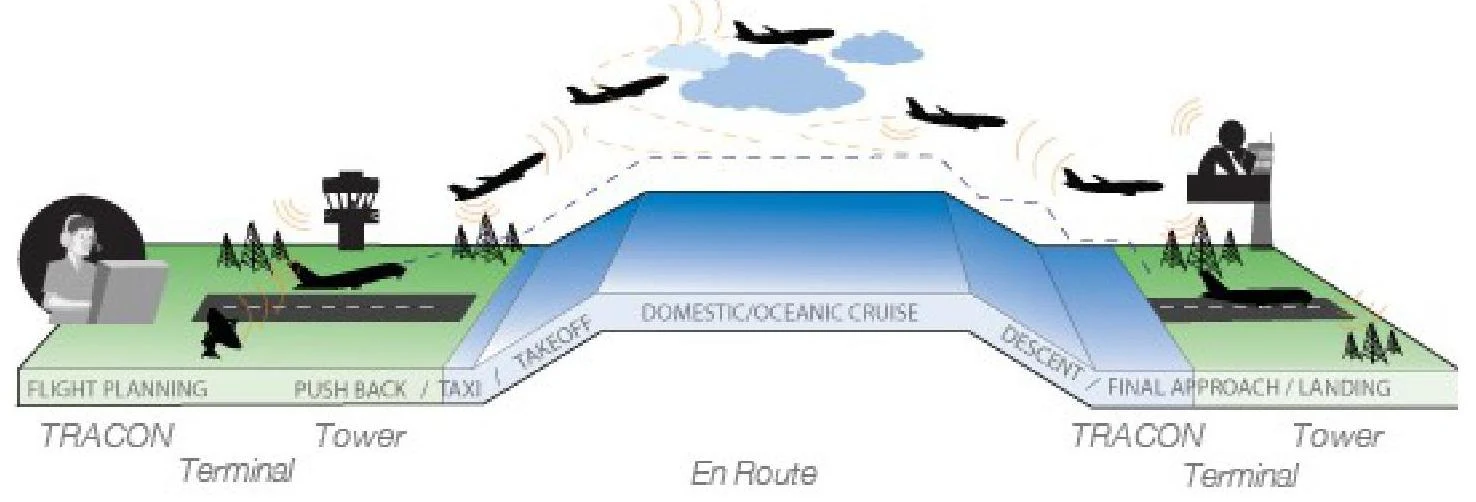
This diagram illustrates the different phases of air traffic control, from flight planning and ground operations to takeoff, cruise, descent, and landing.
3. Maintenance and Engineering
Maintenance and engineering serve as the technical support activity that ensures both flight and ground equipment remain in a safe and efficient condition. This department operates overhaul facilities for the repair of airframes, engines, avionics, and components.
Maintenance is categorized into two main types: Line Maintenance and Base/Heavy Maintenance.
Routine Airframe Maintenance: Line Maintenance
Line maintenance involves quick, routine inspections to keep aircraft in service with minimal disruption.
Overnight Maintenance: A 1–2 hour inspection to ensure the aircraft complies with the Original Equipment Manufacturer’s (OEM) Minimum Equipment List (MEL).
A-check: Performed approximately every 125 flight hours (roughly every 2–3 weeks). This is an amplified preflight inspection of the fuselage, power plant, and avionics.
B-check: Performed approximately every 750 flight hours (roughly every 3–4 months). This includes everything in an A-check plus preventive maintenance, such as lubricating parts and checking oil filters.
Base or heavy maintenance involves more intensive, long-term work often performed in a hangar.
C-check: Performed approximately every 3,000 flight hours or 15 months. It incorporates A and B checks and includes component repairs, flight control calibration, and major internal mechanism testing.
D-check: The most intensive check, occurring approximately every 20,000 flight hours or every 6–8 years. During a D-check, the entire cabin interior—including seats, galleys, lavatories, and cockpit furnishings—is removed to allow for a thorough structural inspection for cracks.
External Influences and Challenges
Airline operations do not exist in a vacuum; they are constantly influenced by a variety of external factors and players.
Environmental and Geopolitical Factors
24/7 Operations: Managing time differentials and varying working patterns across global networks.
Weather: Varying weather conditions require different ground service and equipment operations.
Unpredictable Events: Wars, revolutions, and civil strife can disrupt entire regions.
Regulatory Constraints: Local laws and airport curfews can limit when an airline can operate.
Key External Players
Operations must navigate a complex web of stakeholders:
Regulatory Bodies: Organizations like the ICAO (setting international standards), FAA (national safety rules), and EASA (regional European standards).
Airport Authorities: Managing the facilities where the airline operates.
Government Agencies: Customs, Immigration, and Health/Quarantine (CIQ) services.
Labor Unions: As seen in the 2011 Qantas strike, labor disputes involving pilots, mechanics, and baggage handlers can ground entire fleets, causing massive financial losses and reputational damage.
Case Study Note: In 2011, a Qantas labor dispute resulted in the grounding of 108 planes, costing the airline approximately $20 million per day. This highlights how sensitive the "supply side" of the airline is to human resource and union factors.
Keep reading for free.
Create an account to finish this reading and make it part of your study routine.