Understanding Acid-Base Balance and Arterial Blood Gas Interpretation
This guide explains the physiological mechanisms of acid-base balance, including buffer systems, respiratory and renal compensation, and the interpretation of arterial blood gas (ABG) results to identify imbalances like acidosis and alkalosis.
Maintaining a stable internal environment is one of the most critical functions of human physiology. Among these homeostatic processes, acid-base balance is paramount. To ensure cellular function, the body must maintain a precise concentration of hydrogen ions ($H^+$) in the blood. Even minor deviations from the physiological norm can lead to life-threatening consequences, necessitating a complex, multi-layered regulatory system involving chemical buffers, the lungs, and the kidneys.
Hydrogen Ion and pH
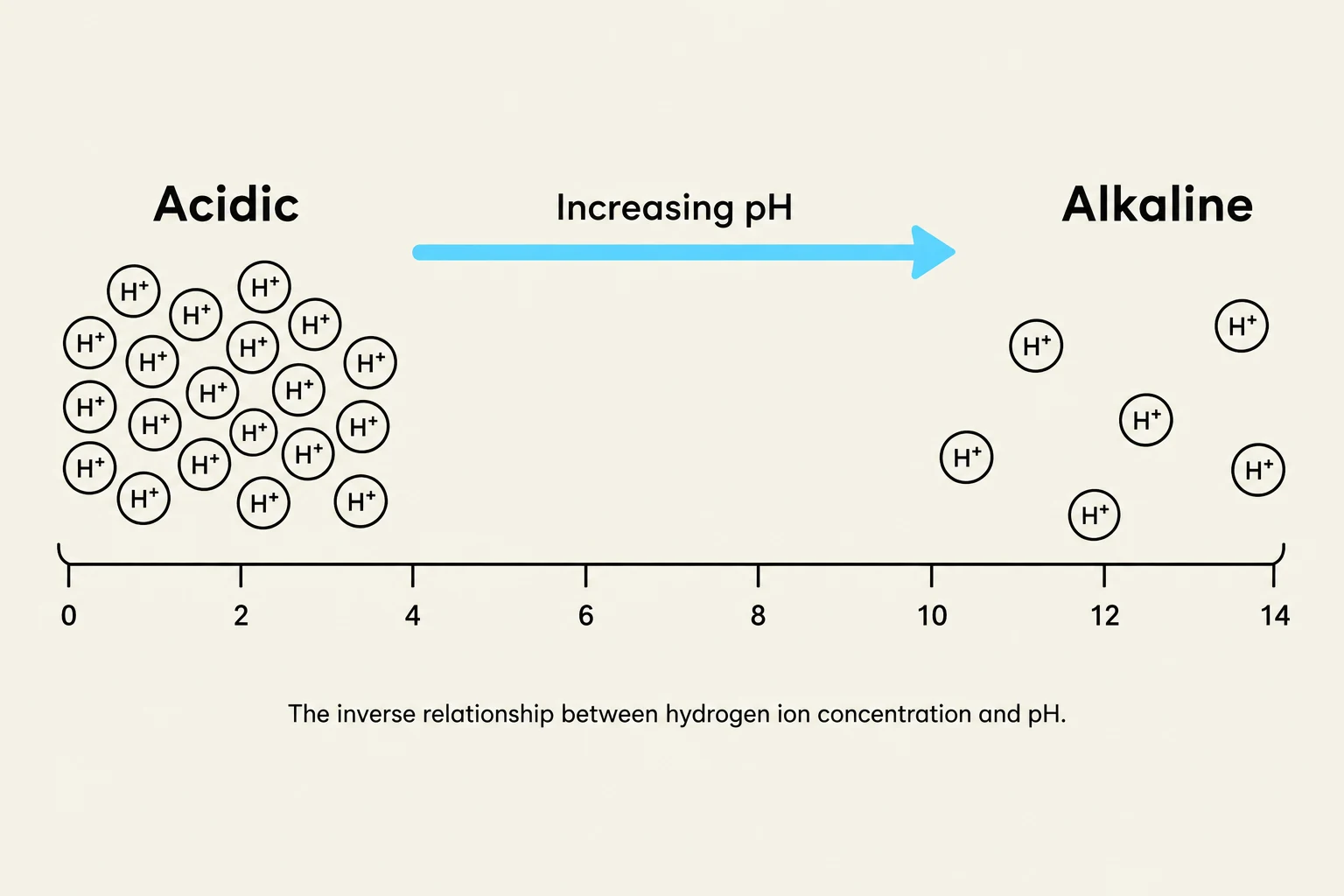
This diagram illustrates the relationship between pH and hydrogen ion concentration, showing that acidic solutions have a high concentration of H+ ions, while alkaline solutions have a low concentration of H+ ions.
The concept of acidity and alkalinity is measured by the pH of a solution. Mathematically, pH is defined as the negative logarithm of the hydrogen ion concentration:
pH=−log[H+]
Because of this inverse relationship, the rules of pH are straightforward:
**Low $H^+concentration∗∗\rightarrow$ High pH (Alkaline)
The normal range for arterial blood pH is strictly maintained between 7.35 and 7.45. Acids are produced naturally as end products of the metabolism of proteins, carbohydrates, and fats. To prevent these metabolic byproducts from dropping the pH, the body must either neutralize the $H^+$ ions or excrete them efficiently.
The Body's Defense: Buffer Systems
When a sudden change in pH occurs, the body cannot wait for the lungs or kidneys to respond; it needs immediate chemical intervention. This is the role of buffer systems. A buffer is a chemical agent capable of binding excess $H^+$ or $OH^-$ ions to prevent significant shifts in pH.
The Carbonic Acid–Bicarbonate Pair
This diagram illustrates the 20:1 ratio of bicarbonate to carbonic acid required to maintain a target pH of 7.4, crucial for physiological balance.
The most critical plasma-buffering system is the carbonic acid–bicarbonate pair (H2CO3/HCO3−). This system operates based on a specific ratio. To maintain a physiological pH of 7.4, the ratio of bicarbonate (HCO3−) to carbonic acid (H2CO3) must be maintained at 20:1. While the absolute amounts of these substances may increase or decrease, the ratio is the key to stability.
Other Buffering Mechanisms
Beyond the bicarbonate system, the body employs other specialized buffers:
Protein Buffering: Proteins, such as hemoglobin, possess negative charges that allow them to bind to free $H^+$ ions, acting as a sponge to soak up excess acidity.
Renal Buffering: The kidneys provide a slower but more powerful buffering mechanism by directly secreting $H^+$ into the urine and reabsorbing bicarbonate back into the bloodstream.
Volatile vs. Nonvolatile Acids
To understand how the body compensates for imbalances, we must distinguish between the two types of acids produced in the body:
Volatile Acids: These include carbonic acid (H2CO3). They are "volatile" because they can be converted into carbon dioxide (CO2) gas and water, allowing them to be eliminated through the lungs.
Nonvolatile Acids: These include sulfuric, phosphoric, and other organic acids produced during metabolism. Because they cannot be turned into gas, they must be eliminated by the renal tubules through the regulation of bicarbonate.
Regulatory Systems and Compensation
The body uses two primary organ systems to manage these acids through a process called compensation.
Respiratory Compensation
The respiratory system regulates volatile acids by adjusting the rate and depth of breathing (ventilation).
To raise pH (combat acidosis): The body increases ventilation to "blow off" CO2. Since CO2 combines with water to form carbonic acid, reducing CO2 reduces the acid load.
To lower pH (combat alkalosis): The body decreases ventilation to retain CO2, thereby increasing the concentration of carbonic acid.
Renal Compensation
The renal system manages nonvolatile acids and provides long-term stability. It compensates by:
Increasing the secretion of $H^+$ into the urine.
Increasing the reabsorption of HCO3− (bicarbonate) into the blood.
Study Tip: Think of the lungs as the "fast" responder (minutes to hours) and the kidneys as the "slow but thorough" responder (hours to days).
Acid-Base Imbalances
An imbalance occurs when the regulatory mechanisms are overwhelmed or fail. These are categorized into four primary types based on whether the cause is respiratory or metabolic.
1. Respiratory Imbalances
These are driven by changes in the partial pressure of carbon dioxide (PaCO2).
Respiratory Acidosis: Occurs when there is an elevation of PaCO2 due to hypoventilation (decreased breathing). This can be caused by respiratory disorders that impair gas exchange.
Respiratory Alkalosis: Occurs when there is a decrease in PaCO2 due to hyperventilation (excessive breathing). This leads to an excessive loss of CO2.
2. Metabolic Imbalances
These are driven by changes in bicarbonate (HCO3−) levels or the accumulation of noncarbonic acids.
Metabolic Acidosis: Characterized by a depression of HCO3− or an increase in noncarbonic acids. Common causes include:
Excessive production of $H^+$ (e.g., Sepsis, Diabetic Ketoacidosis (DKA), or starvation).
Excessive loss of bicarbonate.
Potassium shifts.
Metabolic Alkalosis: Characterized by an elevation of HCO3−. This is often caused by:
Excessive loss of metabolic acids (e.g., through gastrointestinal loss).
Excessive bicarbonate intake.
Potassium shifts.
Arterial Blood Gas (ABG) Interpretation
A flowchart illustrating the relationship between pH, PaCO2, and HCO3- in cases of acidosis and alkalosis.
To clinically assess these imbalances, healthcare providers use Arterial Blood Gas (ABG) sampling. An ABG test measures the pH, the partial pressure of carbon dioxide (PaCO2), and the concentration of bicarbonate (HCO3−).
When interpreting an ABG, follow this logical flow:
Check the pH: Is it low (acidosis) or high (alkalosis)?
Check the PaCO2: Is it high or low? If it matches the pH direction (e.g., low pH and high CO2), the problem is Respiratory.
Check the HCO3−: Is it high or low? If it matches the pH direction (e.g., low pH and low HCO3−), the problem is Metabolic.
Exam Tip: Always look for the "match." In respiratory issues, CO2 and pH move in opposite directions. In metabolic issues, HCO3− and pH move in the same direction.
Keep reading for free.
Create an account to finish this reading and make it part of your study routine.