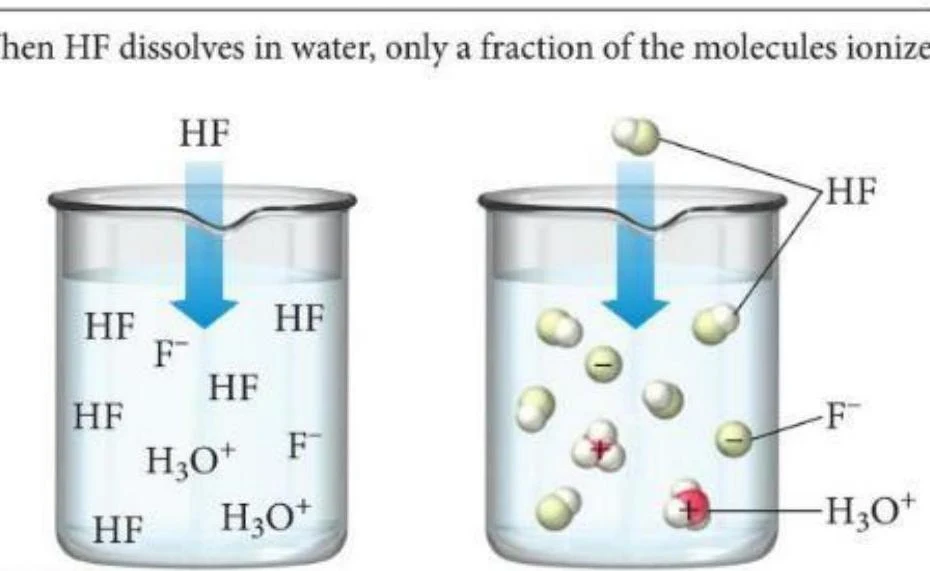
The Acid Ionization Constant (Ka)
For a weak acid (HA) reacting with water, the equilibrium is written as:
HA(aq)+H2O(l)⇌H3O+(aq)+A−(aq)
The acid ionization constant, Ka, is expressed as:
Ka=[HA][H3O+][A−]
A larger Ka value indicates a stronger acid because it means the equilibrium lies further to the right, producing more ions.
The Base Ionization Constant (Kb)
Similarly, for a weak base (B) reacting with water:
B(aq)+H2O(l)⇌BH+(aq)+OH−(aq)
The base ionization constant, Kb, is:
Kb=[B][BH+][OH−]
A larger Kb indicates a stronger base.
Expressing Strength with $pK_a$ and $pK_b$
Because K values are often very small numbers (like 1.8×10⁻⁵), chemists use a logarithmic scale called pK to make them easier to work with.
- pKa=−log(Ka)
- pKb=−log(Kb)
Exam Tip: Note the inverse relationship! A larger Ka means a stronger acid, but a smaller $pK_a$ means a stronger acid.
Water Autoionization and Kw
Water is an amphoteric substance, meaning it can act as both an acid and a base. Through a process called autoionization, water molecules react with each other to produce ions:
H2O(l)+H2O(l)⇌H3O+(aq)+OH−(aq)
The equilibrium constant for this process is Kw, the ion product of water. At 25∘C:
Kw=[H3O+][OH−]=1.00×10⁻¹⁴
This constant is vital because if you know the concentration of hydronium, you can always calculate the concentration of hydroxide, and vice versa.
Calculating Equilibrium Concentrations: The ICE Table
To find the specific concentrations of ions in a weak acid or base solution, we use an ICE table (Initial, Change, Equilibrium).
Example: Finding [H3O+] for a weak acid
Suppose you have a 0.10 M solution of a weak acid HA with a Ka=1.8×10⁻⁵.
- Initial: $[HA] = 0.10$, [H3O+]=0, $[A^-] = 0$
- Change: $[HA] = -x$, [H3O+]=+x, $[A^-] = +x$
- Equilibrium: $[HA] = 0.10 - x$, [H3O+]=x, $[A^-] = x$
Plug these into the Ka expression:
1.8×10−5=0.10−xx2
For many weak acids, we can assume x is much smaller than the initial concentration (0.10−x≈0.10), simplifying the math to:
1.8×10⁻⁵≈0.10x2⟹x2=1.8×10⁻⁶⟹x=1.34×10⁻³ M
Thus, [H3O+]=1.34×10⁻³ M.
Percent Ionization
Percent ionization is a way to express how much of a weak acid or base has actually dissociated. It is calculated as:
Percent Ionization=[Acid]initial[H3O+]equilibrium×100%
A strong acid would have a percent ionization of $100%$, while a weak acid will have a value significantly less than $1%$.
Polyprotic Acids
Some acids, known as polyprotic acids, can donate more than one proton. These acids ionize in steps, and each step has its own ionization constant (Ka1,Ka2,…). Generally, the first ionization is much stronger than the second (Ka1>Ka2>Ka3).
For most calculations involving pH, you only need to consider the first ionization step because the subsequent steps produce such small amounts of H_3O+ that they are negligible. However, for sulfuric acid (H2SO4), the first ionization is complete (strong), so you must account for the second ionization constant (Ka2) when calculating the total acidity.