Understanding ACE Inhibitors and ARBs in Cardiovascular Health
This content explains the mechanism of action, adverse effects, contraindications, drug interactions, and nursing implications of Angiotensin-Converting Enzyme Inhibitors (ACEIs) and Angiotensin Receptor Blockers (ARBs) in managing cardiovascular conditions like hypertension and heart failure.
In the management of cardiovascular health, particularly for patients with hypertension and Heart Failure with reduced Ejection Fraction (HFrEF), Angiotensin-Converting Enzyme Inhibitors (ACEIs) and Angiotensin Receptor Blockers (ARBs) serve as cornerstone therapies. These medications target the Renin-Angiotensin-Aldosterone System (RAAS) to reduce blood pressure, decrease cardiac workload, and provide essential renal and cardioprotective benefits. While highly effective, their use requires vigilant nursing assessment due to specific adverse effects, contraindications, and complex drug interactions.
Mechanism of Action: Targeting the RAAS
The RAAS is a complex hormonal cascade that regulates blood pressure and fluid balance. Under normal physiological conditions, the body uses this system to maintain homeostasis. ACEIs and ARBs interrupt this process at different stages to achieve therapeutic goals.
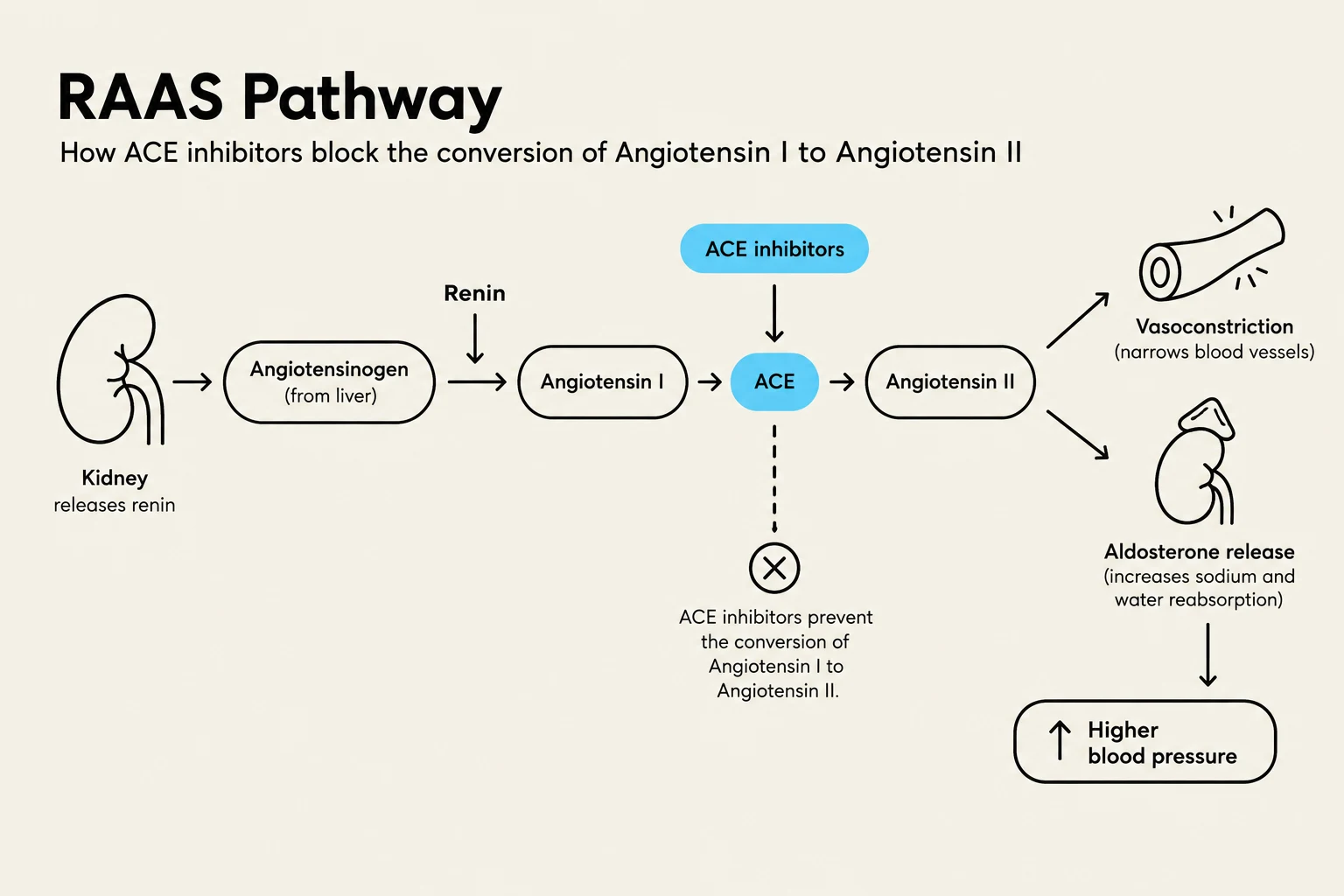
ACE Inhibitors (ACEIs): These drugs inhibit the enzyme responsible for converting Angiotensin I into Angiotensin II. By lowering levels of Angiotensin II—a potent vasoconstrictor—ACEIs promote vasodilation and reduce the secretion of aldosterone, which in turn decreases sodium and water reabsorption.
Angiotensin Receptor Blockers (ARBs): Instead of preventing the production of Angiotensin II, ARBs block the ability of Angiotensin II to bind to its receptors. This effectively blocks vasoconstriction and aldosterone secretion.
Clinical Note: While both classes are effective, ARBs are often preferred for patients who cannot tolerate the specific side effects associated with ACEIs, such as a persistent dry cough.
The RAAS pathway illustrates how ACE inhibitors block the conversion of Angiotensin I to Angiotensin II, leading to vasodilation and reduced blood pressure.
Adverse Effects and Clinical Manifestations
Despite being well-tolerated, ACEIs and ARBs are associated with several significant adverse effects that require monitoring.
The ACEI-Induced Dry Cough
A unique side effect of ACEIs is a persistent, non-productive dry cough, occurring in approximately 5–20% of patients. This is believed to be caused by the accumulation of bradykinin or substance P in the respiratory tract. If a patient develops this cough, the healthcare provider may switch them to an ARB, which does not typically cause this effect.
Angioedema
A rare but potentially fatal adverse effect is angioedema, characterized by rapid swelling of the lips, tongue, and airway. This risk is significantly higher in patients of Black heritage, with an incidence of 0.43% compared to 0.18% in non-Black individuals.
Hypotension and Hyperkalemia
Because these drugs promote vasodilation and reduce sodium/water retention, patients may experience hypotension (low blood pressure) or orthostatic hypotension (dizziness upon standing). Furthermore, because both classes reduce aldosterone (the hormone responsible for potassium excretion), there is a significant risk of hyperkalemia (elevated serum potassium).
This diagram illustrates the physiological responses to the inhibition of the Renin-Angiotensin-Aldosterone System (RAAS) pathway by ACE inhibitors (ACEI) or Angiotensin II Receptor Blockers (ARB), leading to decreased Angiotensin II levels. The resulting effects include vasodilation, reduced aldosterone secretion, decreased sympathetic activity, and less vascular remodeling, all contributing to lower blood pressure and reduced cardiac workload.
Contraindications and Precautions
Certain patient profiles make the use of ACEIs and ARBs unsafe. Nurses must screen for the following contraindications:
Bilateral Renal Artery Stenosis: These drugs can cause acute renal failure in these patients.
Pregnancy: Both classes are contraindicated due to potential fetal toxicity.
History of Angioedema: A prior history of angioedema related to RAAS inhibitors is a major contraindication.
Existing Hyperkalemia: If serum potassium ($K^+$) is already elevated (>5 mmol/L), these drugs should not be initiated.
Drug Interactions
Managing patients on ACEIs or ARBs requires a thorough review of their current medication list to prevent dangerous interactions:
Potassium-Sparing Diuretics & Supplements: Combining these with ACEIs, ARBs, or MRAs (like Spironolactone) creates an additive effect, significantly increasing the risk of life-threatening hyperkalemia.
NSAIDs (Nonsteroidal Anti-inflammatory Drugs): NSAIDs can inhibit prostaglandins, which may lead to renal dysfunction and decrease the blood-pressure-lowering efficacy of the antihypertensive therapy.
Lithium: ACEIs and ARBs can inhibit the renal elimination of lithium, leading to increased lithium levels and potential toxicity.
Nursing Implications and Patient Education
Nurses play a critical role in the safe administration and monitoring of these medications.
Clinical Monitoring
Laboratory Values: Regularly monitor serum potassium ($K^+$) levels and creatinine to assess renal function.
Blood Pressure: Monitor for hypotension, especially when initiating therapy or increasing doses.
Patient Education
To ensure safety and adherence, educate patients on the following:
Orthostatic Precautions: Instruct patients to rise slowly from sitting or lying positions to prevent dizziness and falls related to orthostatic hypotension.
Dietary Management: If the patient is on a potassium-sparing agent, they should be cautious with potassium-rich foods (e.g., bananas, oranges, potatoes). Conversely, if taking loop diuretics (which deplete potassium), they may need to increase these foods.
Symptom Reporting: Advise patients to report any swelling of the face/lips (angioedema), a persistent dry cough, or significant changes in urine output immediately.
Weight Monitoring: For patients with heart failure, emphasize the importance of daily weight monitoring to detect fluid retention early.
Exam Tip: If a patient is transitioning from an ACEI to an ARNI (e.g., Sacubitril/Valsartan), remember they must have a "washout period" of at least 36 hours after stopping the ACEI to minimize the risk of angioedema.
Keep reading for free.
Create an account to finish this reading and make it part of your study routine.