


In the world of science and engineering, no measurement is ever perfect. Whether you are weighing a chemical sample in a lab, measuring the distance to a star, or timing a sprinter, there will always be a difference between your recorded value and the "true" value. Understanding why these differences occur—and how to characterize them—is fundamental to data analysis. To do this effectively, we must distinguish between two often-confused concepts: accuracy and precision.
Accuracy vs. Precision: The Core Distinction
While people often use these terms interchangeably in everyday conversation, they have very specific, distinct meanings in a scientific context.
Accuracy: Closeness to the Truth
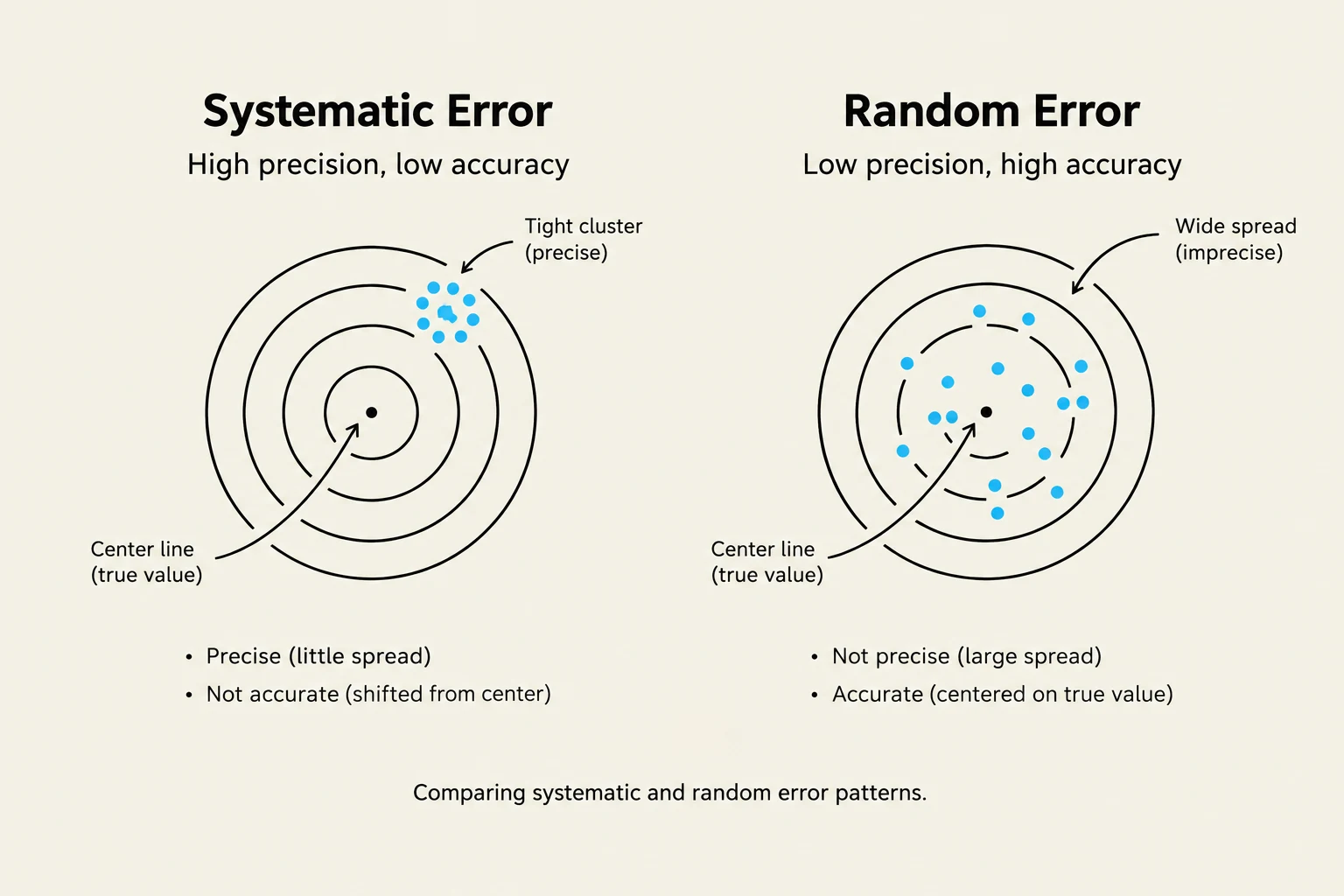
Accuracy refers to how close a measured value is to the true or accepted value of the quantity being measured. If you are measuring a standard weight that is exactly , and your scale reads , your measurement is highly accurate. Accuracy is essentially a measure of "correctness."
Precision: Consistency and Reproducibility
Precision refers to how close a series of measurements are to one another. It describes the consistency or reproducibility of your results. If you weigh that same standard five times and get , , , , and , your measurements are highly precise (because they are very consistent), but they are not accurate (because they are far from the true value of ).
Exam Tip: When analyzing data, remember that you can have high precision with low accuracy, high accuracy with low precision, both, or neither.


Keep reading for free.
Create an account to finish this reading and make it part of your study routine.
Continue reading freeAlready have an account? Log in
Updated