Understanding Accounting and Financial Information
This material explains the fundamental concepts of accounting, including bookkeeping, the accounting cycle, stakeholders, and the five disciplines of accounting. It details how to decode financial statements like the balance sheet, income statement, and statement of cash flows, and introduces ratio analysis for perform
In the world of business, information is power. However, not all information is created equal. To run a successful organization, one must be able to read, understand, and analyze accounting reports and financial statements. Without these tools, managers are essentially flying blind, unable to see the true financial health or the underlying risks of their enterprise.
What is Accounting?
At its core, accounting is the systematic process of recording, classifying, summarizing, and interpreting financial transactions and events. It is much more than just keeping track of numbers; it is about transforming raw data into meaningful information that supports decision-making.
To understand how this works, it is vital to distinguish between bookkeeping and accounting. Bookkeeping is the mechanical, repetitive process of recording daily transactions—such as sales or purchases—into a journal. Accounting is the broader discipline that takes that recorded data, classifies it, and interprets it to provide a clear picture of the business's performance.
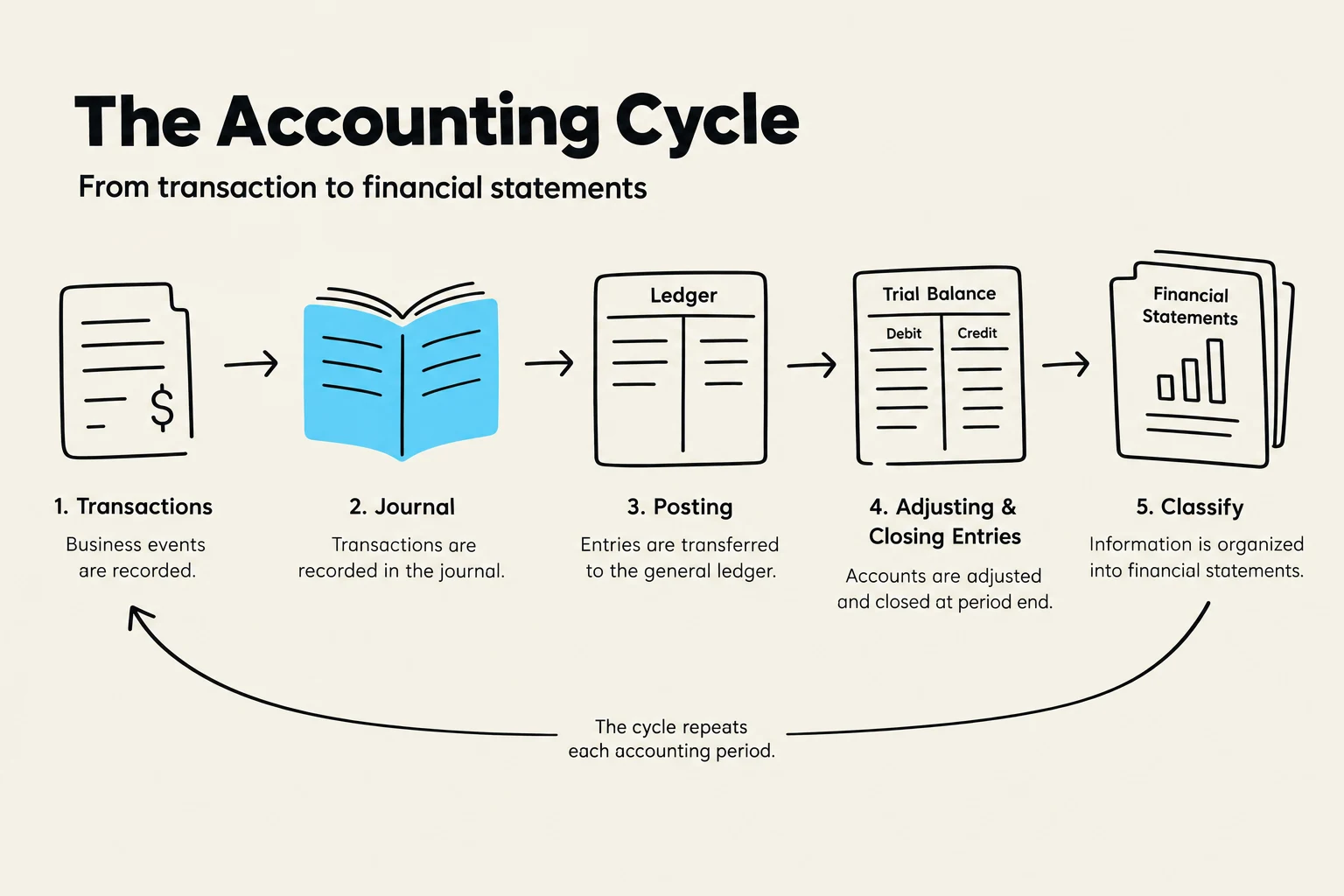
The process follows a structured path known as the accounting cycle. This cycle involves moving data from a journal (the first record of entry) to a ledger (where information is accumulated into specific accounts), and finally to a trial balance to ensure all figures are correct and balanced.
The accounting cycle illustrates the process from recording business transactions to organizing information into financial statements, repeating each accounting period.
Exam Tip: If a question asks for the difference between bookkeeping and accounting, remember that bookkeeping is the input (recording), while accounting is the output (interpreting and reporting).
The Stakeholders: Who Uses This Information?
Accounting information is not produced for just one person; it serves a diverse group of stakeholders, each with different needs:
Managers: They use internal financial reports to identify business problems and spot new opportunities.
Investors, Suppliers, and Creditors: These external parties use financial statements to analyze a company's income and financial position to assess risk and long-term viability.
Government: Taxing authorities (like the Canada Revenue Agency) use accounting data for tax collection, while other regulatory agencies use it for oversight.
The Five Disciplines of Accounting
The accounting profession is vast and is categorized into five distinct working areas:
Managerial Accounting: Focuses on providing information specifically for use inside the organization to assist managers in making strategic decisions.
Financial Accounting: Focuses on providing information to external users (like shareholders or creditors) through standardized, regulated financial statements.
Compliance (Auditing): This involves the "attestation function." Auditors review and evaluate the records used to prepare financial statements to provide an unbiased opinion on their accuracy.
Tax Accounting: Specialists in this field are trained in tax law to prepare tax returns and develop "tax strategies"—which often means finding legal ways to minimize tax payments.
Governmental and Not-for-Profit Accounting: These practitioners use specialized methods tailored to the unique needs of public entities and non-commercial organizations, where the goal is often transparency for contributors and citizens rather than profit.
Decoding the Financial Statements
The ultimate output of the accounting process is the financial statement. These reports provide a summary of all transactions over a specific period. There are three primary statements you must understand:
1. The Balance Sheet (Statement of Financial Position)
The balance sheet reports a firm's financial position at a specific point in time. It is built upon the fundamental accounting equation:
Assets=Liabilities+Owners’ Equity
Assets: Economic resources owned by the firm, such as cash, inventory, buildings, or intangible items like patents. Assets are often listed by liquidity, which is how quickly they can be converted into cash.
Liabilities: What the business owes to others (debts), such as accounts payable or long-term bank loans.
Owners' Equity: The residual interest in the assets after deducting liabilities. It represents the amount invested by owners plus accumulated profits.
2. The Income Statement (Statement of Earnings)
This statement summarizes revenues, costs, and expenses over a specific period to show the "bottom line"—the net profit or loss.
Net Profit/Loss=Total Revenue−Total Expenses
A key component here is Gross Profit, which is calculated as:
Gross Profit=Net Sales−Cost of Goods Sold
3. The Statement of Cash Flows
This statement tracks the actual movement of cash in and out of the business through three main activities: operations (daily business), investing (buying/selling assets), and financing (borrowing or repaying debt).
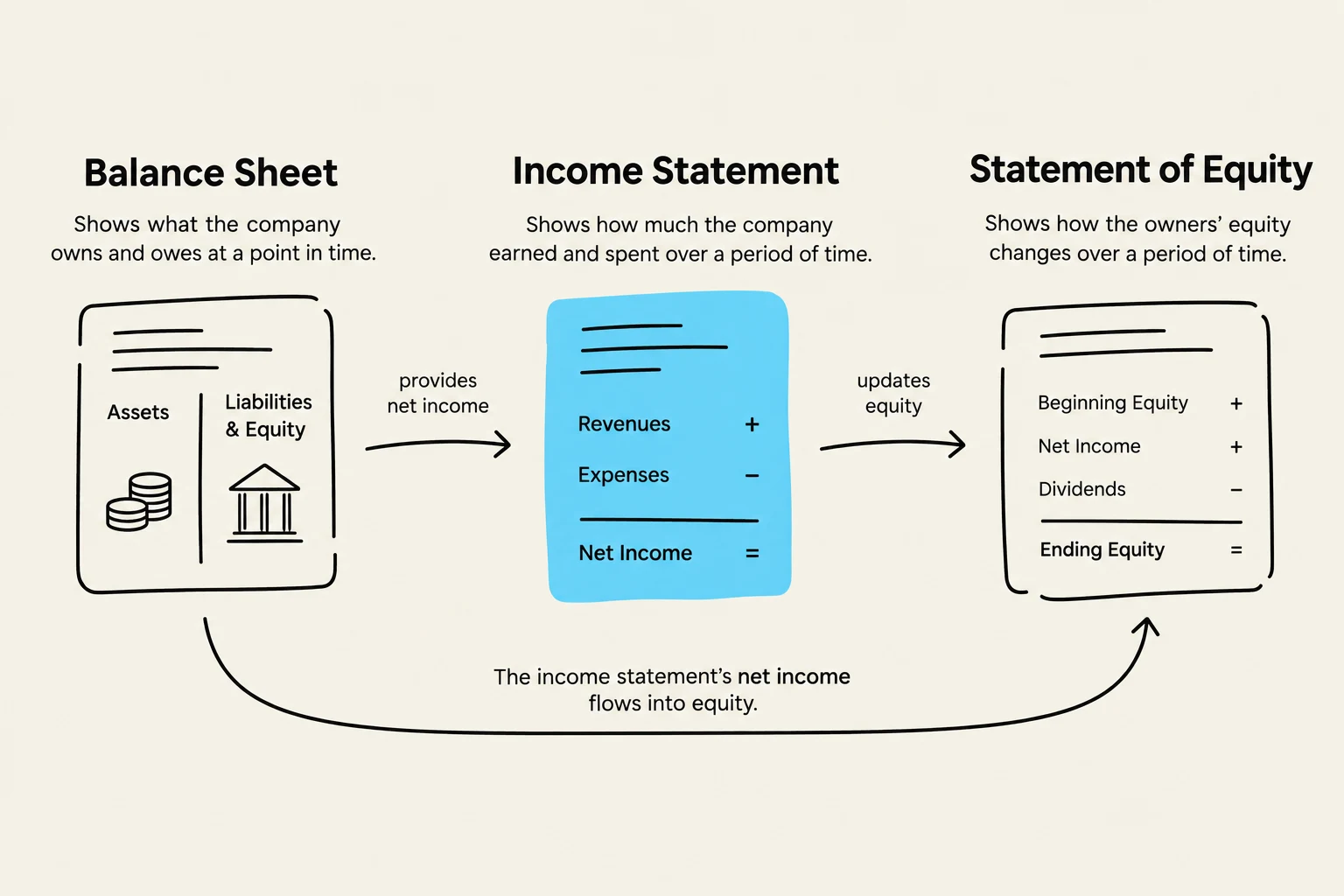
This diagram illustrates the relationship between a company's Balance Sheet, Income Statement, and Statement of Equity, showing how net income from the income statement flows into equity.
Analyzing Performance: Ratio Analysis
Once the statements are prepared, stakeholders use ratio analysis to assess a firm's performance and compare it to past years or industry competitors. Common categories include:
Liquidity Ratios: Measure the ability to pay short-term debts. For example, the Current Ratio is:
Current Ratio=Current LiabilitiesCurrent Assets
Leverage (Debt) Ratios: Measure how much a firm relies on borrowed funds.
Profitability Ratios: Measure how effectively managers use resources to generate profit, such as Return on Equity (ROE).
Activity Ratios: Measure how efficiently a firm manages its assets, such as the Inventory Turnover Ratio, which tracks how quickly inventory is sold.
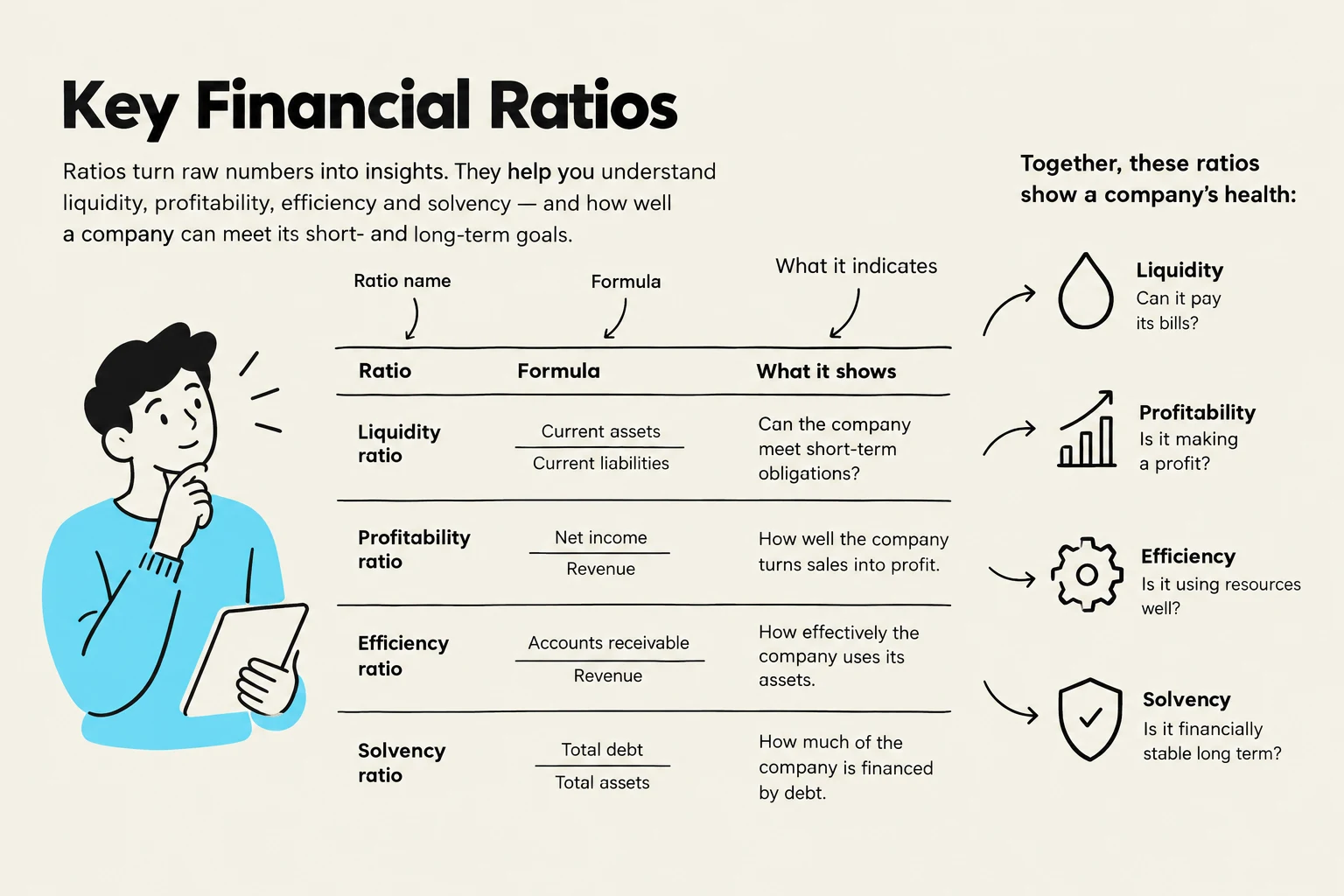
This illustration explains key financial ratios used to assess a company's health, including liquidity, profitability, efficiency, and solvency, along with their formulas and what they indicate.
Summary Note: Understanding these components allows you to look past the raw numbers and see the story of a company's stability, efficiency, and future potential.
Keep reading for free.
Create an account to finish this reading and make it part of your study routine.