UCC Article 2 Hybrid Transactions: Determining Applicable Law
Explains hybrid transactions, which involve both the sale of goods and services, and how courts determine which legal framework (UCC Article 2 or common law) applies using tests like the predominant purpose test and the 2022 Revised UCC's two-tiered approach.
In the modern economy, contracts rarely fit into neat, single-category boxes. A homeowner might hire a contractor to install a new HVAC system, or a company might contract a manufacturer to design and build a custom robot. These are known as hybrid transactions: agreements that involve both the sale of goods and the provision of services, or even the transfer of real property.
Because the Uniform Commercial Code (UCC) Article 2 governs the sale of goods, while common law typically governs services, these "mixed" contracts create a legal dilemma: which set of rules applies? To resolve this, the law uses specific tests to determine the "predominant purpose" of the deal.
Defining the Hybrid Transaction
A hybrid transaction is characterized by the coexistence of sale-of-goods aspects and service-oriented elements. For example, a contract to replace a roof involves both the sale of shingles (goods) and the labor to install them (services).
It is important to distinguish these from a security transaction. Under UCC § 2-102, Article 2 does not apply to transactions that are intended to operate only as a security interest (such as a mortgage or a chattel mortgage), even if they take the form of an unconditional contract to sell.
Exam Tip: When analyzing a problem, first identify if the "goods" are the primary focus or if the "service" is the primary focus. If the contract is purely to create a security interest, Article 2 is excluded from the start.
The Evolution of Legal Tests
Historically, courts have used different methods to decide which law governs a hybrid contract. Understanding these helps clarify why the 2022 Revised UCC is so significant.
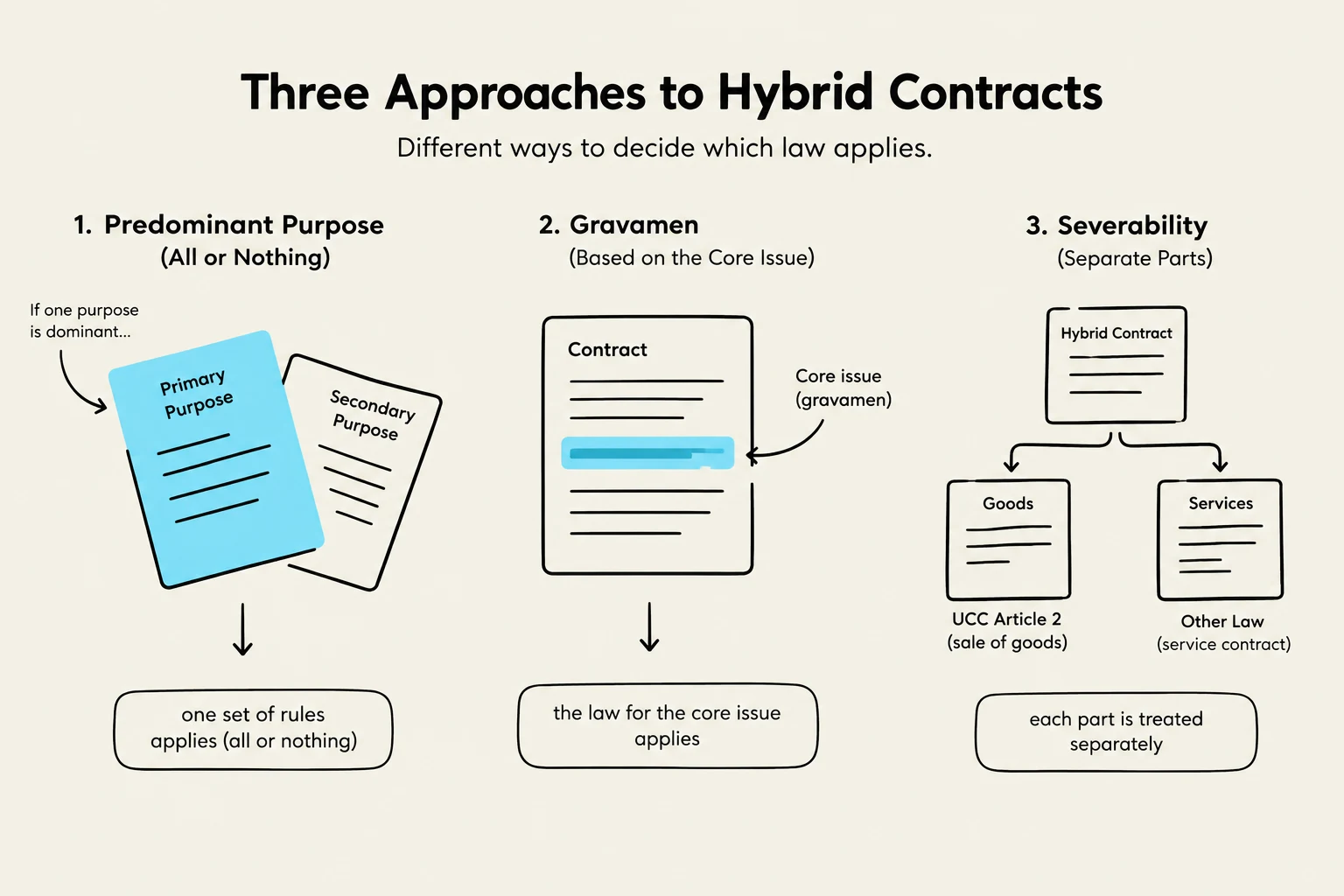
1. The Predominant Purpose Test
This was the traditional approach used by many courts. Under this test, the court looks at the transaction as a whole to see if its "thrust" or "purpose" is the sale of goods or the rendition of services. If the goods predominate, the entire contract is governed by the UCC; if services predominate, common law applies.
2. The Gravamen of the Claim Test
A minority of states (such as Mississippi and Maryland) use the "gravamen test". Instead of looking at the whole contract, this test looks at the specific nature of the dispute. If the lawsuit is about a defect in the goods, the UCC applies; if the lawsuit is about poor workmanship, common law applies.
3. The Bifurcation Approach
This approach splits the contract. It applies the UCC to the goods aspect and common law to the service aspect.
This diagram illustrates three distinct approaches to determining applicable law in hybrid contracts: Predominant Purpose, Gravamen, and Severability.
The 2022 Revised UCC: A Two-Tiered Approach
The 2022 Amendments to UCC § 2-102 codify and combine elements of the predominant purpose and bifurcation approaches into a structured two-tiered test. This provides much-needed clarity for modern commerce.
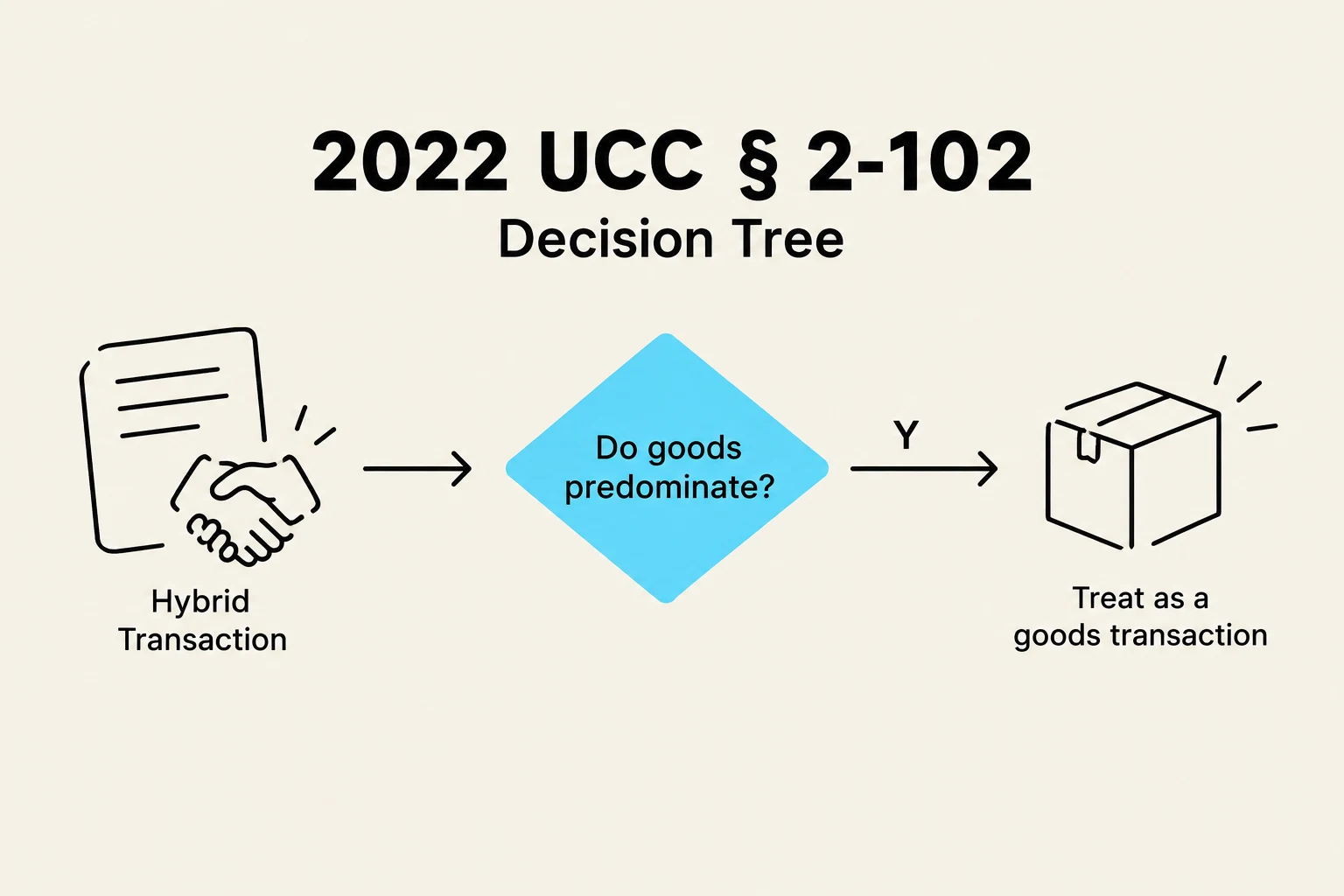
Tier 1: Sale-of-Goods Aspects Predominate
If the goods aspects of the transaction are the primary driver, the entire transaction is subject to UCC Article 2. However, this does not mean other laws are completely ignored. The application of Article 2 does not preclude the use of other laws (like real property law or service-specific licensing regulations) to govern the non-goods aspects.
Tier 2: Sale-of-Goods Aspects Do Not Predominate
If the services or other aspects predominate, the application of the UCC is limited. Only the provisions of Article 2 that relate primarily to the sale of goods apply.
Crucially, provisions that relate to the transaction as a whole—such as contract formation (§ 2-204), the Statute of Frauds (§ 2-201), or contract modification (§ 2-209)—are governed by other law (usually common law) rather than the UCC.
A decision tree illustrating the classification of a hybrid transaction based on whether goods predominate, as per 2022 UCC § 2-102.
How Courts Determine Predominance
Courts do not use a rigid formula but instead evaluate transactions on a case-by-case basis. When deciding which aspect predominates, they look at several key factors:
Language of the Agreement: Does the contract emphasize the service or the product? In Shelby Aviation, Inc. v. Pass, the court found that because the invoice emphasized "repair and inspection," the transaction was predominantly a service, even though parts were replaced.
Allocation of Price: How much of the total cost is attributed to the goods versus the services? An agreed-upon price split is usually binding.
Nature of the Parties' Businesses: Is the seller a merchant of goods or a service provider?
Specially Manufactured Goods: Services involved in the actual manufacturing of goods are generally attributed to the sale-of-goods aspect. However, design services for those goods may be treated as services.
Case Study: The Aviation Inspection
In Pass v. Shelby Aviation, Inc., a plane owner sued an aviation company for breach of warranty after a crash caused by defective brackets installed during an inspection. The court held that because the purchaser's ultimate goal was to procure an inspection service, the transaction was predominantly for service. Therefore, the UCC's warranty provisions did not apply.
Key UCC Provisions in Non-Predominant Transactions
Even when the sale of goods does not predominate, a buyer is not left without protection regarding the physical items they receive. Under the 2022 revision, certain "goods-specific" UCC provisions still apply to the non-predominant aspects of the transaction:
Warranties: Provisions regarding express or implied warranties (§§ 2-312 through 2-318).
Tender of Delivery and Risk of Loss: Rules determining when the seller has fulfilled their duty and who bears the risk if goods are damaged (§§ 2-503, 2-504, 2-509, 2-510).
Acceptance and Rejection: Rules for how a buyer accepts or rejects nonconforming goods (§§ 2-508, 2-601 through 2-606).
Remedies: Remedies for non-delivery or for the delivery of nonconforming goods (§§ 2-711, 2-714, 2-715, 2-716).
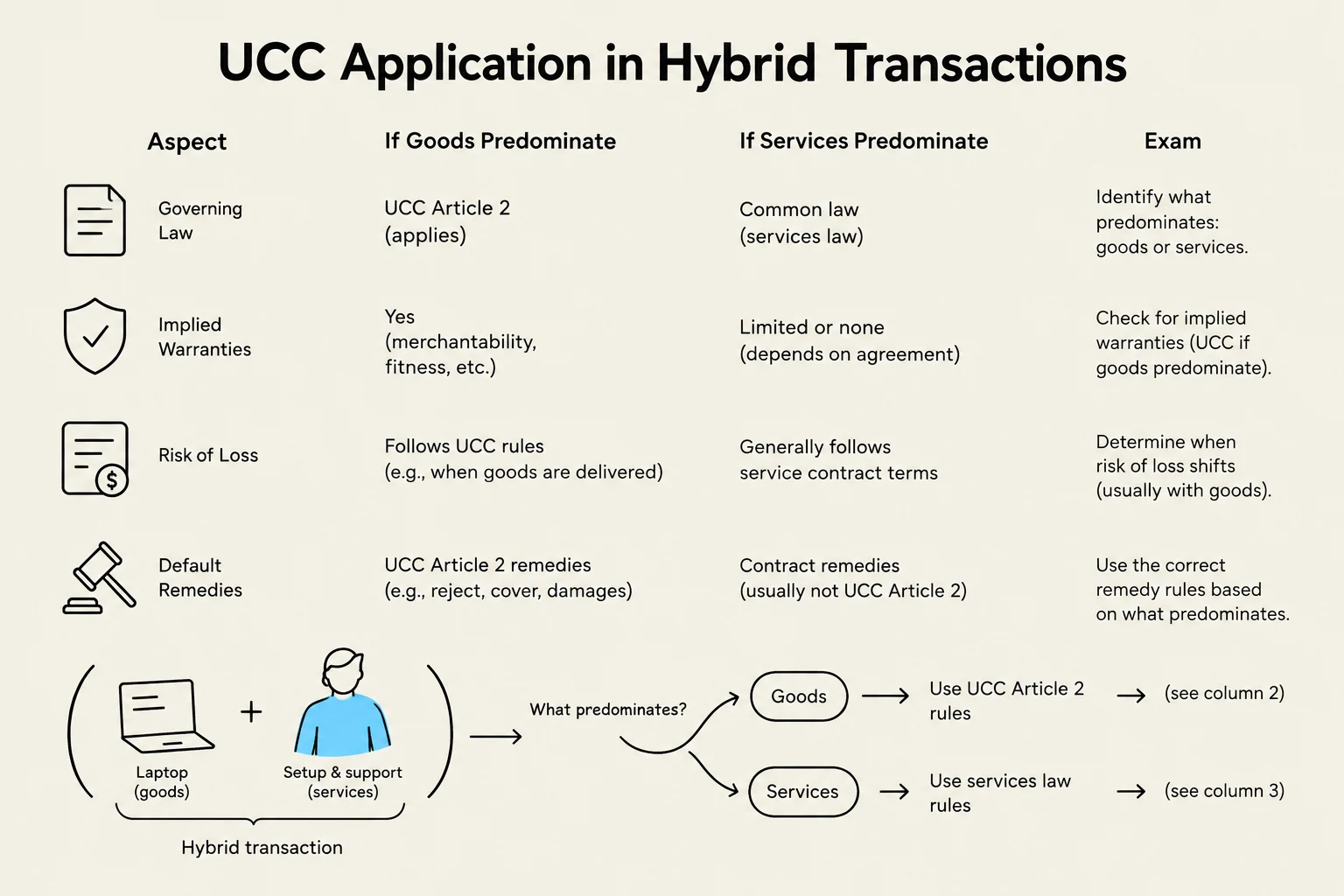
This diagram illustrates the application of the Uniform Commercial Code (UCC) in hybrid transactions, distinguishing between scenarios where goods or services predominate. It outlines governing law, implied warranties, risk of loss, and default remedies for each case, concluding with a flowchart to determine applicable rules based on the predominant aspect of the transaction.
Warranties (§ 2-314), Risk of Loss (§ 2-509), Remedies (§ 2-714)
UCC Applies
UCC Applies
By distinguishing between the "transaction as a whole" and "provisions relating to goods," the 2022 Revision ensures that even in service-heavy contracts, the actual physical products provided are still subject to the standardized protections of the UCC.
Keep reading for free.
Create an account to finish this reading and make it part of your study routine.