UCC 2022 Amendments: Digital Assets and Controllable Electronic Records
An overview of the 2022 Uniform Commercial Code (UCC) Amendments, focusing on the creation of UCC Article 12 and Controllable Electronic Records (CERs) to govern digital assets like cryptocurrencies, and the challenges posed by non-uniform state adoptions.
The rapid evolution of financial technology has outpaced much of the existing legal framework governing commercial transactions. As traditional concepts of "possession" and "property" struggle to accommodate intangible digital entries, the legal community has moved to modernize the rules of the road. The 2022 Amendments to the Uniform Commercial Code (UCC) represent a landmark effort to bridge this gap, providing a standardized legal structure for the era of blockchain, distributed ledger technology (DLT), and virtual currency.
The Core Innovation: UCC Article 12
At the heart of these amendments is the creation of UCC Article 12. Historically, the UCC has been highly effective at governing physical goods (Article 2) and secured transactions involving tangible or traditional intangible assets (Article 9). However, the rise of digital assets—which often exist as entries on a decentralized ledger rather than as physical objects or standard bank deposits—created a "legal vacuum".
Article 12 introduces a new category of property known as Controllable Electronic Records (CERs). A CER is an electronic record that is identifiable, contains no obligation of a third party, and is capable of being "controlled". By defining "control" in a digital context, the amendments allow for the legal transfer of rights in assets like cryptocurrencies and other tokenized interests, providing the certainty required for large-scale institutional adoption.
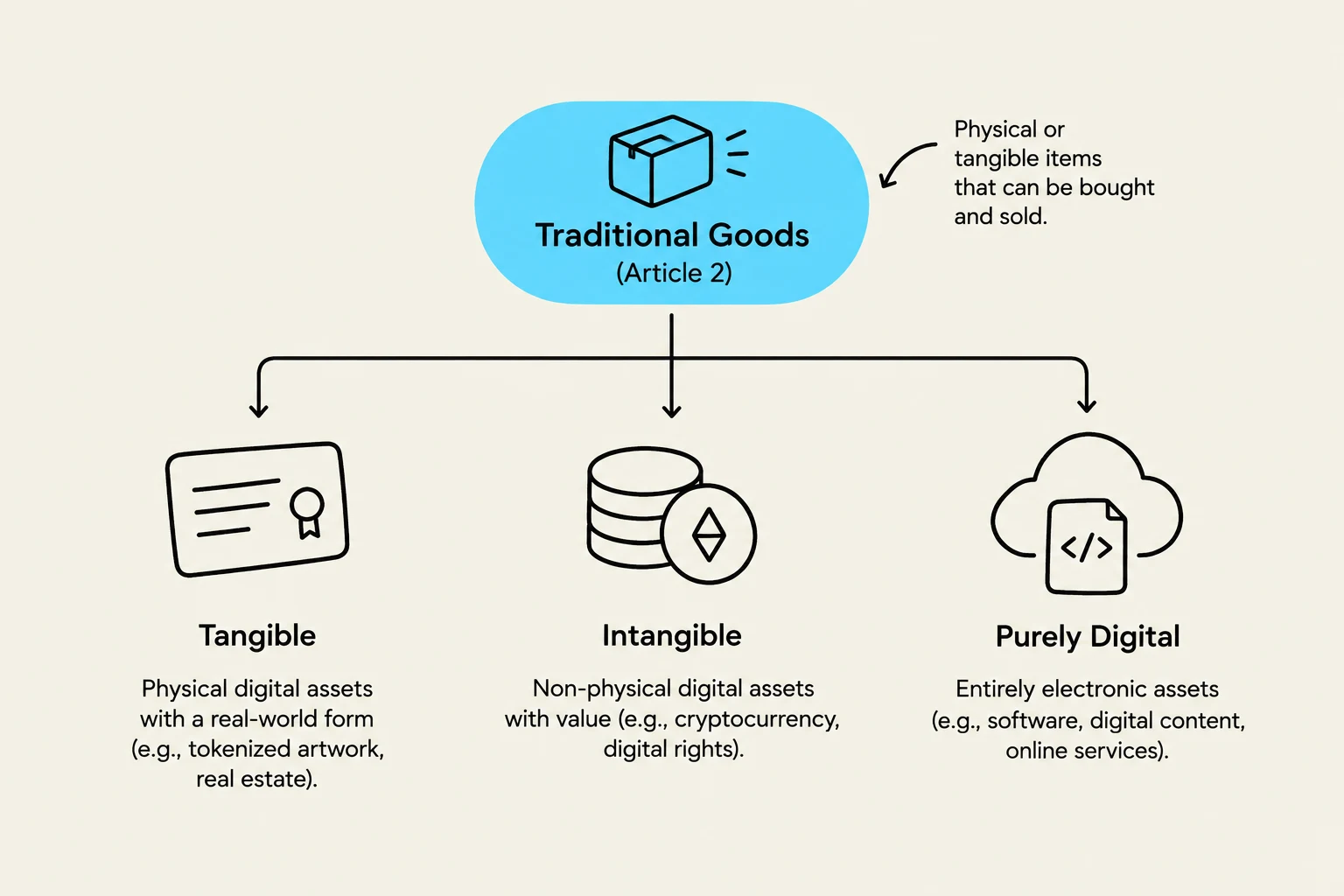
This diagram illustrates the classification of traditional goods into tangible, intangible, and purely digital categories, with examples for each.
Study Tip: When analyzing a transaction, always ask: "Is the asset a physical good, a traditional intangible (like a debt), or a Controllable Electronic Record (CER)?" The answer determines which UCC Article governs the transfer of rights.
Understanding Controllable Electronic Records (CERs)
To understand CERs, one must distinguish them from traditional assets. While a standard bank account is a "payment intangible" (a claim against a bank), a CER is often a self-contained digital asset held on a blockchain.
The concept of "control" is the digital equivalent of "possession." In the physical world, if you hold a gold coin, you control it. In the digital world, if you hold the private keys to a specific blockchain address, you "control" the CER. Article 12 provides the rules for how this control is established, transferred, and used to secure loans.
Perfecting Security Interests
For lenders, the ability to secure a loan against digital collateral is vital. Under the amendments, a lender can perfect a security interest in a CER by obtaining "control" over it. This is a more robust method than simply filing a public notice (a financing statement), as it gives the lender a priority position in the event of a debtor's bankruptcy or dispute.
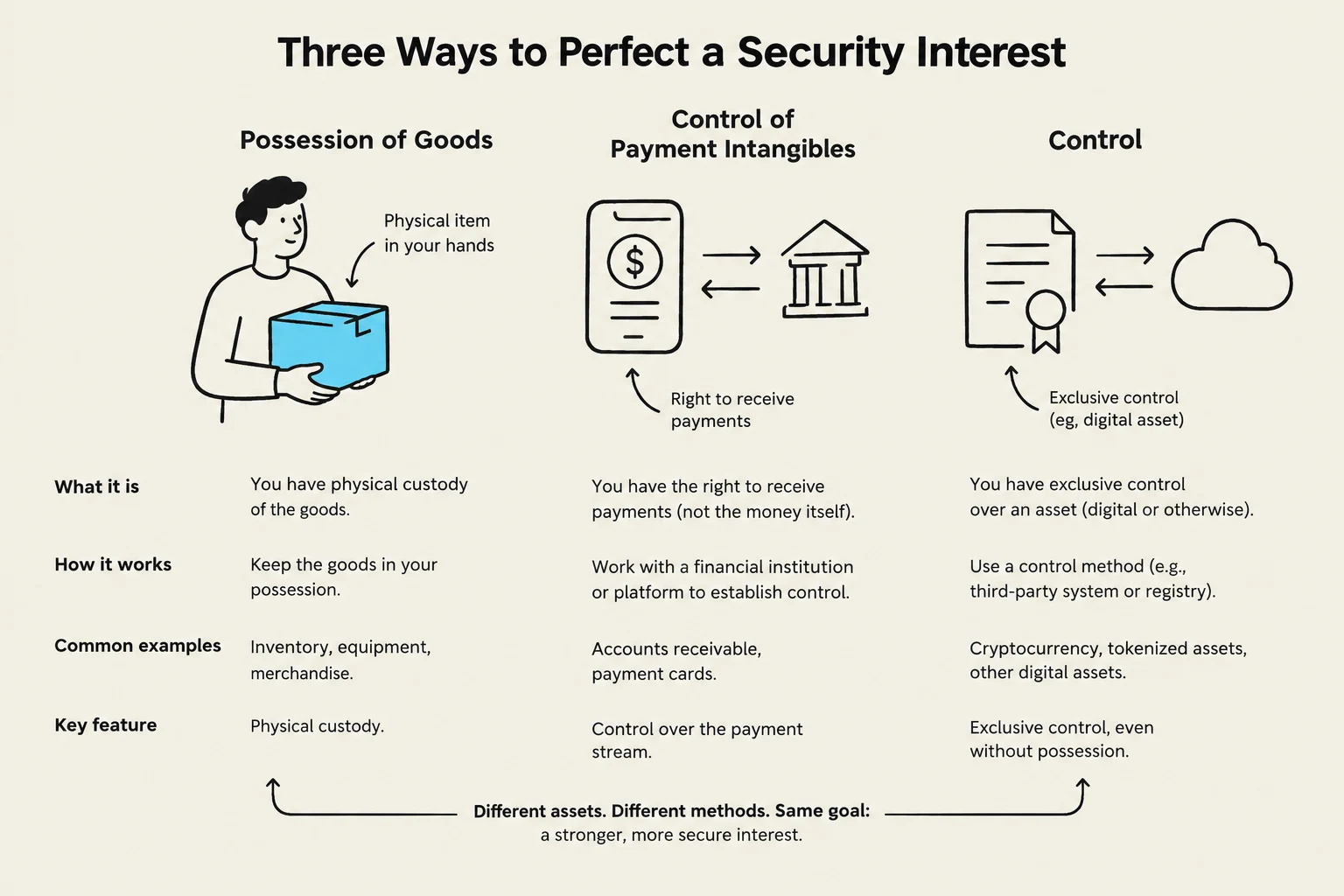
This diagram illustrates three methods for perfecting a security interest: possession of goods, control of payment intangibles, and control over assets. Each method is explained with its definition, how it works, common examples, and key features, emphasizing that different assets and methods can lead to a stronger, more secure interest.
The Challenge of Non-Uniform Provisions
While the goal of the ULC and ALI was to create a "uniform" code, the actual implementation across the United States has been anything but uniform. As states began enacting the amendments, many introduced non-uniform provisions to protect local interests or address specific political concerns.
1. The Definition of "Money"
One of the most contentious areas is how a state defines "money." This is critical because if a digital asset is classified as "money," it may fall under different regulatory regimes than if it is classified as a "CER".
Central Bank Digital Currency (CBDC): Some states, such as Nevada and South Dakota, have explicitly excluded central bank digital currency from their definition of money to prevent potential federal overreach.
Electronic Mediums: Other states, like Oklahoma and Pennsylvania, have adopted definitions that exclude any medium of exchange in electronic form from the legal definition of money.
2. Codification and Structural Variations
States are also diverging in how they organize these new rules within their own statutes:
Article Numbering: While the official text places these rules in Article 12, some states have placed them elsewhere. For example, Indiana uses Article 11, and Iowa uses Article 14. Tennessee has even proposed placing these provisions in a chapter formerly reserved for Bulk Transfers.
Omissions: Some states have opted to omit specific provisions entirely. Alabama, for instance, has omitted certain rules regarding the control of electronic money.
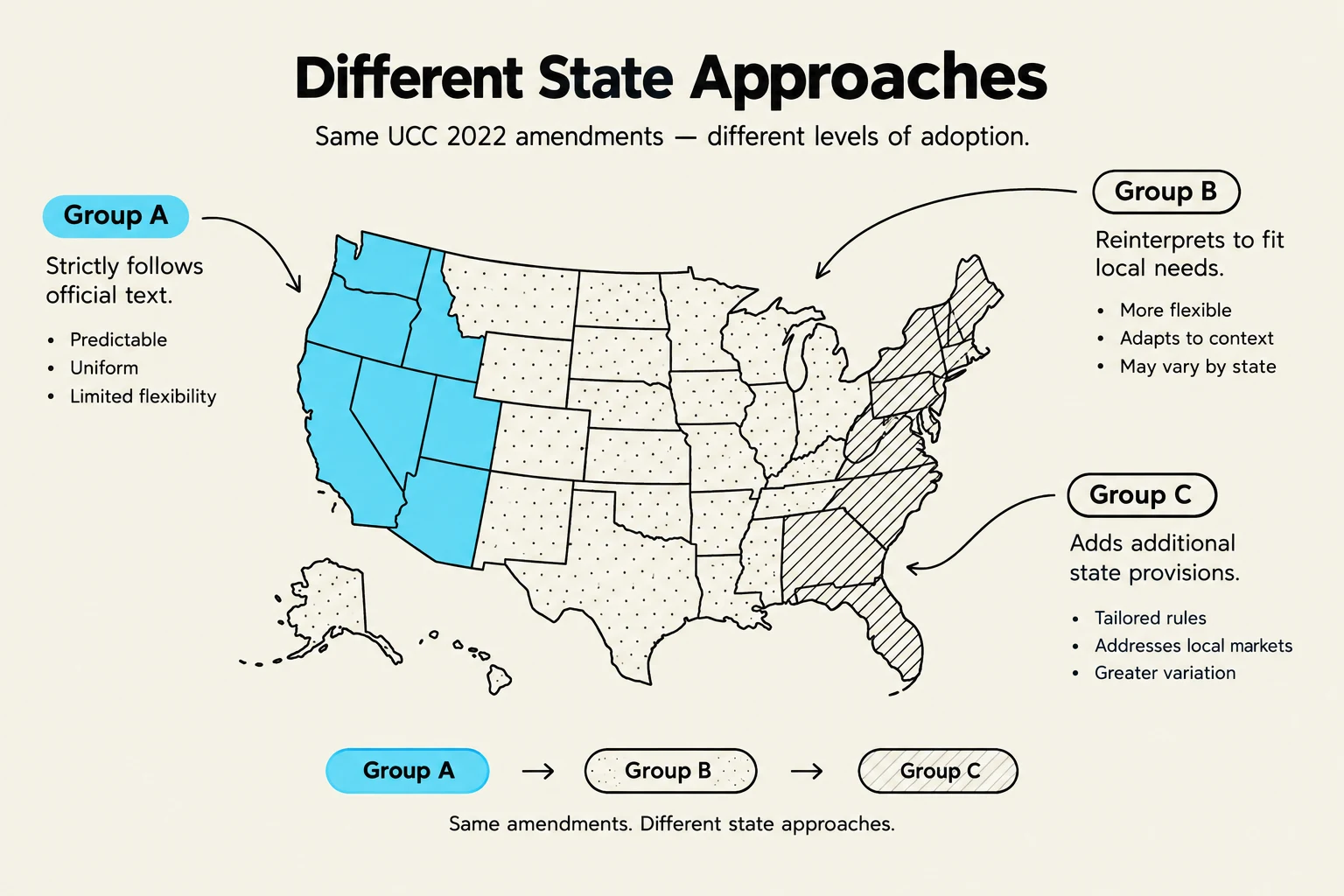
This map illustrates different state approaches to adopting UCC 2022 amendments, categorized into Group A (strictly follows official text), Group B (reinterprets for local needs), and Group C (adds additional state provisions).
Summary Table of State Implementation (Selected Examples)
State
Effective Date
Key Characteristics/Deviations
Nebraska
July 2022 / July 2024
Enacted early version; updated in 2024 to match final official text.
Nevada
October 2023
Excluded CBDC from the definition of "money" and deleted references to "electronic money".
New York
June 2026 (Est.)
Adopted Transitional Provisions as Article 12-A; minor deviations in "Qualifying Purchaser" definitions.
Oklahoma
November 2024
Adopted a non-uniform definition of "money" that excludes electronic mediums of exchange.
South Dakota
July 2024
Revised version excludes "central bank digital currency" from the definition of Money.
Conclusion for Students
For legal professionals and students, the 2022 Amendments represent a shift from a world of "tangible certainty" to one of "algorithmic control." While Article 12 provides the necessary foundation for digital commerce, the lack of true uniformity across state lines means that practitioners must perform rigorous jurisdictional analysis. A transaction that is perfectly valid under the official UCC text in one state may be subject to vastly different definitions of "money" or "control" in another.
Exam Tip: If a question asks about the validity of a security interest in a cryptocurrency, do not assume the UCC is uniform. Check if the state in the prompt has a non-uniform definition of "money" or if they have specifically excluded CBDCs.
Keep reading for free.
Create an account to finish this reading and make it part of your study routine.