U.S.-China Competition and the Global Decline of Democracy
Examines the intensifying competition between the United States and China and its impact on the global trend toward democratic decline, contrasting it with the Cold War and analyzing economic and military power dynamics.
The geopolitical landscape of the 21st century is being reshaped by two simultaneous phenomena: the intensifying competition between the United States and China, and a global trend toward democratic decline. Unlike the rigid bipolarity of the Cold War, the current era is defined by deep economic interdependence and a complex web of ideological tensions. As China ascends as an economic and military superpower, the traditional Western model of liberal democracy faces internal erosion and external challenges from rising autocratic influences.
The Nature of U.S.-China Competition
The rivalry between Washington and Beijing is fundamentally different from the 20th-century struggle between the U.S. and the Soviet Union. While the Cold War was characterized by two isolated economic blocs, the U.S. and Chinese economies are highly intertwined and deeply integrated into the global market. This interdependence means that economic conflicts, such as trade wars and tariffs, often result in mutual harm to both nations.
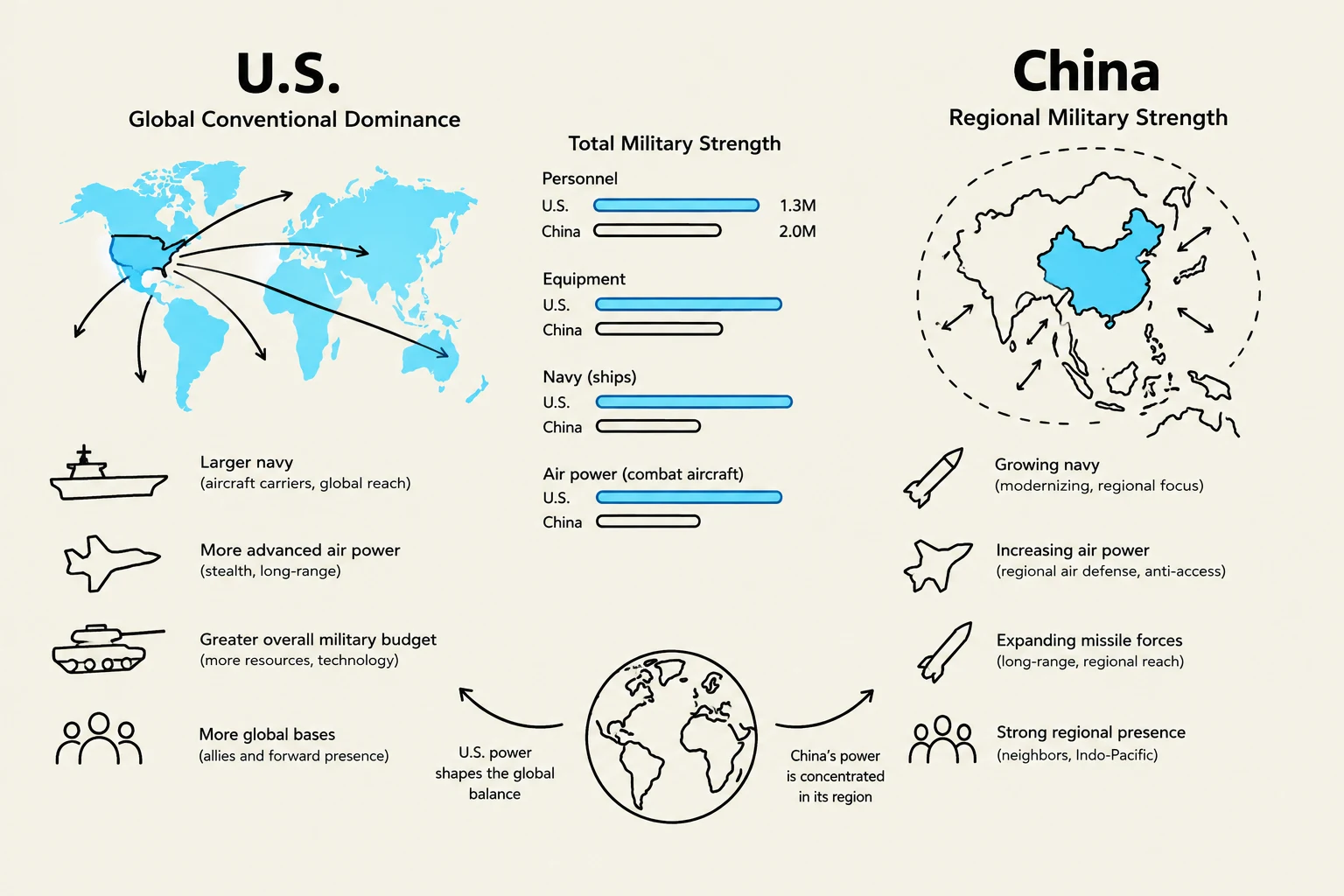
In terms of military capability, the United States maintains a sizable global advantage in conventional military power, particularly when accounting for its network of allies. However, this advantage diminishes in specific regional contexts. In contested areas like the South China Sea and the Taiwan Strait, the military power balance is much more equal. China is rapidly closing the gap in specific domains, most notably in naval power, missile capabilities, and radar technology.
This infographic compares the global conventional dominance of the U.S. with China's regional military strength, detailing personnel, equipment, navy, and air power, as well as strategic advantages like global bases for the U.S. and regional presence for China.
Exam Tip: If asked to distinguish U.S.-China competition from the Cold War, emphasize "economic interdependence" and "regional vs. global military parity" rather than total ideological isolation.
Economic Power: GDP vs. PPP
Measuring the relative strength of these two giants requires looking beyond simple nominal figures. While the U.S. GDP stands at approximately $29 trillion compared to China's $19 trillion, the comparison shifts when using Purchasing Power Parity (PPP). PPP adjusts for the relative cost of living and the purchasing power of local currencies, and under this metric, China's economy is larger than that of the United States.
Despite this scale, a significant gap remains in individual prosperity. The U.S. is much wealthier on a GDP per capita basis, whereas China's GDP per capita sits at roughly $13,000. China's economic model has focused heavily on research and development, allowing it to excel in high-tech sectors such as:
5G communications and electric batteries
Autonomous systems and drones
High-speed rail and electric vehicles
Robotics and hypersonic missiles
However, China faces significant headwinds. The Belt and Road Initiative (BRI), intended to expand Chinese influence through infrastructure, has resulted in massive debt levels nearing 300% of China's GDP. Furthermore, the economy is struggling with a shrinking workforce, declining birth rates, and massive inequality.
The Global Waning of Democracy
The post-Cold War era was marked by an "optimism about democracy," where the transition of former communist states in Europe and the end of Apartheid in South Africa suggested that democracy was becoming the universal standard. However, this era of "American democracy promotion" has faced severe setbacks.
The failure to establish stable democracies in Iraq and Afghanistan, following the 2003 invasion of Iraq, significantly eroded global support for U.S.-led democratic interventions. This perceived "American overreach" has been compounded by domestic political shifts in the United States.
Democratic Decline in the United States
The U.S. itself is experiencing internal democratic erosion, characterized by:
Unregulated campaign financing and gerrymandering
Intense societal polarization and attacks on the truth/public media
The politicization of the legal system and refusal to recognize election results
The political era of Donald Trump has been identified as a period of significant democratic stress, involving the expansion of executive power, the undermining of federal regulatory independence, and the transformation of segments of the population into anti-democratic forces.
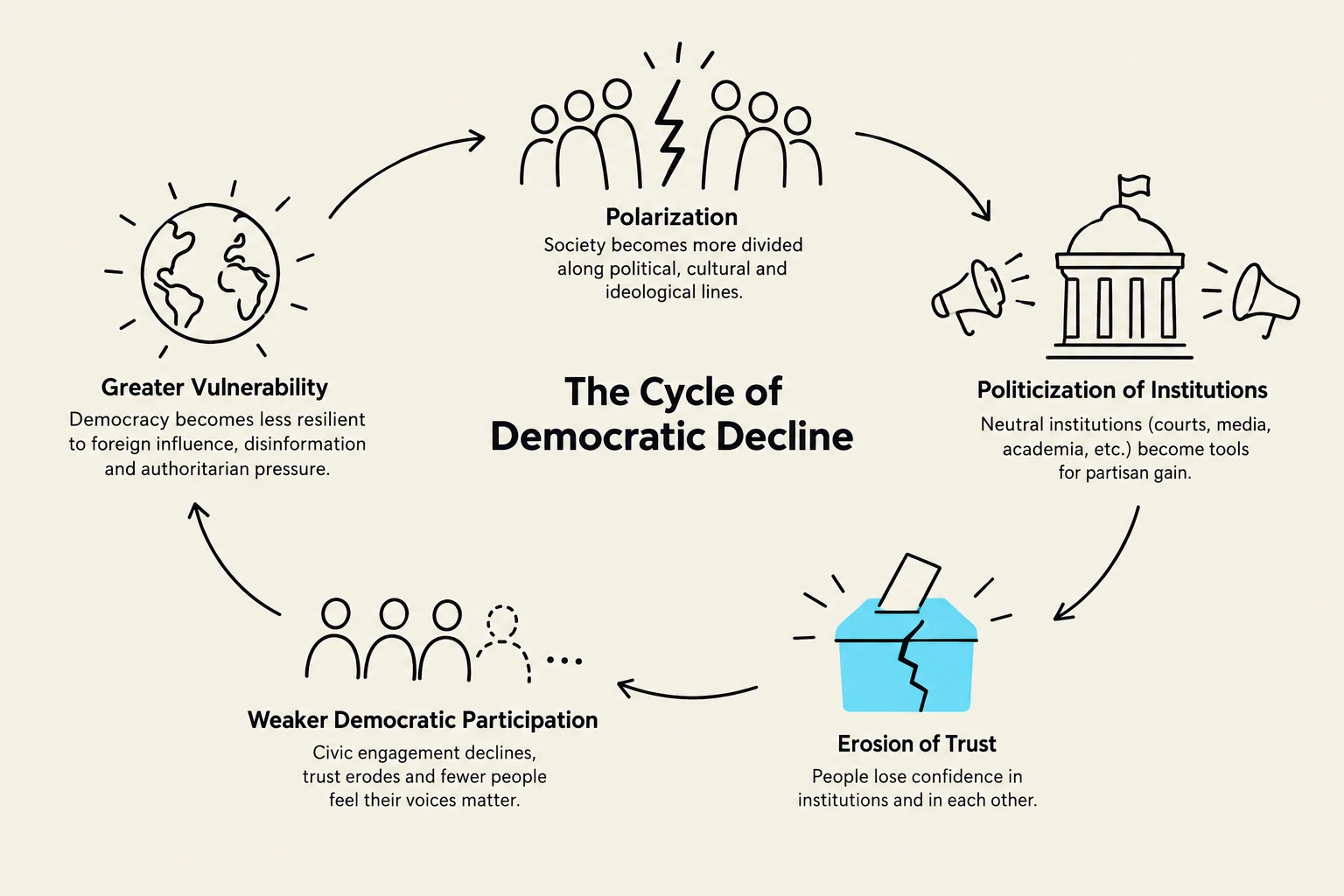
The cycle of democratic decline illustrates how societal polarization, politicization of institutions, erosion of trust, and weaker democratic participation can lead to greater vulnerability in a democracy.
Autocratic Models: Putinism and Xi Jinping Thought
As democracy wanes, alternative autocratic models are being exported globally. These models do not necessarily aim to export communism, but rather to defend the sovereignty of existing autocratic regimes.
Putinism
"Putinism" focuses on identity politics, nationalism, and the defense of a strong state. It utilizes propaganda and disinformation—often through state-controlled media like RT—to sway foreign elections and undercut the concept of objective truth. Russia has actively worked to sustain autocracy by intervening in conflicts (such as in Syria) and supporting coup plotters or autocratic leaders in Africa and Eastern Europe.
Xi Jinping Thought
Under Xi Jinping, China has moved toward increased state control over the economy and a more pronounced emphasis on Marxism-Leninism and socialism. Unlike the Soviet model, Chinese ideological promotion is often "defensive." It focuses on:
Advancing the Chinese economic development model
Defending the principle of non-interference in domestic affairs
Promoting a positive image of China as a successful alternative to Western liberal democracy
While China's ideological promotion is less overtly violent than the Soviet era, the success of its state-led economic model continues to challenge the global legitimacy of democratic capitalism.
Summary Table: Comparing Autocratic Export Styles
Feature
Putinism (Russia)
Xi Jinping Thought (China)
Primary Tool
Disinformation & Identity Politics
Economic Model & Sovereignty
Goal
Undercutting Western Truth/Values
Defending Autocracy & Non-interference
Style
Offensive/Disruptive
Defensive/Institutional
As the U.S. grapples with internal polarization and a declining interest in democracy promotion, the competition with China is no longer just about trade or territory—it is a fundamental contest over the ideological direction of the global order.
Keep reading for free.
Create an account to finish this reading and make it part of your study routine.