Types of Educational Assessment: Timing, Purpose, and Impact
This guide explains the three main types of educational assessments: Diagnostic, Formative, and Summative. It details their timing, primary purpose, and impact on student learning, providing a framework for educators to effectively measure understanding and guide instruction.
In the field of education, assessment is much more than just grading a final exam. It is a continuous process used to measure student understanding, guide teaching strategies, and improve learning outcomes. To use assessment effectively, educators must distinguish between different types of evaluations based on when they occur and why they are being conducted.
By understanding the distinctions between Diagnostic, Formative, and Summative assessments, teachers can create a roadmap for student success that supports learners at every stage of the instructional cycle.
The Assessment Cycle: A Framework for Learning
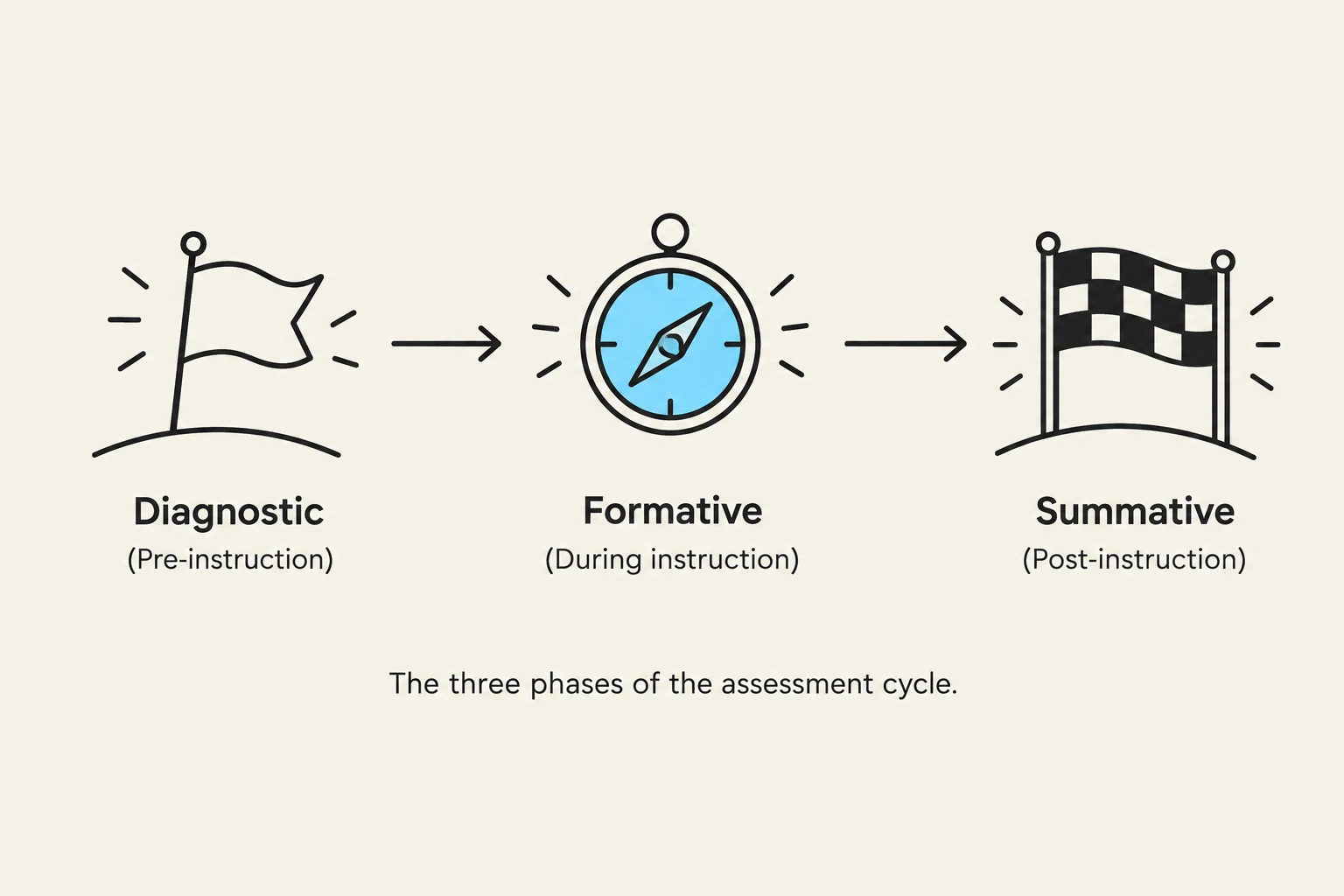
The three phases of the assessment cycle: Diagnostic (Pre-instruction), Formative (During instruction), and Summative (Post-instruction).
Assessment is not a single event but a cycle that mirrors the instructional process. To visualize this, think of the learning journey in three distinct phases: before the journey begins, during the journey itself, and once the destination is reached.
Assessment Type
Timing
Primary Purpose
Impact on Learning
Diagnostic
Pre-instruction
To identify strengths and gaps
Sets the baseline for instruction
Formative
During instruction
To monitor progress and adjust
Provides immediate feedback for growth
Summative
Post-instruction
To evaluate final achievement
Measures mastery of standards
1. Diagnostic Assessment: The Starting Line
Diagnostic assessment, often referred to as pre-instructional assessment, takes place before a new unit of study or a school year begins. Its primary goal is to "diagnose" what students already know and, more importantly, what they do not yet understand.
Purpose and Function
The purpose of a diagnostic assessment is not to assign a grade, but to gather data that informs the teacher's planning. If a teacher knows that 80% of the class has already mastered a specific concept, they can skip the introductory lessons and move directly to more complex material, saving valuable instructional time. Conversely, if the assessment reveals significant gaps in foundational knowledge, the teacher knows they must slow down and provide remedial support before moving forward.
Worked Example: The Pre-Algebra Check
Imagine a math teacher preparing to teach quadratic equations. Before starting the unit, they administer a short, ungraded quiz on factoring polynomials and basic algebraic manipulation.
Scenario A: Students struggle with factoring. The teacher decides to spend the first three days of the unit reviewing factoring techniques.
Scenario B: Students excel at factoring. The teacher moves immediately into the complexities of the quadratic formula.
Exam Tip: When you encounter questions about "pre-assessment" or "baseline data," think Diagnostic. These assessments are about preparation, not finality.
2. Formative Assessment: The Compass During Instruction
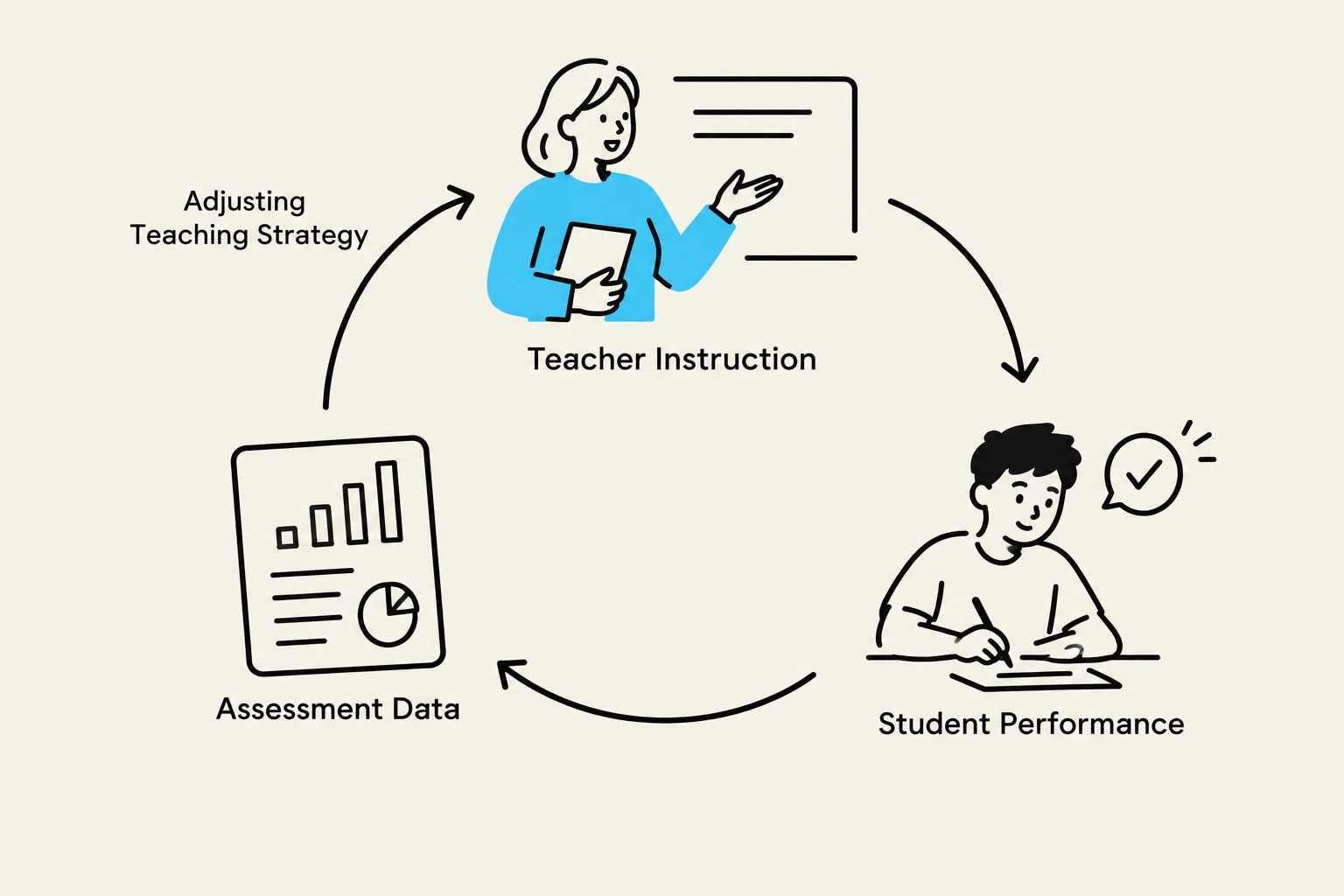
A diagram illustrating the cyclical process of teaching, student performance, assessment data, and adjusting teaching strategy.
Formative assessment occurs while learning is actively happening. If diagnostic assessment is the map, formative assessment is the compass that tells the teacher if they are still on the right track.
Purpose and Function
The hallmark of formative assessment is its role in providing continuous feedback. It is "low-stakes," meaning it typically carries little to no weight in a student's final grade. Instead, it serves as a pulse check for both the student and the instructor.
For the student, formative assessment highlights where they are succeeding and where they need to apply more effort. For the teacher, it provides real-time evidence of whether the current instructional methods are working. If a teacher notices through formative checks that most students are confused, they can pivot their strategy—perhaps by re-teaching the concept using a different medium, such as a visual diagram instead of a lecture.
Common Formative Techniques
Exit Tickets: A single question at the end of class that students must answer before leaving.
Think-Pair-Share: Students process a question individually, discuss it with a partner, and then share with the class.
Polling: Using digital tools to get an instant snapshot of class understanding.
Callout: The Feedback Loop
The true power of formative assessment lies in the feedback loop. Assessment without feedback is just a measurement; assessment with feedback is a tool for growth.
3. Summative Assessment: The Final Destination
Summative assessment occurs at the end of an instructional period, such as the conclusion of a unit, a semester, or a school year. This is the "high-stakes" phase where the focus shifts from the process of learning to the product of learning.
Purpose and Function
The primary purpose of summative assessment is to evaluate student learning, skill acquisition, and academic achievement by comparing it against a standard or benchmark. Unlike formative assessments, which are used to improve learning, summative assessments are used to document what has been learned.
These assessments provide the data used for report cards, graduation requirements, and school accountability measures. While they are essential for measuring mastery, they occur too late to change the instructional approach for the specific unit being tested.
Worked Example: The History Capstone
At the end of a unit on the Industrial Revolution, a history teacher assigns a formal research paper or a comprehensive final exam. This assignment evaluates whether the student has met the state standards for understanding economic shifts, technological advancements, and social impacts. The grade received on this paper serves as the final record of the student's proficiency in that specific topic.
Summary of Differences
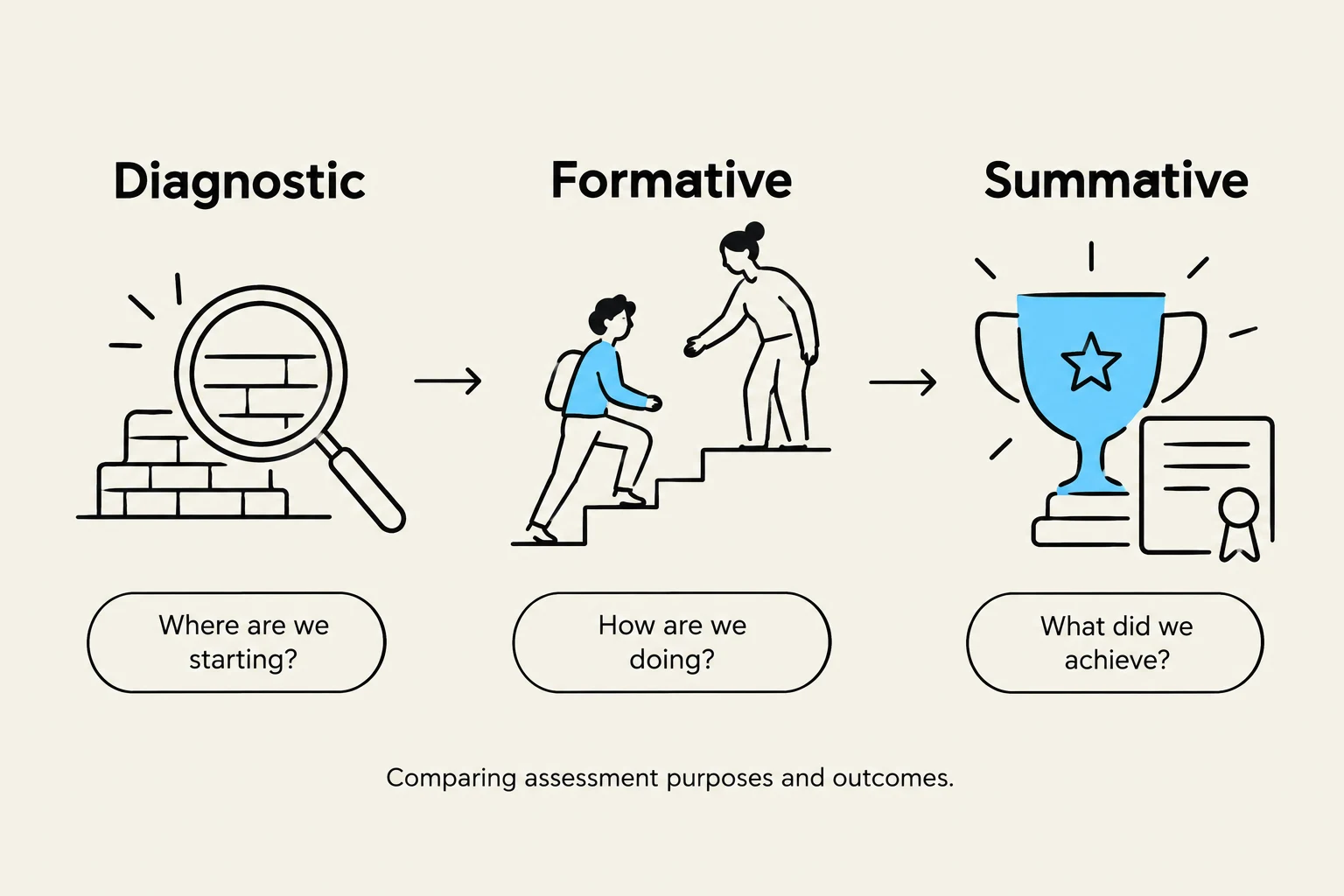
This diagram illustrates the three main types of assessments: diagnostic, formative, and summative, along with their respective purposes and outcomes.
To master these concepts, remember the distinction between the "why" and the "when":
Diagnostic asks: "Where are we starting from?"
Formative asks: "How are we doing right now?"
Summative asks: "What did we achieve in the end?"
By integrating all three types of assessment, educators create a balanced environment where students are not just tested, but are supported through every step of their educational journey.
Keep reading for free.
Create an account to finish this reading and make it part of your study routine.