Explore the fundamental classifications of chemical reactions, including redox and nonredox reactions, with a focus on driving forces in aqueous solutions such as precipitation, acid-base neutralization, and gas formation.
The science of chemistry is unique in its ability to create new forms of matter by combining elements and existing compounds in controlled ways. When these substances interact, they undergo chemical reactions to produce new substances with different properties. In this article, we will explore the fundamental classifications of these reactions, with a special focus on those occurring in aqueous solutions—where water acts as the solvent.
Fundamental Reaction Categories
Chemical reactions can be broadly categorized into two main groups based on whether electrons are transferred between species: Redox (oxidation-reduction) reactions and Nonredox reactions.
Redox Reactions
In a redox reaction, electrons are transferred from one reactant to another. This process involves changes in the oxidation numbers of the atoms involved.
Oxidation is the loss of electrons, which increases the oxidation number. The substance being oxidized acts as a reducing agent.
Reduction is the gain of electrons, which decreases the oxidation number. The substance being reduced acts as an oxidizing agent.
Redox reactions include several specific types, such as combustion (burning) and single displacement reactions. For example, a combustion reaction is highly exothermic, meaning it produces heat, such as when magnesium burns in air:
2Mg(s)+O2(g)→2MgO(s)+heat
Nonredox Reactions
Nonredox reactions do not involve a change in oxidation states. These include combination (synthesis) reactions, where two or more reactants form a single product, and decomposition reactions, where one reactant breaks down into two or more products.
Exam Tip: To identify a reaction type, ask yourself: Are electrons being transferred? If yes, it is Redox. If no, look for patterns like the formation of water (Acid-Base) or a solid (Precipitation).
Double Displacement (Metathesis) Reactions
A major category of nonredox reactions is the double displacement reaction, also known as a metathesis reaction. In these reactions, the number of reactants is typically equal to the number of products, and two compounds exchange ions to form new combinations.
The general formula is:
A+X−+B+Y−→A+Y−+B+X−
It is crucial to remember that for the products to be chemically valid, the cation must always be paired with the opposite anion. However, simply mixing two aqueous solutions does not always result in a chemical reaction. For a double displacement reaction to be considered successful, there must be a net change driven by the formation of a precipitate, a gas, or a non-electrolyte/weak electrolyte.
This diagram illustrates different types of chemical reactions, including combustion, combination, and single displacement, with examples of each.
Driving Forces in Aqueous Solutions
When reactions occur in water, we look for specific "driving forces" that pull the reaction forward by removing ions from the aqueous phase.
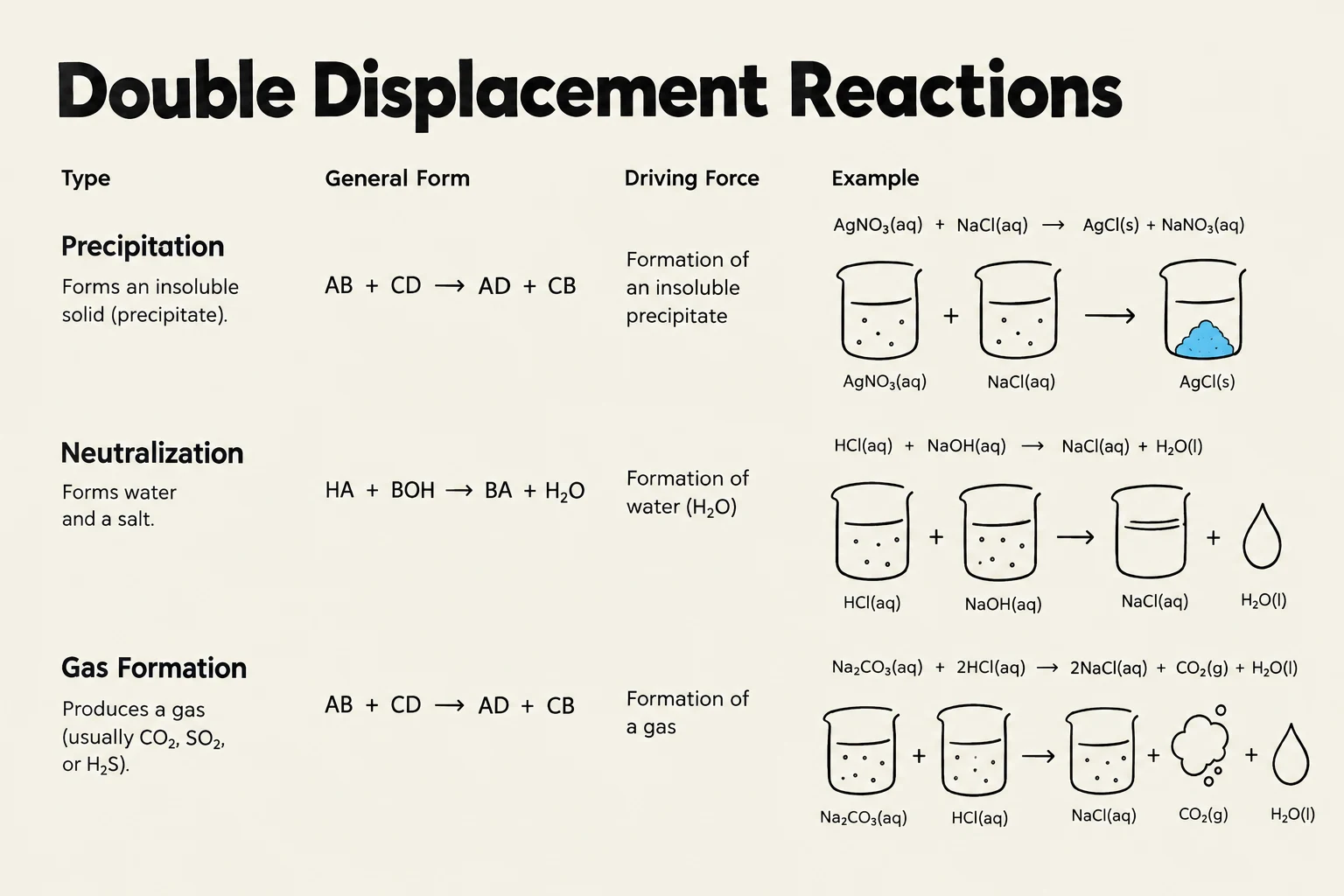
1. Precipitation Reactions
Precipitation occurs when two aqueous solutions are mixed and an insoluble ionic compound forms. This solid is known as a precipitate. To predict whether a precipitate will form, chemists use solubility rules. For instance, salts containing alkali metal ions (Li+, Na+, etc.) or nitrates (NO3−) are generally soluble, while many carbonates (CO32−) are insoluble.
Example:NaCl(aq)+AgNO3(aq)→NaNO3(aq)+AgCl(s)
In this case, the formation of solid silver chloride (AgCl) is the driving force.
2. Acid–Base (Neutralization) Reactions
An acid-base reaction occurs when an acid reacts with a base to produce a salt and water. These are often called neutralization reactions. The driving force here is the formation of water, which acts as a non-electrolyte (a substance that does not conduct electricity in solution).
General Formula:Acid+Base→Water+Salt
Example:HCl(aq)+NaOH(aq)→H2O(l)+NaCl(aq)
3. Gas-Forming Reactions
In gas-forming reactions, one of the products is a gas that escapes the solution in the form of bubbles. These reactions often occur in two steps involving unstable intermediate species.
Carbonates/Bicarbonates + Acid: These produce a metal salt, CO2, and H2O. An intermediate, carbonic acid (H2CO3), forms and immediately decomposes:
CaCO3(s)+2HCl(aq)→[CaCl2(aq)+H2CO3(aq)]→CaCl2(aq)+CO2(g)+H2O(l)
Sulfites + Strong Acid: These produce a metal salt and sulfur dioxide (SO2) gas.
Ammonium Salts + Base: These produce a metal salt, ammonia (NH3), and water. For example:
NH4Cl(aq)+NaOH(aq)→[NaCl(aq)+NH4OH(aq)]→NaCl(aq)+NH3(g)+H2O(l)
This chart illustrates three types of double displacement reactions: precipitation, neutralization, and gas formation, with their general forms, driving forces, and specific chemical examples.
Summary Table of Double Displacement Reactions
To help you study, use the following summary of the nonredox double displacement reactions:
General Form
Driving Force
Example
Precipitation
Formation of a precipitate
NaCl(aq)+AgNO3(aq)→NaNO3(aq)+AgCl(s)
Acid-Base
Formation of a non-electrolyte
HCl(aq)+NaOH(aq)→NaCl(aq)+H2O(l)
Gas-Forming
Formation of a gas
CaCO3(s)+2HCl(aq)→CaCl2(aq)+CO2(g)+H2O(l)
Final Check: When identifying a reaction in a lab, look for these physical cues: temperature changes, color changes, gas bubbles (fizzing), or the appearance of a solid (precipitate).
Keep reading for free.
Create an account to finish this reading and make it part of your study routine.