Explore the fundamental concepts of traveling waves, including mechanical waves, transverse and longitudinal motion, and the mathematical descriptions of sinusoidal waves. Learn about wave speed and its dependence on the medium.
When you drop a pebble into a still pond, ripples spread outward in expanding circles. While it looks like the water itself is moving toward the shore, what is actually traveling is an organized disturbance moving through the water. This phenomenon is the essence of a traveling wave: an organized disturbance that propagates through space with a well-defined wave speed (v).
One of the most important distinctions to make in wave physics is that while waves transfer energy from a source to other locations, they do not transfer matter. The medium (the substance through which the wave moves) remains in its general location; its individual particles merely oscillate around an equilibrium position.
The Wave Model and Mechanical Waves
The wave model provides a framework to describe the basic properties common to all waves, from light to seismic activity. We categorize waves based on the type of medium they require. Mechanical waves specifically require a material medium to travel.
A wave is created when a source introduces a disturbance into the medium, displacing the atoms or molecules from their equilibrium positions. Because a wave is not a particle, we cannot apply Newton's laws to the wave itself; instead, we use Newton's laws to analyze how the individual particles within the medium respond to the disturbance.
Classifying Wave Motion: Transverse vs. Longitudinal
Mechanical waves are classified by the direction of particle motion relative to the direction of the wave's travel.
Transverse Waves
In a transverse wave, the particles of the medium move perpendicular to the direction of the wave's travel. A classic example is a wave pulse on a stretched string. When you shake one end of a string up and down, the string moves vertically while the wave travels horizontally. The curvature of the string creates net forces that drive this motion. In seismology, S waves (secondary waves) are transverse waves that move the ground up and down.
A wave pulse is shown traveling along a rope to the right with velocity v.
Longitudinal Waves
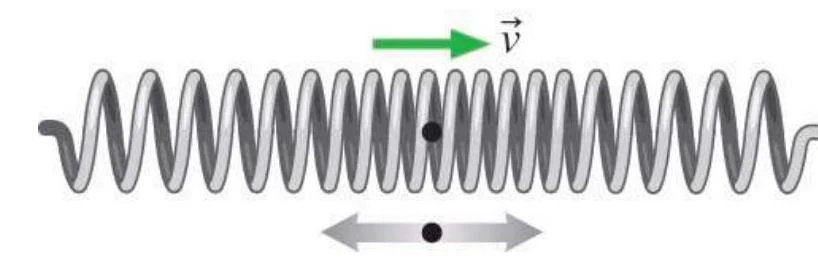
In a longitudinal wave, the particles of the medium move parallel to the direction of the wave's travel. This motion creates regions of compression (where particles are crowded together) and expansion (where they are spread apart).
Sound waves are the primary example of longitudinal waves. When a loudspeaker vibrates, it creates compressions in the air that travel outward. In seismology, P waves (primary waves) are longitudinal waves that expand and compress the ground.
A diagram illustrating wave propagation through a spring, with arrows indicating velocity and direction of motion.
Mathematical Descriptions of Sinusoidal Waves
Many traveling waves follow a sinusoidal pattern, which is the same shape seen in simple harmonic motion (SHM). Because the motion of each individual particle in the medium is periodic, we use the same terminology to describe waves that we use for oscillations.
Key Wave Parameters
Amplitude (A): The maximum value of displacement from the equilibrium position.
Period (T): The time interval required to complete one full cycle of motion.
Frequency (f): The number of cycles per unit time, defined by the relationship f=1/T.
Wavelength (λ): The distance spanned by one complete cycle of the wave.
Exam Tip: To distinguish between a "snapshot graph" and a "history graph," look at the axes. A snapshot graph shows displacement vs. position (x) at a fixed time, where you can measure wavelength. A history graph shows displacement vs. time (t) for a single point, where you can measure the period.
The Wave Function
To describe a traveling wave mathematically, we combine the displacement as a function of position and time into a single wave function y(x,t):
y(x,t)=Acos(2π(λx∓Tt))
Or, using angular wave number (k=2π/λ) and angular frequency (ω=2πf):
y(x,t)=Acos(kx∓ωt)
Note the sign convention: a wave traveling to the right (positive x direction) uses a minus sign in the argument, while a wave traveling to the left uses a plus sign.
Wave Speed and the Medium
A fundamental principle of wave mechanics is that wave speed is a property of the medium, not the wave itself. The speed does not depend on the amplitude or the shape of the pulse.
Speed on a String
For a wave on a stretched string, the speed v depends on the tension (Ts) and the linear mass density (μ, which is mass per unit length):
vstring=μTs
Increasing the tension makes the string respond more rapidly, increasing the speed. Conversely, increasing the linear density (making the string heavier) increases inertia, which decreases the speed.
Speed of Sound
In a gas, the speed of sound depends on the temperature (T) and the molar mass (M) of the gas:
vsound=MγRT
In air, the speed of sound increases as the temperature rises. For example, at 0∘C, the speed is 331 m/s, but at 20∘C, it increases to 343 m/s.
Comparison of Speeds
While mechanical waves are limited by their medium, electromagnetic waves (like light) do not require a medium and can travel through a vacuum at the constant speed c=3.00×10⁸ m/s.
Medium
Speed (m/s)
Air (0∘C)
331
Water
1480
Aluminum
5100
Light (Vacuum)
3.00×10⁸
Table 15.1: Comparison of wave speeds.
Worked Example: Lightning and Thunder
Problem: During a thunderstorm, you see a flash of lightning. 8.0 seconds later, you hear the thunder. How far away was the lightning strike? (Assume the speed of sound in air is 343 m/s at 20∘C).
Strategy: This involves two waves: light and sound. Because the speed of light is so high (3.00×10⁸ m/s), the time it takes for the light to reach you is negligible. Therefore, the 8.0-second delay is entirely due to the time it takes the sound wave to travel the distance.
Solution:
Using the relationship between distance, speed, and time:
d=v⋅Δtd=(343 m/s)⋅(8.0 s)d=2744 m≈2.7 km
The lightning strike was approximately 2.7 km away.
Keep reading for free.
Create an account to finish this reading and make it part of your study routine.