Examines how transport systems embed societal biases, impacting different social groups through travel behavior, access to opportunities, and externalities. Discusses transport poverty, social exclusion, and the mobility of care, advocating for inclusive policies and 'caring cities'.
Transport is often viewed as a neutral utility—a way to get from point A to point B. However, transport systems are not neutral; they are built, operated, and managed in ways that often embed existing societal biases. Because transport impacts how people access opportunities, how they experience their environment, and how they are impacted by the side effects of movement, it is a central pillar of social equity. To understand transport equity, we must look beyond the movement of vehicles and examine how different social groups experience mobility.
The Dimensions of Transport Inequality
Transport impacts people differently through three primary lenses: travel behaviour, access to opportunities, and transport externalities.
Travel behaviour refers to how individuals actually move—their choice of mode (walking, driving, transit), their trip frequency, and their patterns of movement. Access to opportunities concerns whether a person can actually reach essential services like healthcare, education, or employment. Finally, transport externalities are the unintended side effects of transport systems, such as noise, pollution, or safety risks, which are often disproportionately felt by certain communities.
Exam Tip: When analyzing a transport policy, don't just ask "Does this move people?" Ask "Who does this move, and what are the side effects for those living near the infrastructure?"
Social Disadvantage and the Drivers of Inequality
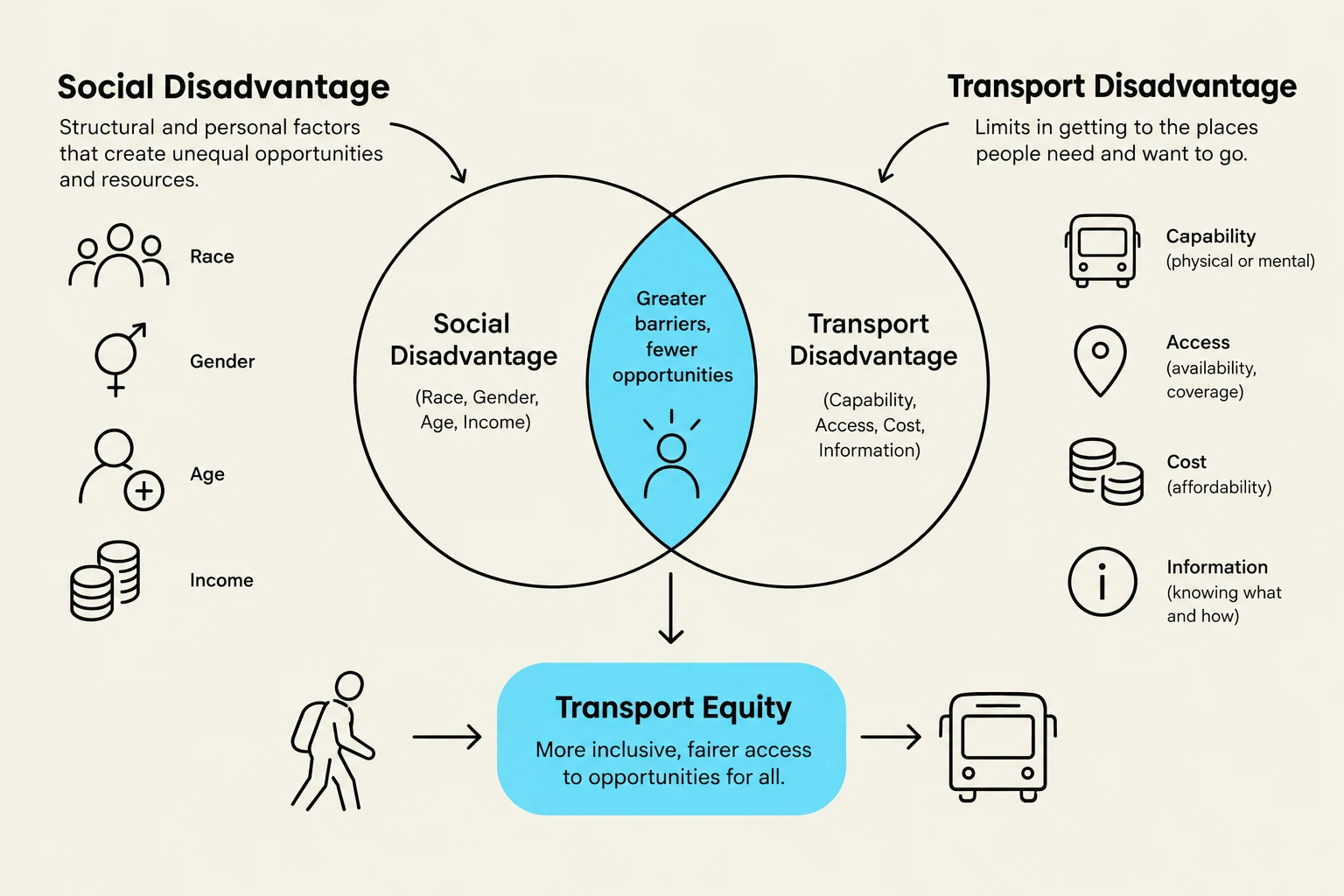
Inequality in transport is deeply linked to social disadvantage—the condition of being subjected to prejudice or bias due to group identity (such as race, gender, or disability) through circumstances beyond an individual's control. These social identities intersect with transport in several ways:
Socioeconomic Status: Income is a massive determinant of mobility. In the US, transportation is the second largest expense for households after housing. While the average American spends about 16% of household expenditure on transport, this jumps to 30% for low-income households.
Age and Ability: Those who cannot drive due to age or physical/cognitive disability are often "left out" of car-dependent systems.
Race and Ethnicity: People of color may experience "arrested mobility" due to targeted and predatory law enforcement or built environments that nudge them toward breaking rules.
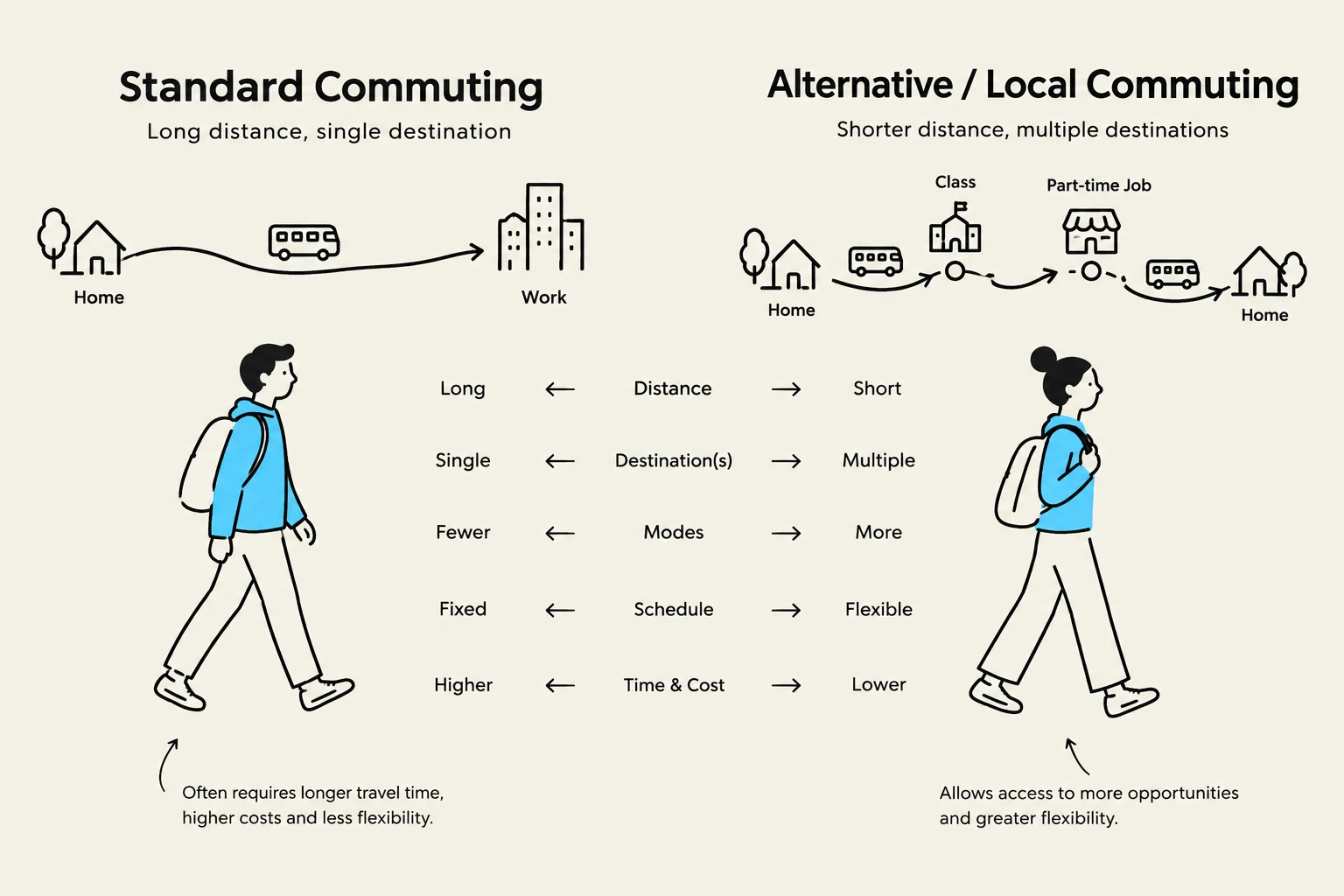
Gender: Women often travel differently than men. They tend to make more frequent, shorter trips and are more likely to engage in "trip-chaining"—making multiple stops (like school drop-offs) between an origin and a destination.
This diagram illustrates the relationship between social disadvantage and transport disadvantage, and how addressing these can lead to transport equity.
Understanding Transport Poverty and Social Exclusion
When social disadvantage meets a lack of transport resources, we encounter transport disadvantage. This is a lack of resources that hinders an individual's potential mobility, specifically regarding:
Capabilities: The physical or mental ability to travel.
Accessibility: The ease of reaching destinations.
Affordability: The financial cost of travel.
Time: The duration required to complete trips.
Safety/Security: The perceived and actual safety of the journey.
Transport poverty is the cumulative combination of social and transport disadvantage. If left unaddressed, transport poverty leads to social exclusion, where individuals are effectively cut off from the economic and social life of their community.
The Hidden Burden: Mobility of Care
A significant "blind spot" in current transport planning is the mobility of care. This refers to all the travel required to perform care work, such as grocery shopping, running errands, or transporting dependents.
Globally, women complete two-thirds of paid and three-quarters of unpaid care work. In Canada, adult women complete an average of 1.9 hours more unpaid care per day than men. Because care trips are often short, frequent, and involve multiple stops (trip-chaining), they are frequently omitted or poorly captured in standard census commute questions, which focus heavily on the single trip from home to work.
A diagram illustrating the concept of trip-chaining, showing the process of a parent or caregiver driving a student from home to school.
Built Environment and Community Severance
The physical design of our cities can also create barriers. Community severance occurs when transport infrastructure, such as a large highway, creates a negative impact on the wellbeing and social interaction of the surrounding area. High-traffic areas can act as physical barriers that prevent people from congregating or connecting with neighbors, effectively "severing" the social fabric of a community.
Furthermore, newcomers (immigrants and refugees) often undergo travel assimilation. Recent arrivals are less likely to drive and more likely to use public transit, walk, or carpool. However, over approximately five years, as they gain economic security and change residences, they often shift toward automobile use.
Moving Toward Transport Equity
Addressing transport poverty requires moving away from car-centric models and toward "caring cities". This involves:
Inclusive Policy: Implementing transit fares that support trip-chaining (e.g., two-hour transfer windows) and providing free rides for children.
Community Initiatives: Programs like "Pop-Up Bike Hubs" to increase repair access in rural areas, or workshops that teach residents how to navigate bus systems.
Better Data: Using travel diaries rather than just census questions to capture the true complexity of how people move, including care trips.
This illustration compares standard commuting with long distances and single destinations to alternative or local commuting with shorter distances and multiple destinations, highlighting differences in distance, destinations, modes, schedule, and time/cost.
By planning for care and recognizing the specific needs of disadvantaged groups, planners can create systems that provide genuine access for all, rather than just mobility for some.
Keep reading for free.
Create an account to finish this reading and make it part of your study routine.