


The hydrophobic interior of a lipid bilayer acts as a formidable barrier to most water-soluble molecules, particularly inorganic ions. Because ions are highly attracted to water and carry electric charges, they cannot simply diffuse through the fatty acid tails of the membrane. To overcome this, cells utilize specialized membrane transport proteins that provide "private portals" for specific solutes. These proteins are broadly categorized into two functional classes: transmembrane pumps and ion channels. While they both facilitate transport, they operate on fundamentally different energetic principles—one building gradients through work, and the other releasing stored energy through flow.
Transmembrane Pumps and Active Transport
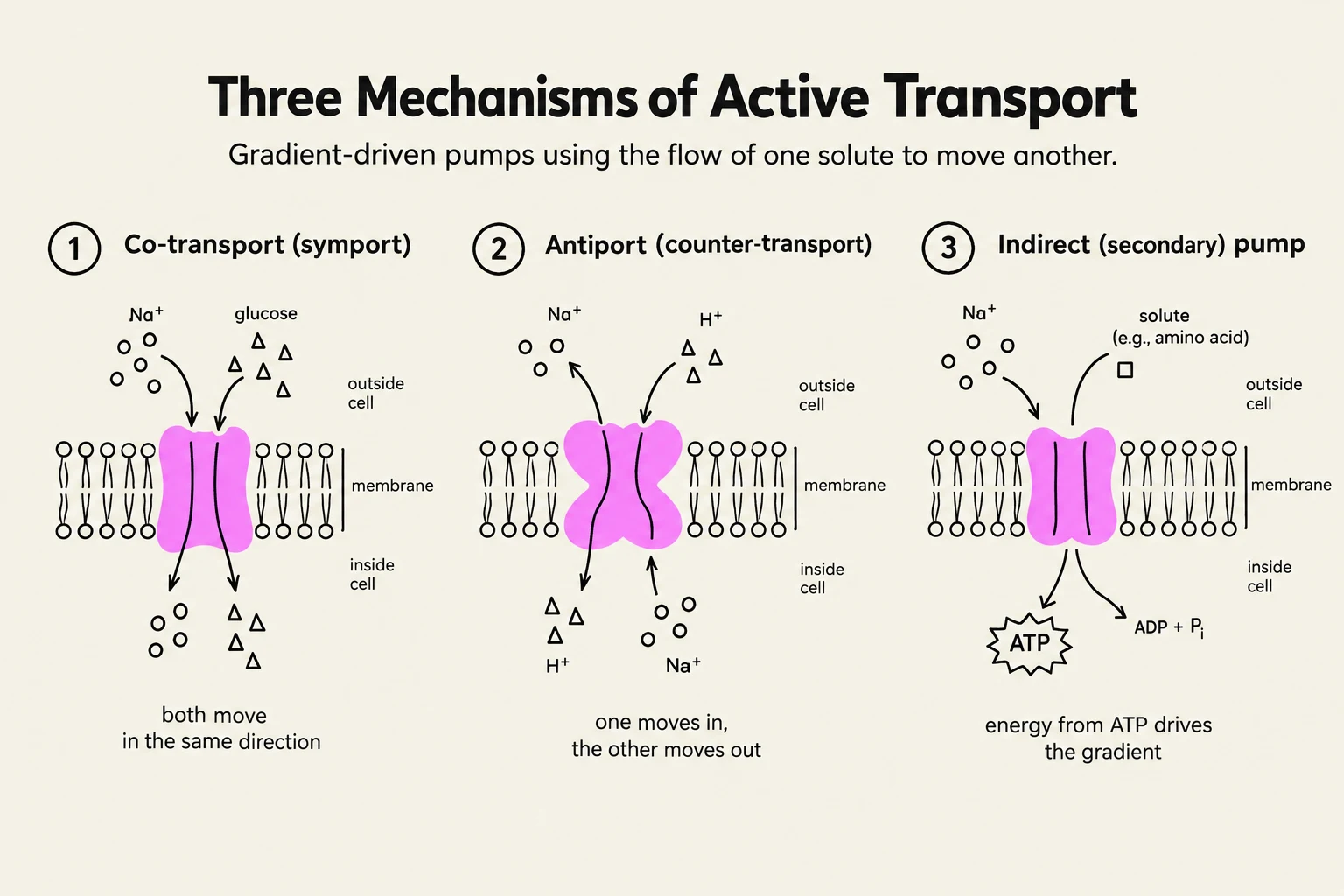
Transmembrane pumps are responsible for active transport, a process that moves solutes "uphill" against their electrochemical gradients. Moving a molecule from an area of low concentration to an area of high concentration requires an input of energy.
Most pumps harness this energy through ATP hydrolysis, the chemical breakdown of adenosine triphosphate (ATP) into ADP and inorganic phosphate. This energy release triggers conformational changes in the protein, physically pushing the solute across the membrane.
Diversity in Pump Mechanisms
The specific "currency" used to create gradients varies across the tree of life:
- Animal Cells: The most critical pump is the - ATPase (the sodium-potassium pump). It uses ATP to export three ions and import two ions per cycle. This creates a steep gradient that can then be used by symports—secondary active transporters—to pull in nutrients like glucose.
- Plants, Fungi, and Bacteria: Rather than relying on sodium, these organisms primarily utilize pumps. By pumping protons () out of the cell, they establish an electrochemical gradient that drives the import of sugars and amino acids via symports.
- Organelles: Pumps are also used internally. For example, ATP-dependent pumps in animal lysosomes maintain the acidic environments necessary for digestion.
Keep reading for free.
Create an account to finish this reading and make it part of your study routine.
Continue reading freeAlready have an account? Log in
Updated