Transition Metal Ions: Charge Patterns and Roman Numeral Nomenclature
Learn about the variable oxidation states of transition metals and how to name their ions using the Stock System with Roman numerals. This guide covers common pitfalls and provides examples for compounds with monatomic and polyatomic ions.
In the study of chemistry, the elements are often categorized by their predictable behavior. Group 1 and Group 2 metals, for instance, almost always form ions with a +1 or +2 charge, respectively. However, as we move into the center of the periodic table—the d-block—we encounter the transition metals. These elements are far more "flexible" in their chemical personalities. Unlike their neighbors, transition metals can exist in multiple oxidation states, meaning a single element can form several different types of ions depending on the chemical environment.
The Nature of Variable Oxidation States
The defining characteristic of transition metals is their ability to lose different numbers of electrons from their outer shells. This occurs because the energy levels of the $4s$ and $3d$ orbitals are very close to one another. When a transition metal reacts, it can lose electrons from both the s and d subshells, leading to a variety of possible positive charges, known as oxidation states.
For example, Iron (Fe) is a classic case. It can exist as Fe2+ (the ferrous ion) or Fe3+ (the ferric ion). Manganese (Mn) is even more versatile, capable of displaying oxidation states ranging from +2 all the way to +7 in certain compounds. This variability is what allows transition metals to act as powerful catalysts in industrial processes and biological systems.
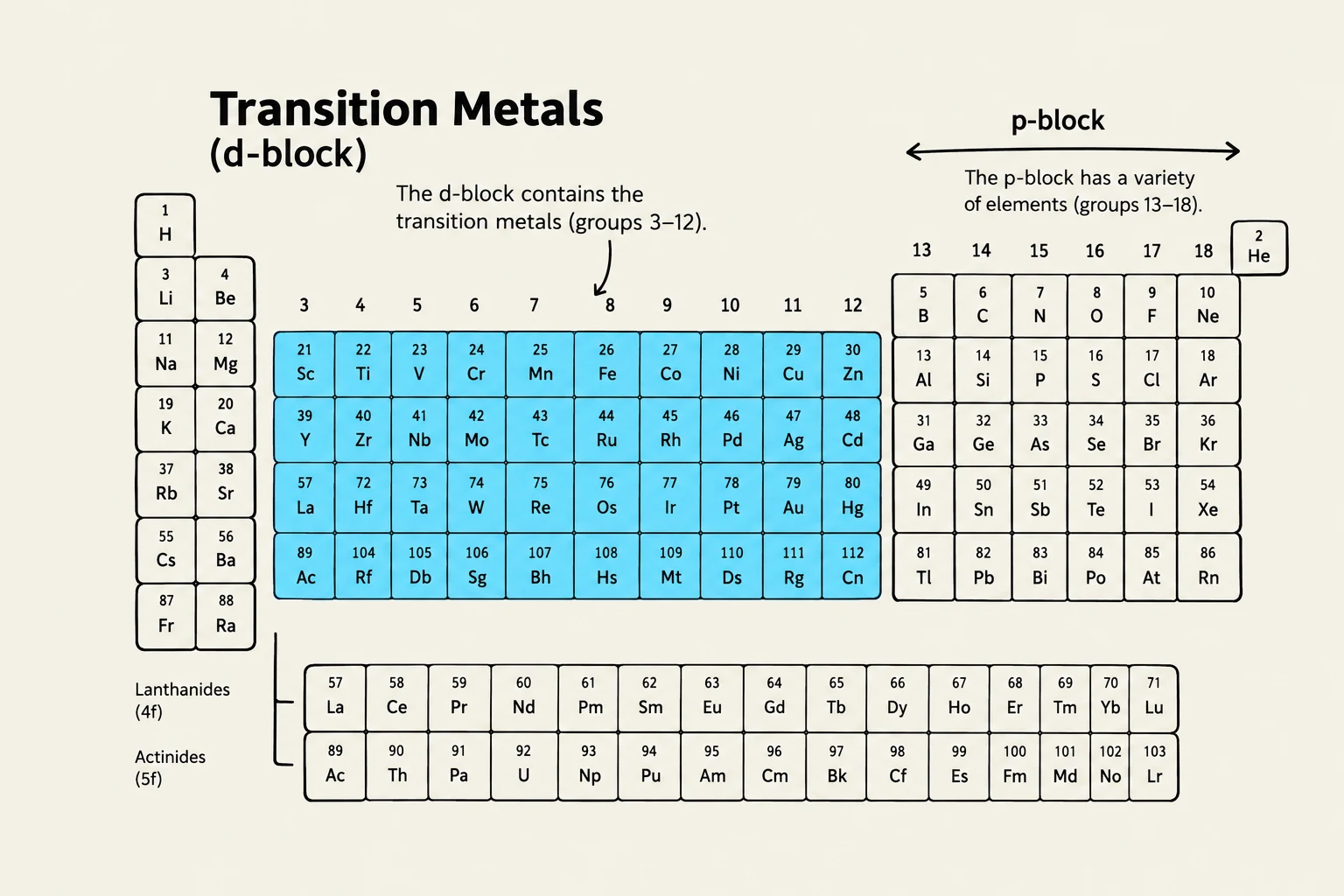
A periodic table showing the transition metals (d-block), lanthanides, and actinides.
Exam Tip: When you see a transition metal in a chemical formula, never assume its charge is the same as the metals in Group 1 or 2. You must use the known charge of the anion (the negative part) to calculate the metal's charge.
Naming with Roman Numerals (Stock System)
Because a single element can form multiple ions, simply saying "Iron Chloride" is ambiguous. Does it mean FeCl2 or FeCl3? To solve this ambiguity, chemists use the Stock System, which employs Roman numerals in parentheses immediately following the metal's name.
The Roman numeral represents the specific charge (oxidation state) of the metal ion in that particular compound.
Rules for Nomenclature:
Identify the Metal: Determine which element is the cation (the positive part).
Determine the Charge: Use the known charge of the anion to find the "missing" charge of the metal.
Convert to Roman Numerals: Translate that charge into a Roman numeral (I, II, III, IV, etc.).
Combine: Write the name of the metal, followed by the Roman numeral in parentheses, then the name of the anion.
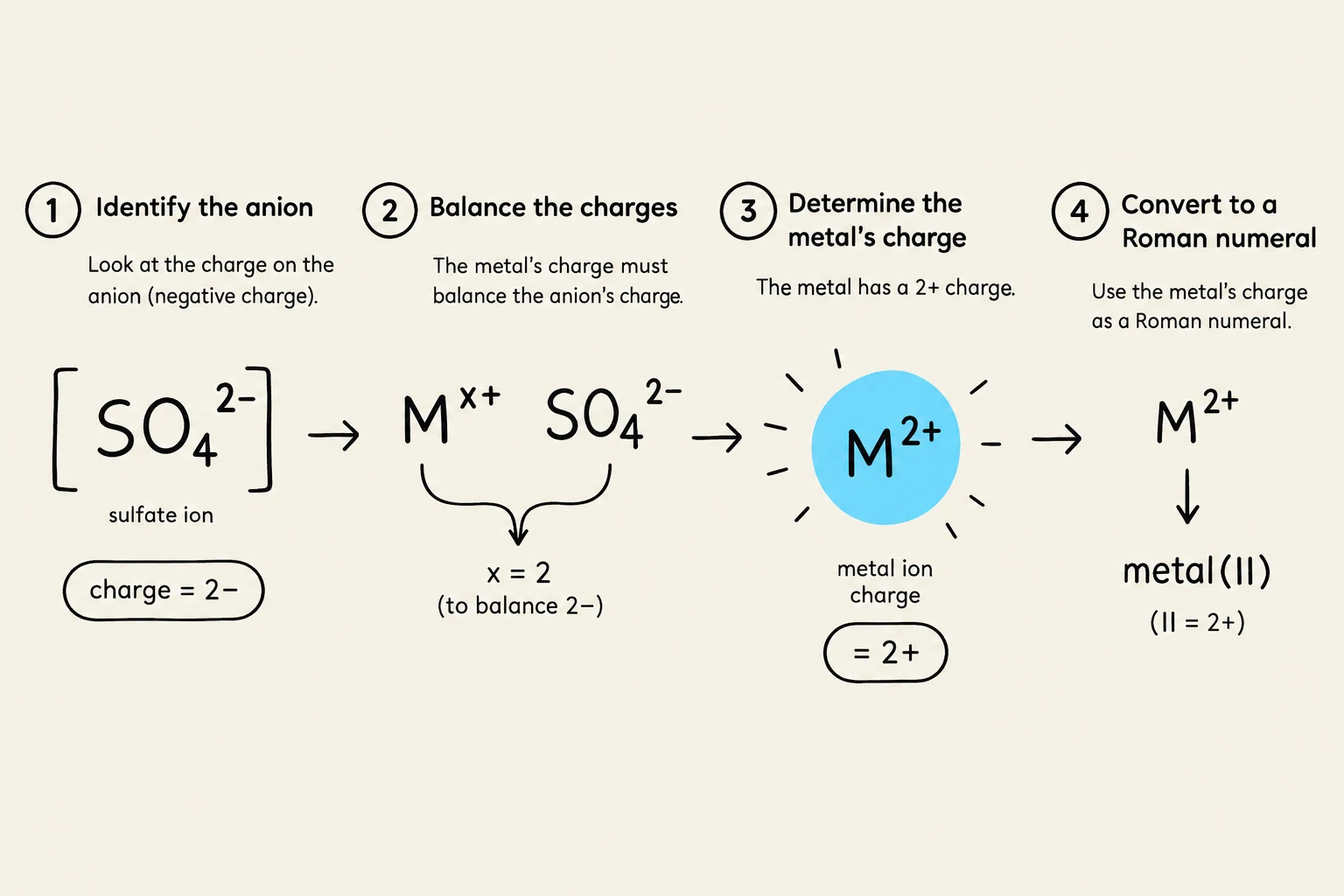
This diagram illustrates the process of determining the charge of a metal ion based on the charge of the anion it is bonded with, and then converting that charge into Roman numeral notation.
Worked Example 1: Copper and Oxygen
Suppose you are looking at the compound Cu2O.
Step 1: The metal is Copper (Cu).
Step 2: Oxygen (O) almost always has a charge of −2. Since there are two oxygen atoms, the total negative charge is:
2⋅(−2)=−4
Step 3: To make the compound neutral, the two Copper atoms must provide a total positive charge of +4.
Step 4: Divide the total charge by the number of copper atoms:
2+4=+2
Step 5: The charge of a single Copper ion is +2. Therefore, the name is Copper(II) oxide.
Common Pitfalls and Exceptions
While the Roman numeral system is highly effective, students often run into trouble when dealing with polyatomic ions or when they miscalculate the total charge.
Polyatomic Ions
A polyatomic ion is a group of atoms that acts as a single unit with a specific charge. When naming transition metal compounds containing polyatomic ions, the process remains the same, but you must be careful to account for the entire group's charge.
Example: Fe2(SO4)3
The sulfate ion (SO4) has a charge of −2.
There are three sulfate ions, so the total negative charge is:
3⋅(−2)=−6
The two Iron atoms must balance this with a total charge of +6.
Each Iron atom has a charge of:
2+6=+3
The name is Iron(III) sulfate.
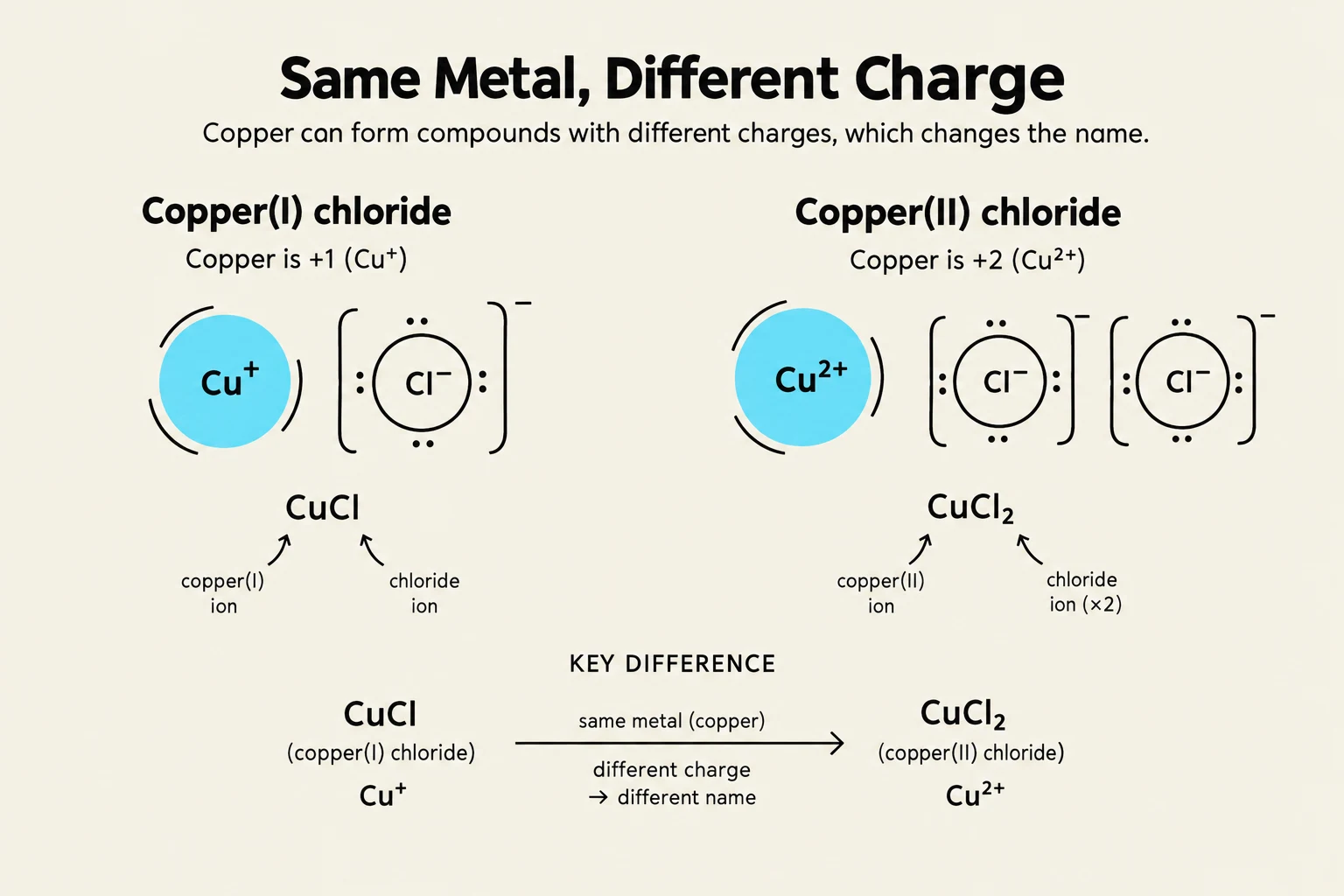
This diagram illustrates how copper can form compounds with different charges, leading to different chemical names and formulas, such as Copper(I) chloride (CuCl) and Copper(II) chloride (CuCl2).
Caution: Do not confuse the Roman numeral with the number of atoms in the formula. In FeCl3, the "3" is a subscript indicating the number of chlorine atoms, but the Roman numeral in the name Iron(III) chloride indicates the charge of the iron ion.
Summary Table of Common Transition Metal Ions
To aid your studies, it is helpful to memorize the most common ions you will encounter in introductory chemistry:
Metal
Common Ions
Roman Numeral Names
Iron (Fe)
Fe2+,Fe3+
Iron(II), Iron(III)
Copper (Cu)
Cu+,Cu2+
Copper(I), Copper(II)
Lead (Pb)
Pb2+,Pb4+
Lead(II), Lead(IV)
Tin (Sn)
Sn2+,Sn4+
Tin(II), Tin(IV)
By mastering the relationship between the d-block's electronic structure and the resulting charge patterns, you can navigate the complexities of inorganic nomenclature with confidence.
Keep reading for free.
Create an account to finish this reading and make it part of your study routine.