This content explains transcriptional regulation in microorganisms, focusing on how repressors and activators control gene expression in response to environmental signals. It details induction, repression, and activation mechanisms, including the roles of inducers and corepressors.
Microorganisms live in constantly changing environments. To survive, they must be able to turn specific genes on or off depending on what nutrients are available or what stressors they encounter. This ability to control gene expression is known as transcriptional regulation.
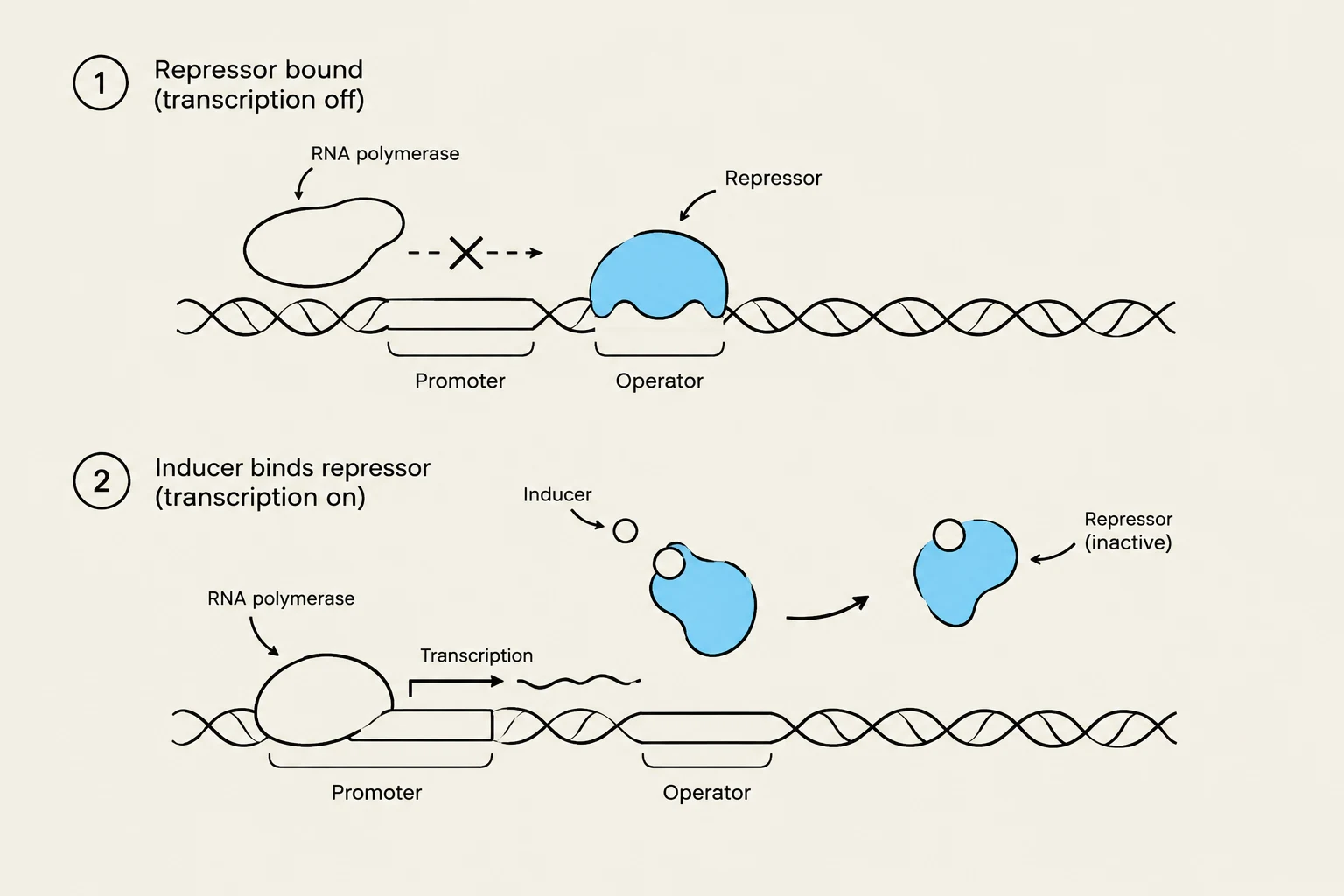
This diagram illustrates the process of gene regulation in bacteria. In the first step, a repressor protein binds to the operator region of the DNA, preventing RNA polymerase from transcribing the gene, thus turning transcription off. In the second step, an inducer molecule binds to the repressor, causing it to change shape and detach from the operator. This allows RNA polymerase to bind to the promoter and initiate transcription, turning transcription on.
At its core, transcriptional regulation is about controlling access to the DNA. The primary enzyme responsible for reading DNA to create RNA is RNA polymerase. For transcription to occur, RNA polymerase must successfully bind to a specific DNA sequence called the promoter. Regulatory proteins can either block this binding or facilitate it, acting as molecular switches that respond to chemical signals in the cell.
The Role of Repressors: Induction and Repression
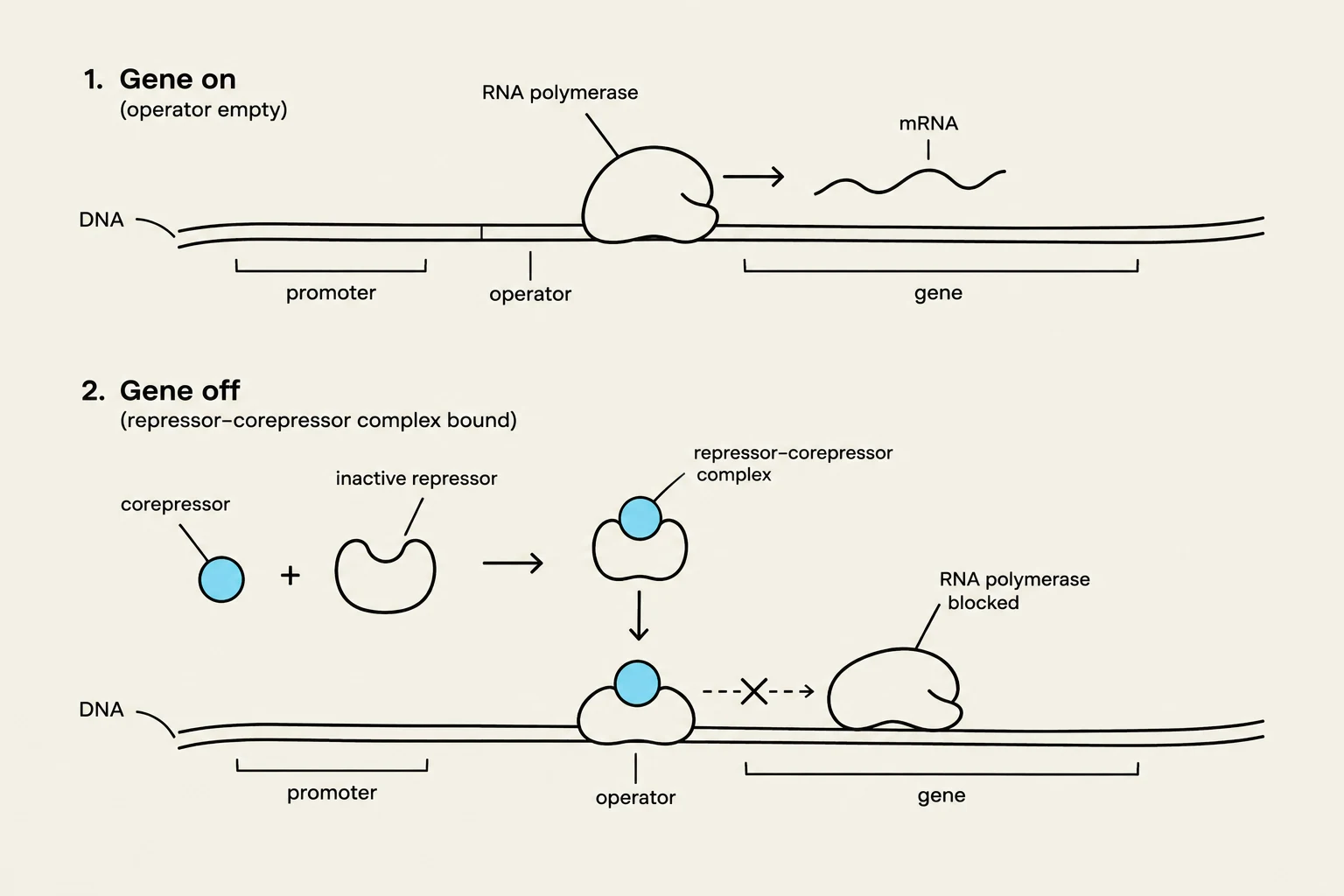
Diagram illustrating the regulation of gene expression, showing how RNA polymerase transcribes a gene when the operator is empty (gene on) and how a repressor-corepressor complex blocks transcription when bound to the operator (gene off).
One of the most common ways bacteria regulate genes is through the use of repressors. A repressor is a protein that binds to a specific DNA sequence called the operator, which is typically located near or overlapping the promoter. When a repressor is bound to the operator, it physically blocks RNA polymerase from moving forward, effectively "turning off" the gene.
Depending on how the repressor responds to environmental molecules, we categorize these systems into two types: induction and repression.
1. Induction (Turning Transcription "On")
In an inducible system, the gene is normally "off" because the repressor is actively bound to the operator, preventing transcription.
To turn the gene "on," the cell requires an inducer—a specific molecule that signals a change in the environment. When the inducer enters the cell, it binds directly to the repressor. This binding causes a conformational change (a change in shape) in the repressor protein, making it unable to hold onto the operator. Once the repressor falls off, the DNA is "open," and RNA polymerase can proceed with transcription.
Figure 7.23: The Role of Repressors in Transcriptional Regulation (a) Induction and (b) Repression.
2. Repression (Turning Transcription "Off")
In a repressible system, the logic is reversed: the gene is normally "on". In this state, the repressor protein is produced in an inactive form that cannot bind to the operator on its own. Because the operator is empty, RNA polymerase can bind to the promoter and transcribe the gene freely.
Transcription is turned "off" when a corepressor is present. The corepressor binds to the inactive repressor, forming a corepressor-repressor complex. This complex has a new shape that allows it to bind tightly to the operator, creating a physical roadblock that stops RNA polymerase.
Exam Tip: Inducer vs. Corepressor
While both molecules change the shape of a regulatory protein, they have opposite effects on transcription. An inducer turns transcription on by removing a repressor, whereas a corepressor turns transcription off by enabling a repressor to bind.
Transcriptional Regulation by Activators
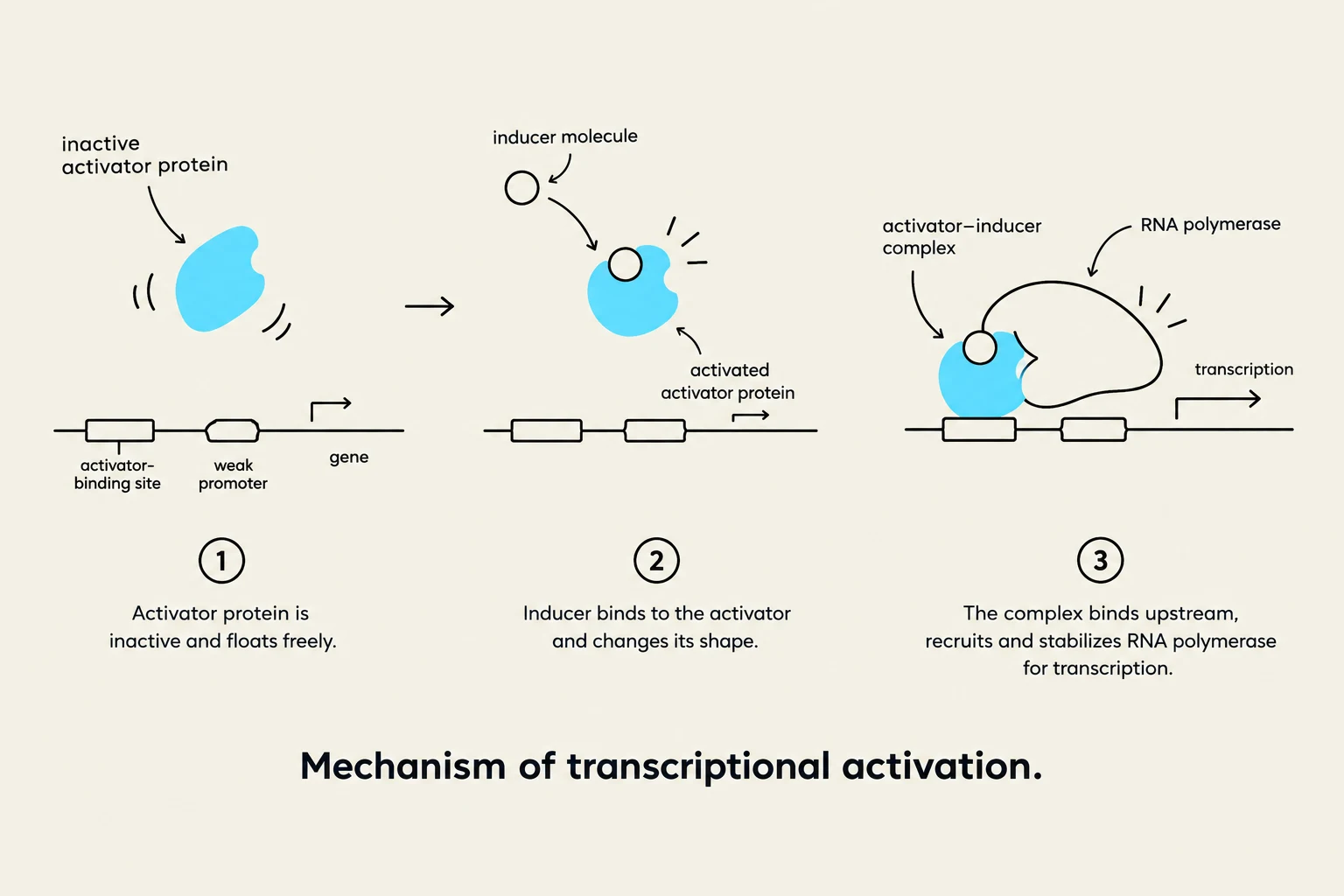
This diagram illustrates the mechanism of transcriptional activation, showing how an inactive activator protein binds to an inducer molecule, forming a complex that then recruits RNA polymerase to initiate transcription.
Not all regulation works by blocking RNA polymerase. Some systems require help to get the enzyme to the DNA in the first place. This is known as regulation by activators.
In these systems, the promoter is "weak," meaning the RNA polymerase has a very low affinity for it and cannot bind effectively on its own. Consequently, transcription is normally "off".
The process follows these steps:
Inactive State: The activator protein is present in the cell but is in an inactive conformation, meaning it cannot bind to the DNA.
Activation: An inducer molecule binds to the inactive activator.
Binding: The binding of the inducer changes the activator's shape into an active activator. This active protein can now bind to a specific activator-binding site located just upstream of the promoter.
Transcription: Once the activator is bound to the DNA, it facilitates the recruitment or binding of RNA polymerase to the promoter, initiating transcription.
Figure 7.24: Transcriptional Regulation by Activators.
Summary Table of Regulatory Mechanisms
To help visualize the differences, refer to the table below summarizing how these components interact:
Mechanism
Default State
Regulatory Protein
Signal Molecule
Effect of Signal
Induction
Off
Repressor
Inducer
Removes Repressor (Turns ON)
Repression
On
Repressor
Corepressor
Enables Repressor (Turns OFF)
Activation
Off
Activator
Inducer
Enables Activator (Turns ON)
Study Question for ReviewHow do activators facilitate transcription?Answer: They bind to a specific site upstream of the promoter after being activated by an inducer, which helps RNA polymerase bind to the promoter more effectively.
Keep reading for free.
Create an account to finish this reading and make it part of your study routine.