Thermodynamics of Exergonic and Endergonic Reactions
Explains the fundamental concepts of Gibbs free energy, exergonic and endergonic reactions, and their relationship to equilibrium constants in chemical thermodynamics.
In the study of biochemistry, understanding why certain reactions occur spontaneously while others require an input of energy is fundamental. This distinction is governed by the laws of thermodynamics, specifically through the concept of Gibbs free energy. By analyzing the free energy change (ΔG), we can predict the direction of a chemical reaction and its eventual equilibrium state.
The Concept of Free Energy Change (ΔG)
The driving force behind chemical transformations is the change in free energy, denoted as ΔG. In thermodynamics, ΔG represents the amount of energy available in a system to do work at a constant temperature and pressure.
A crucial property of ΔG is that it is a state function. This means that the free energy change of a reaction depends only on the free energy difference between the reactants (substrates) and the products, regardless of the specific pathway or mechanism the reaction takes to get there.
Important Distinction: While ΔG tells us if a reaction can happen (spontaneity), it provides absolutely no information about how fast the reaction will occur (rate). For speed, one must look at kinetics and activation energy, not thermodynamics.
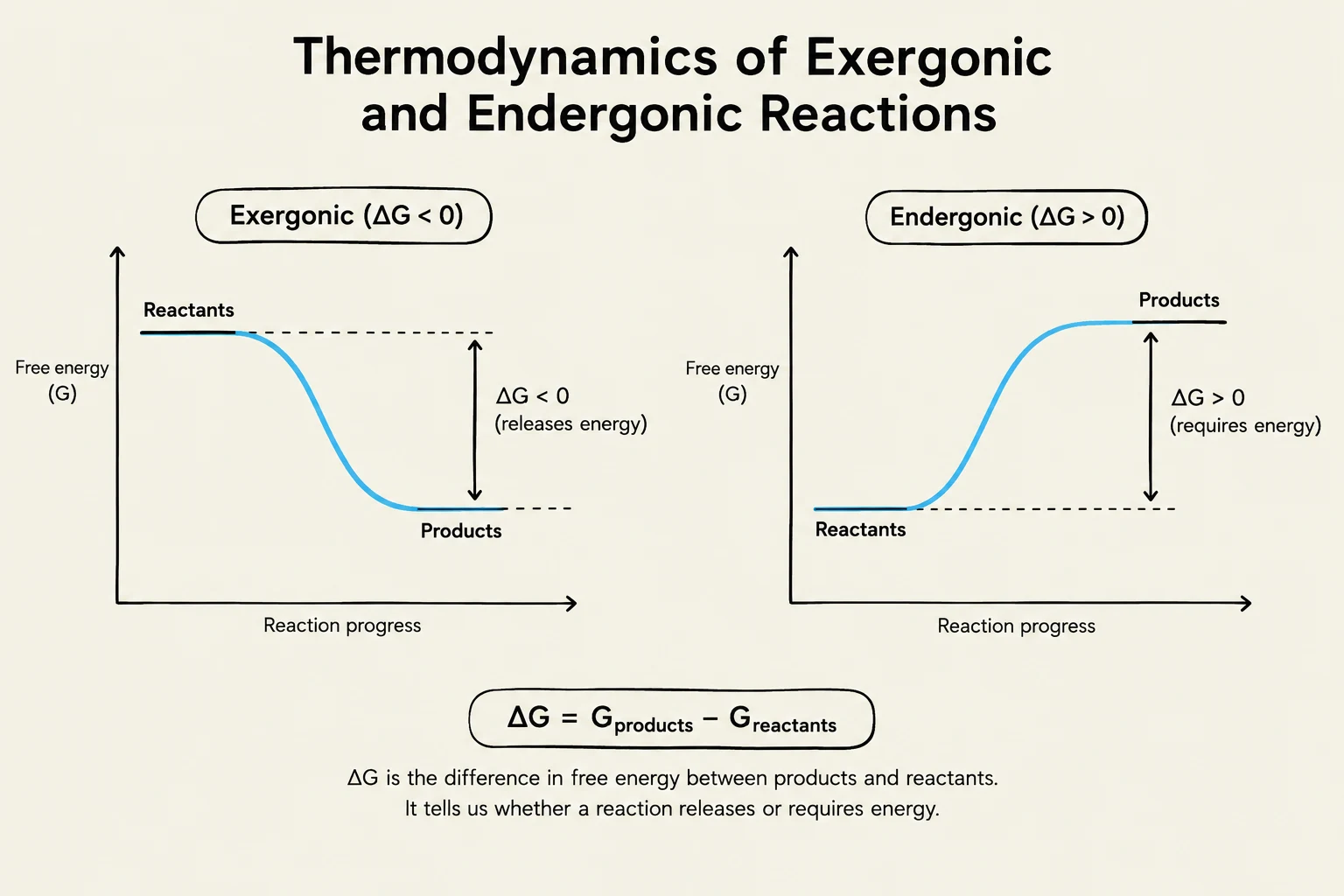
This diagram illustrates the thermodynamics of exergonic and endergonic reactions, showing how free energy changes with reaction progress. Exergonic reactions (ΔG < 0) release energy, while endergonic reactions (ΔG > 0) require energy. The change in free energy (ΔG) is defined as the difference between the free energy of products and reactants.
Exergonic vs. Endergonic Reactions
Chemical reactions are categorized into two main types based on the sign of their free energy change:
1. Exergonic Reactions
An exergonic reaction is one in which the free energy of the products is lower than the free energy of the reactants, resulting in a negativeΔG (ΔG<0). Because energy is released, these reactions occur spontaneously without the need for an external energy input.
2. Endergonic Reactions
Conversely, an endergonic reaction is one where the products have more free energy than the reactants, resulting in a positiveΔG (ΔG>0). These reactions are non-spontaneous and require an input of energy to proceed.
Standard Free Energy and Concentration Effects
In laboratory settings, we often refer to the standard free energy change, denoted as ΔG∘. In biochemistry, we specifically use ΔG∘′ to represent the standard free energy change at a physiological pH of 7.
However, the actual free energy change (ΔG) in a living cell is not always equal to the standard free energy change. ΔG fluctuates based on the actual concentrations of the reactants and products present in the environment. The relationship is defined by the following equation:
ΔG=ΔG∘′+RTln[Reactants][Products]
Where:
R is the gas constant.
T is the absolute temperature (in Kelvin).
The brackets […] denote the molar concentration of the species.
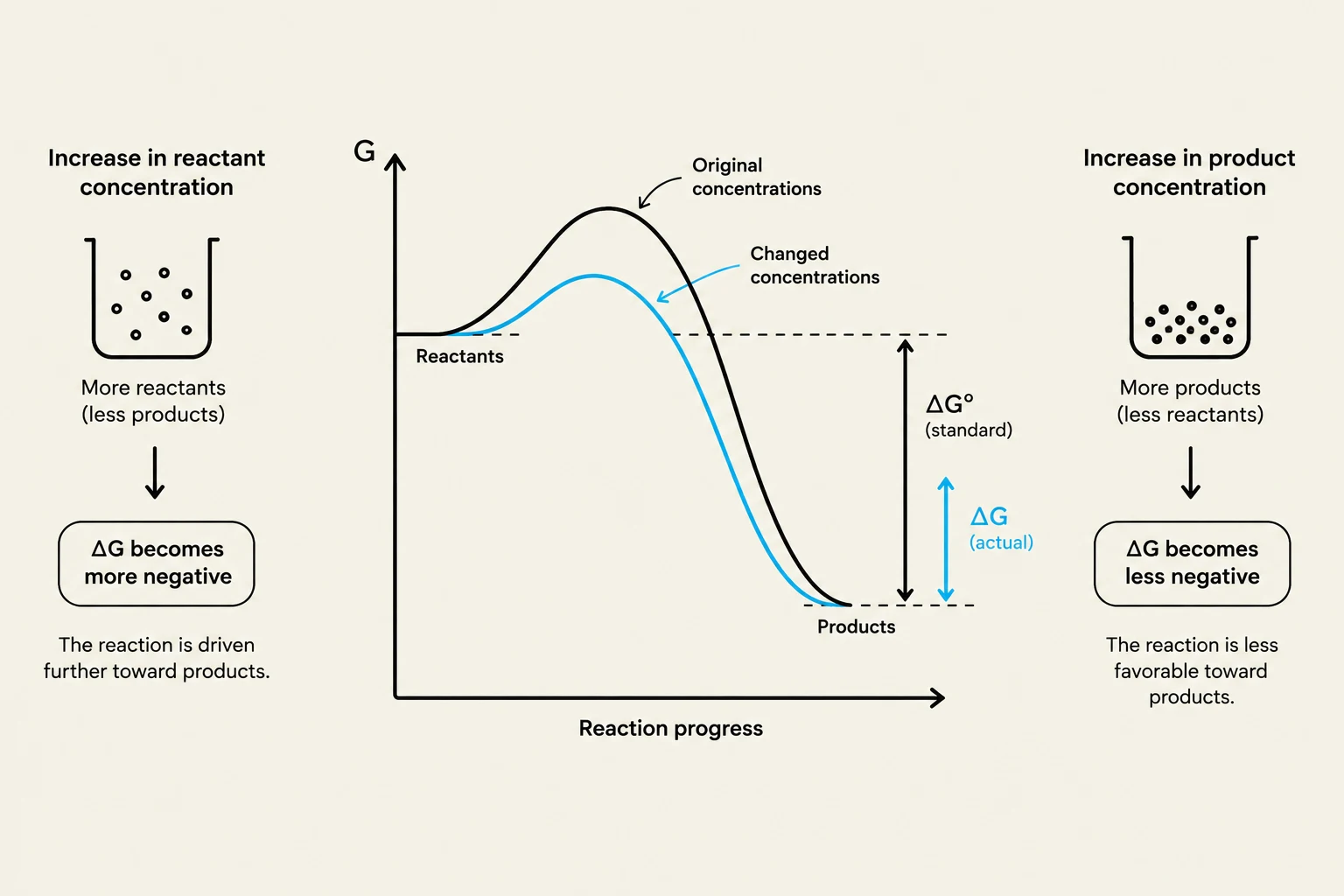
This diagram illustrates how changes in reactant and product concentrations affect the Gibbs free energy change (ΔG) of a reaction. An increase in reactant concentration makes ΔG more negative, driving the reaction towards products. Conversely, an increase in product concentration makes ΔG less negative, making the reaction less favorable towards products.
Equilibrium and the Equilibrium Constant (Keq)
As a reaction proceeds, the concentrations of reactants and products change, which in turn changes the ΔG. Eventually, the system reaches a state of equilibrium, where there is no net change in the amount of reactant or product. At this specific point, the free energy change is zero:
ΔG=0
The relationship between the standard free energy change (ΔG∘′) and the equilibrium constant (Keq′) is a cornerstone of chemical thermodynamics. At equilibrium, the equation simplifies to:
ΔG∘′=−RTlnKeq′
From this relationship, we can derive several critical insights regarding the direction of reactions:
Highly Exergonic Reactions: If a reaction is very exergonic (large negative ΔG∘′), the equilibrium constant Keq′ will be very large (Keq′>1), meaning the reaction favors the formation of products.
Highly Endergonic Reactions: If a reaction is very endergonic (large positive ΔG∘′), the equilibrium constant Keq′ will be very small (Keq′<1), meaning the reaction favors the reactants.
Summary Table: Relationship between ΔG∘′ and Keq′
The following table illustrates how the magnitude of the equilibrium constant scales with the standard free energy change at 25∘C:
Keq′
ΔG∘′ (kJ/mol)
ΔG∘′ (kcal/mol)
10−5
28.53
6.82
10−1
5.69
1.36
1
0
0
101
−5.69
−1.36
105
−28.53
−6.82
Exam Tip: Remember that enzymes do not change the ΔG of a reaction. They only speed up the rate at which equilibrium is reached by lowering the activation energy. They cannot make a non-spontaneous reaction spontaneous!
Keep reading for free.
Create an account to finish this reading and make it part of your study routine.