An overview of key theories explaining human motivation, including Self-Determination Theory, Achievement Goal Theory, and Competence Motivation Theory, and their application to behavior change.
Motivation is a dynamic process that governs both the initiation and the continuation of goal-directed activities. In the context of physical activity and sport, motivation is characterized by three key dimensions: direction (the specific goals or situations a person seeks out), intensity (the amount of effort applied), and persistence (the ability to maintain that effort over time).
To understand why people engage in—or abandon—certain behaviors, psychologists have developed several frameworks. While some models focus on external rewards or rational decision-making, others delve into the internal psychological needs and cognitive orientations that drive human behavior. This article explores the most influential theories used to explain motivation and behavior change.
Self-Determination Theory (SDT)
Self-Determination Theory (SDT) is a global theory of human motivation and development. It posits that humans have innate tendencies toward growth and that the quality of our motivation depends on the satisfaction of three basic psychological needs:
Autonomy: The feeling that one has choice and control over their own behavior and is the initiator of their actions.
Competence: The need to feel capable, effective, and to have a sense of mastery over one's environment and tasks.
Relatedness: The need to feel a sense of belonging, connection, and social support from others.
When these needs are met, individuals experience high-quality, autonomous motivation. When these needs are "thwarted" (blocked or ignored), it can lead to frustration and decreased engagement.
The Motivational Continuum
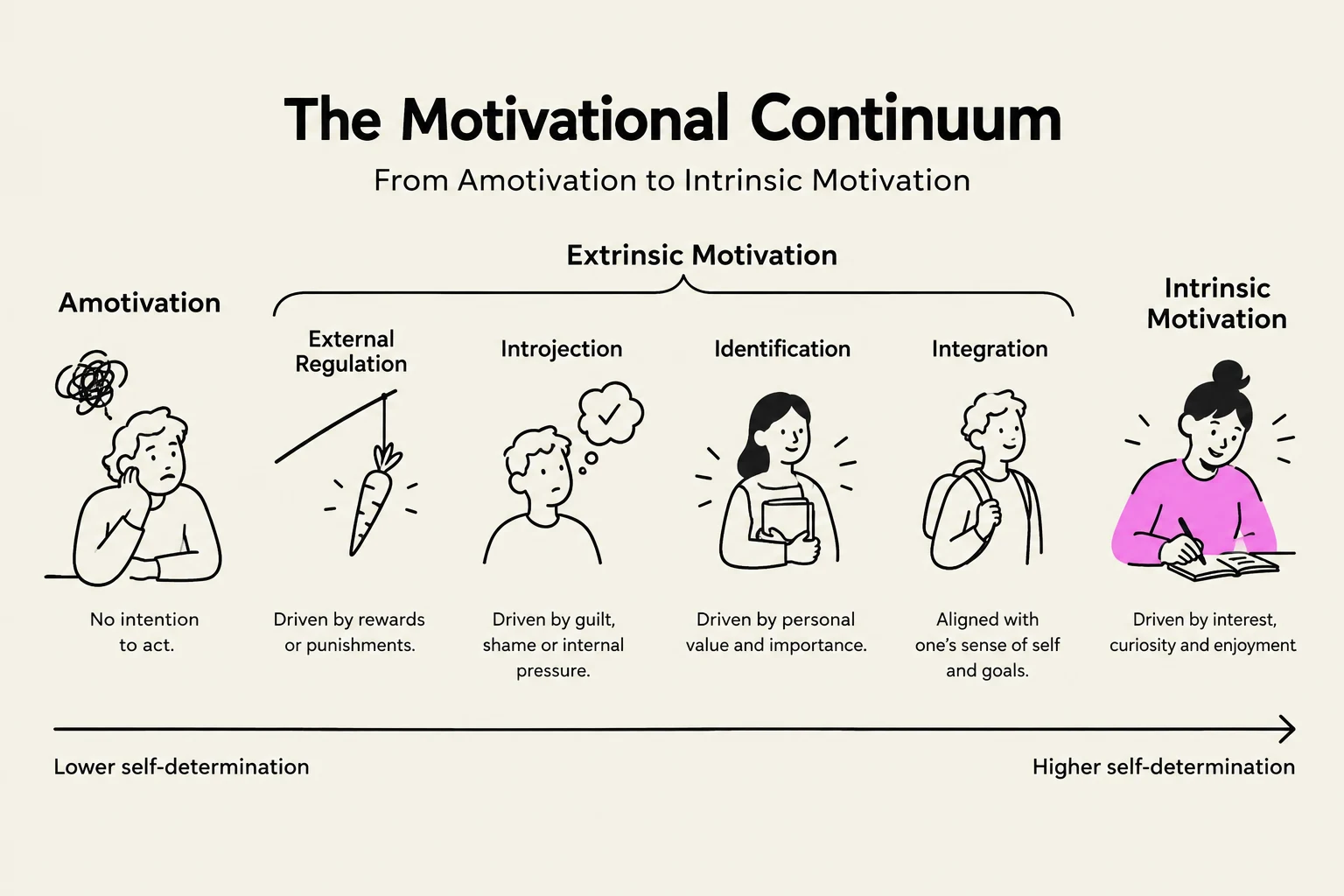
SDT suggests that motivation is not a simple "on/off" switch but exists on a continuum ranging from amotivation to intrinsic motivation:
Amotivation: A complete lack of intention to act.
Extrinsic Motivation: Behavior performed to achieve an external outcome. This includes external regulation (to get a reward), introjected regulation (to avoid guilt), identified regulation (because it is personally important), and integrated regulation (because it aligns with one's core identity).
Intrinsic Motivation: Behavior undertaken for its inherent satisfaction, interest, or enjoyment.
The motivational continuum illustrates the spectrum from amotivation to intrinsic motivation, with various stages of extrinsic motivation in between, each associated with different levels of self-determination.
Exam Tip: If a question asks about a student exercising solely to avoid feeling guilty about their health, they are demonstrating introjected regulation, a form of extrinsic motivation.
Achievement Goal Theory (AGT)
While SDT focuses on the quality of motivation, Achievement Goal Theory (AGT) explains how a person's definition of success influences their behavior. According to AGT, individuals generally adopt one of two primary orientations:
Task-orientation: Success is defined by self-improvement and personal skill development.
Ego-orientation: Success is defined by outperforming others.
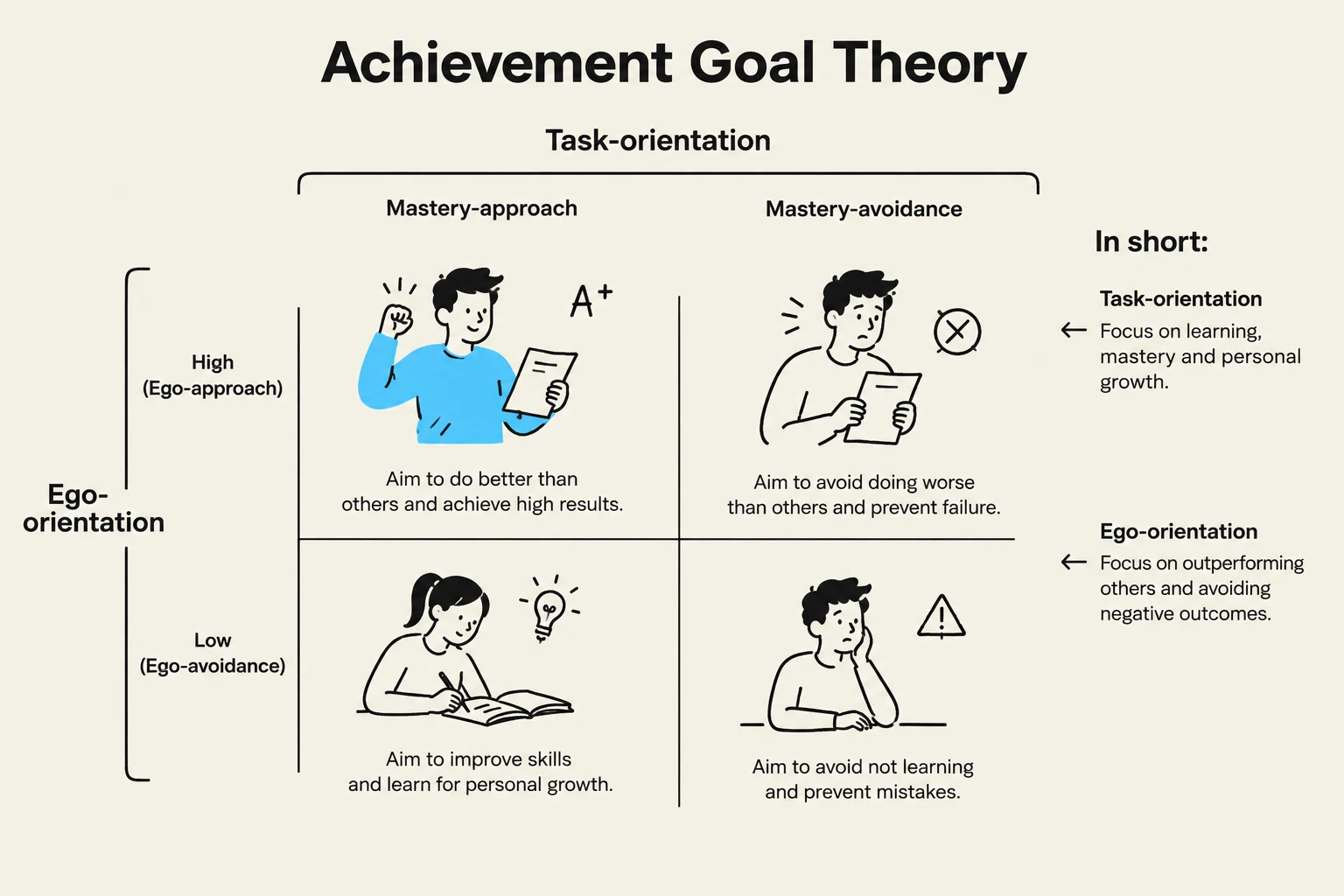
These orientations can be further broken down into a 2x2 framework involving "approach" (seeking success) and "avoidance" (avoiding failure) goals:
Goal Type
Focus
Description
Mastery-approach
Task
Focuses on developing skills and improving oneself.
Mastery-avoidance
Task
Aims to avoid demonstrating incompetence in learning.
Performance-approach
Ego
Strives to demonstrate superior ability relative to peers.
Performance-avoidance
Ego
Seeks to avoid demonstrating incompetence compared to others.
The environment in which a person operates—the motivational climate—plays a crucial role. A mastery/task-involving climate emphasizes effort and cooperation, whereas a performance/ego-involving climate emphasizes winning and social comparison.
This diagram illustrates Achievement Goal Theory, categorizing goal orientations into Task-orientation and Ego-orientation, each with mastery-approach and mastery-avoidance sub-types, and their associated aims.
Competence Motivation Theory
Competence Motivation Theory proposes that people are driven to participate in activities where they feel capable. The core of this theory is perceived competence—the individual's belief in their own ability.
Two critical components of this theory are:
Optimal Challenge: Motivation is highest when tasks are neither too easy (leading to boredom) nor too difficult (leading to frustration).
Feedback and Reinforcement: Perceptions of competence are shaped by feedback from "significant others," such as coaches or parents.
To apply this, practitioners should design tasks that provide an optimal challenge and offer specific, positive feedback that highlights progress.
Non-Conscious Processes and Dual-Process Models
Not all motivation and behavior are the result of deliberate, conscious thought. Non-conscious processes models explain that behavior is often driven by automatic responses. These are explained through dual-process models, which distinguish between two systems of thinking:
System 1 (Automatic/Type 1): Fast, effortless, and unintentional processing. This is the mode of "automaticity" that elite athletes often achieve.
System 2 (Reflective/Type 2): Slow, effortful, and intentional processing that requires working memory and deliberate decision-making.
The default-interventionist framework suggests that System 1 is our default mode, and System 2 only "intervenes" when we encounter something novel or complex. Understanding this allows for the creation of environments where exercise becomes a "habit"—an automatic, System 1 response.
Worked Example: A professional tennis player hitting a serve without thinking about the mechanics is using System 1 (automaticity). However, if they are trying a brand-new technique in a practice session, they must switch to System 2 (reflective) to consciously control their movements.
Summary of Applications
Theory
Key Application Strategy
Self-Determination
Support autonomy by offering choices and promote relatedness through teamwork.
Achievement Goal
Promote a task-involving climate by rewarding effort rather than just winning.
Competence Motivation
Assign challenging yet achievable tasks to maintain optimal challenge.
Non-Conscious Models
Design environments that turn physical activity into a natural, automatic habit.
Keep reading for free.
Create an account to finish this reading and make it part of your study routine.