Explores the fundamental differences between corrective justice (focused on victim compensation) and retributive justice (focused on offender punishment), illustrating their application in civil law (negligence) and criminal law (murder).
In the study of jurisprudence, the law is rarely just a collection of rules; it is a reflection of underlying philosophical beliefs about what is "fair." When a legal wrong occurs, the way the state or the courts respond is dictated by specific theories of justice. These theories provide the rationale for why we compensate victims in civil law and why we punish offenders in criminal law.
Understanding these theories is essential for analyzing legal premises—the foundational assumptions that lead to a specific legal conclusion. By examining the distinction between corrective and retributive justice, we can better understand the logic behind the tort of negligence and the crime of murder.
The Dual Pillars: Corrective vs. Retributive Justice
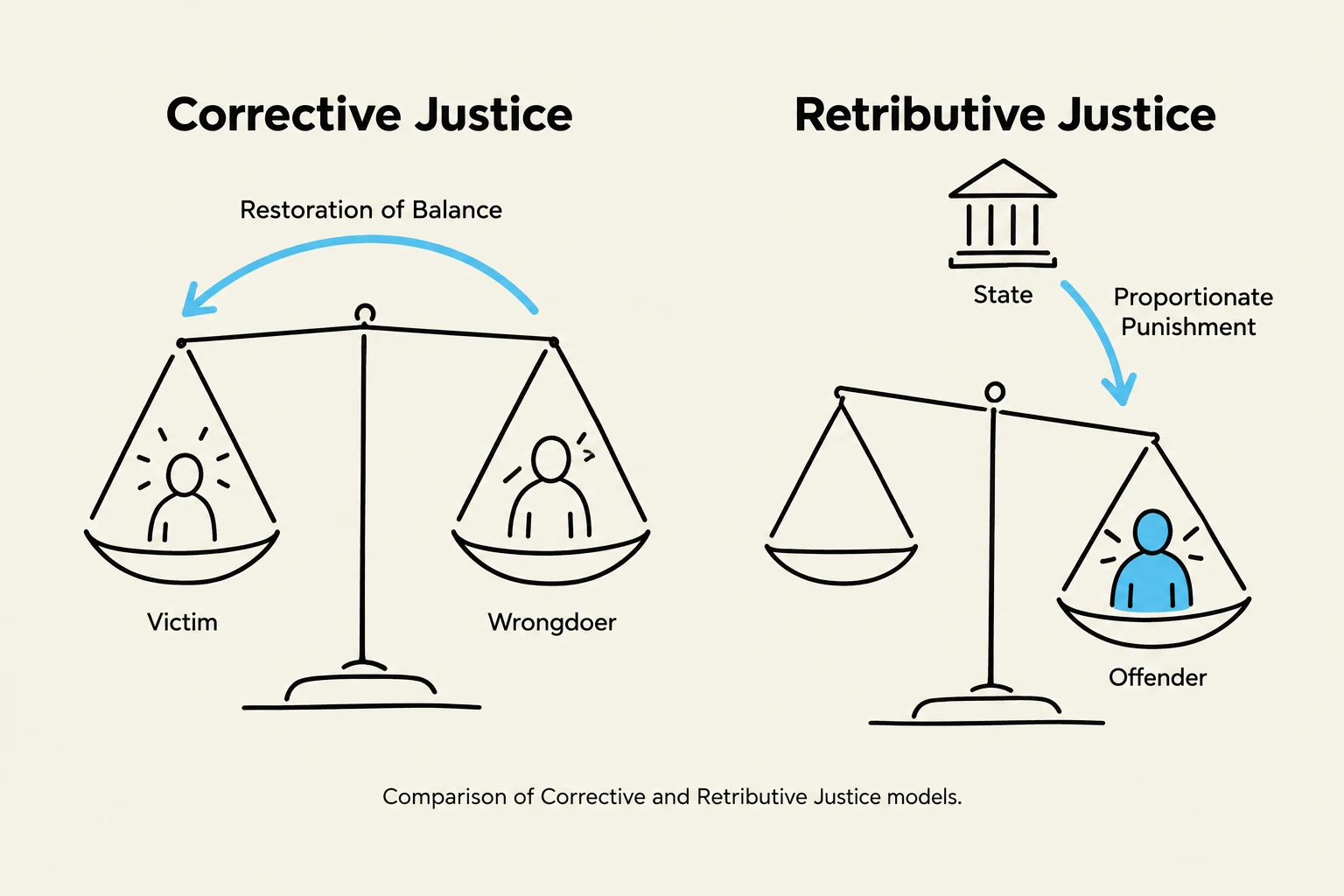
Comparison of Corrective and Retributive Justice models.
To navigate legal reasoning, one must first distinguish between the two primary models of justice: corrective and retributive.
Corrective Justice
Corrective justice is primarily concerned with the relationship between two specific parties: the wrongdoer and the victim. The goal is to restore the "balance" that was disturbed by the wrong. If Party A causes a loss to Party B, corrective justice seeks to return Party B to the position they would have been in had the wrong not occurred. This is the cornerstone of civil law and the law of torts.
Retributive Justice
Retributive justice shifts the focus from the victim to the offender and their moral culpability. It is not concerned with "fixing" the harm, but rather with ensuring that the offender receives a punishment that is proportionate to the gravity of their wrongdoing. This model is the driving force behind criminal law, operating on the principle of "moral desert"—the idea that an individual deserves to suffer a penalty because they have violated the social or moral order.
Study Tip: When analyzing a legal problem, ask yourself: "Is the goal of this legal rule to make the victim whole (Corrective), or to punish the wrongdoer (Retributive)?"
Application in Civil Law: The Tort of Negligence
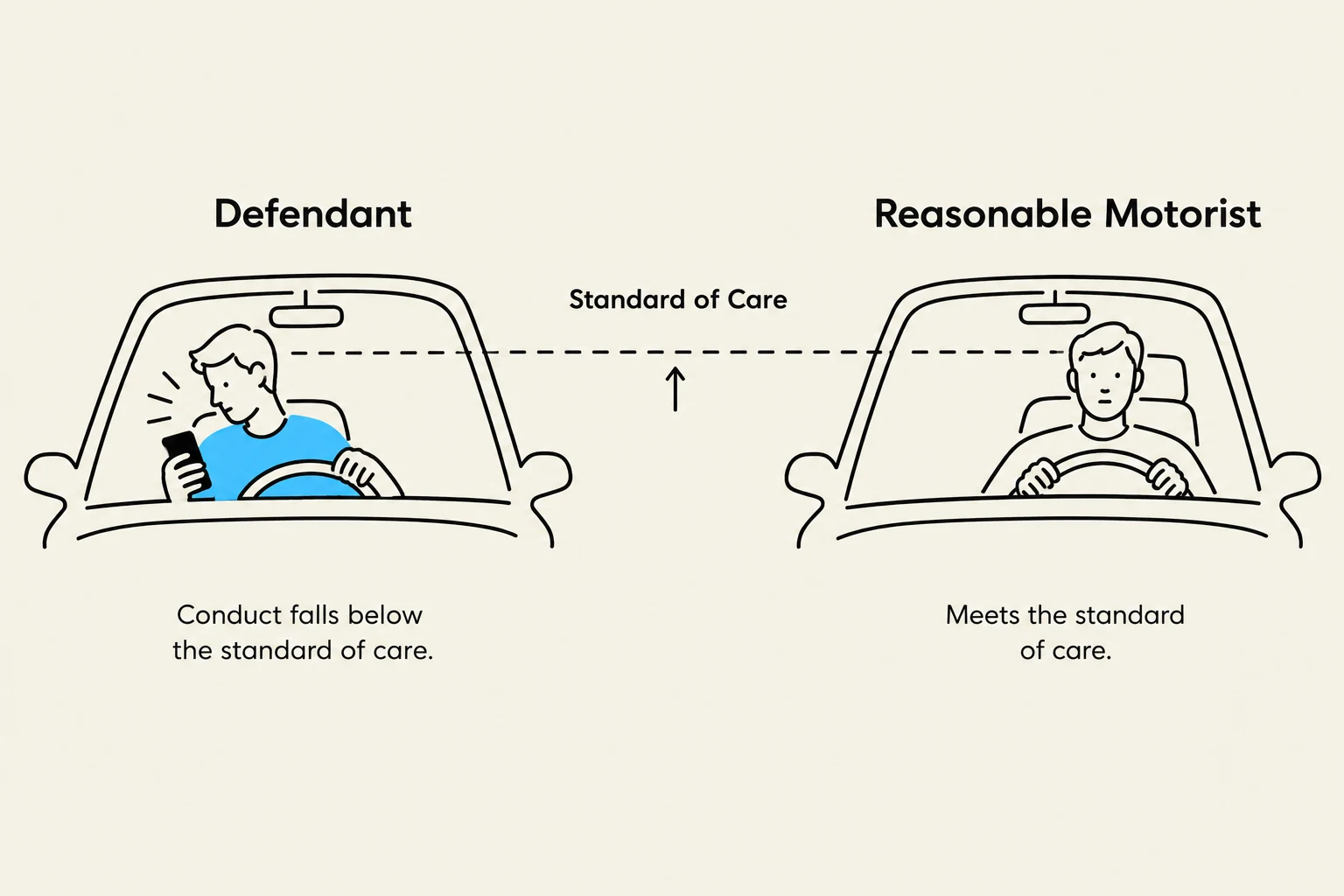
This illustration compares the conduct of a defendant driver, who is distracted by a phone, to that of a reasonable motorist, demonstrating the legal concept of the standard of care.
The tort of negligence provides a perfect case study for corrective justice. In many jurisdictions, a common scenario involves a motor vehicle accident (MVA).
Consider the following legal premise:
A defendant will be found to be negligent if their conduct falls below that of a reasonable motorist and, if the plaintiff suffers a loss as a result, the defendant must pay damages to the plaintiff.
The Role of the "Reasonable Motorist"
In this context, the "reasonable motorist" serves as the objective standard. We do not ask if the defendant thought they were being safe; we ask if their behavior matched what a prudent, careful driver would have done in the same circumstances. If the defendant's conduct falls below this standard, they have breached their duty of care.
Why Corrective Justice Applies
The premise that the defendant must pay damages is supported by corrective justice. The focus is on the "loss" suffered by the plaintiff. By transferring wealth from the negligent driver to the victim, the law "corrects" the imbalance caused by the accident.
What if we applied Retributive Theory here?
If a court applied a retributive model to a negligence case instead of a corrective one, the outcome would shift significantly. Instead of the primary goal being the compensation of the victim, the focus would turn to punishing the driver for their failure to meet the standard of care. This might result in the driver facing fines paid to the state or even imprisonment, regardless of whether the victim received any financial compensation for their injuries.
Application in Criminal Law: The Crime of Murder
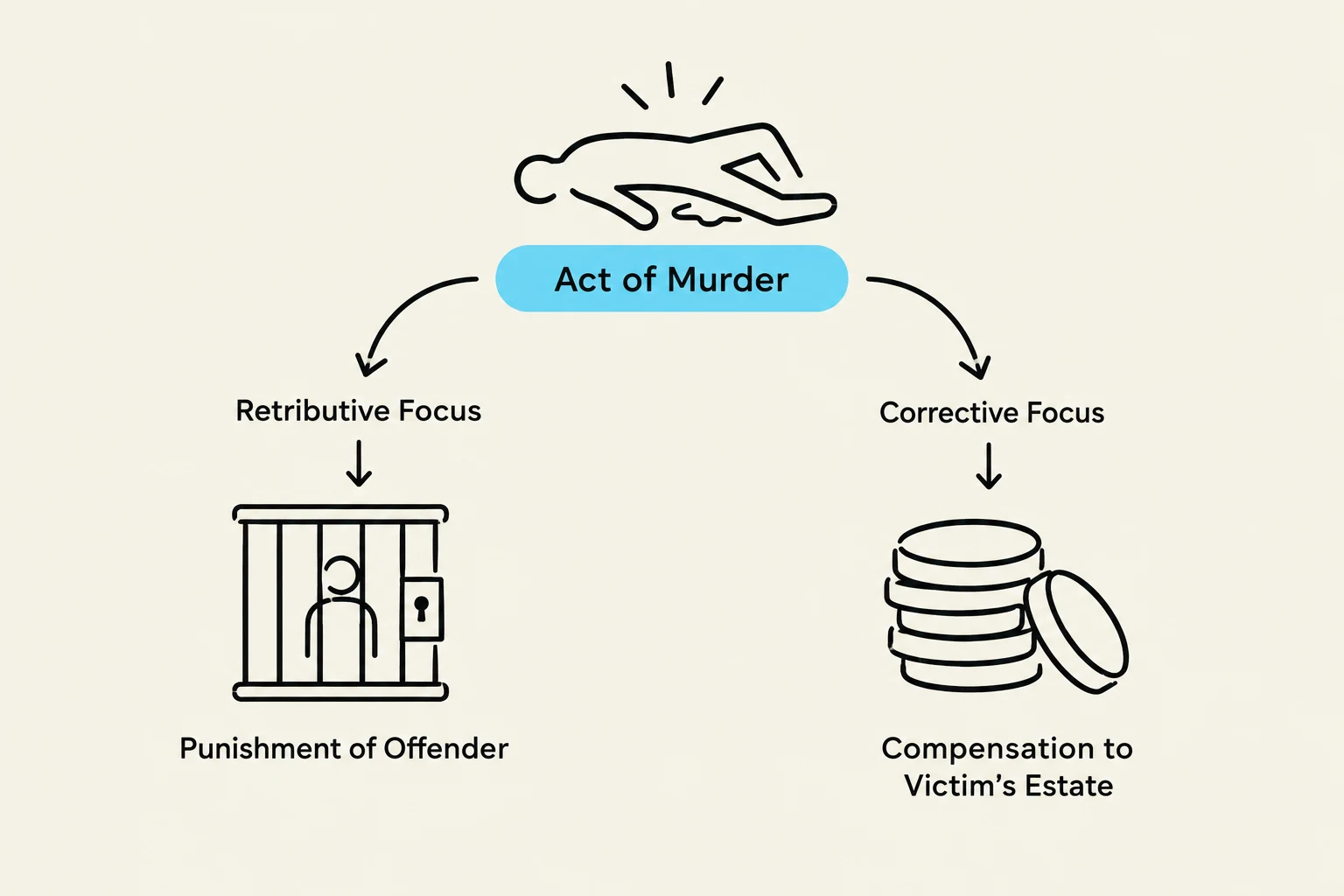
This diagram illustrates two potential focuses following an act of murder: retributive focus leading to punishment of the offender, and corrective focus leading to compensation to the victim's estate.
While negligence often deals with accidents and compensation, the crime of murder deals with intentional harm and moral condemnation.
Consider this premise:
If an accused engages in behavior that causes the death of the victim and the accused meant to cause the death, the accused is guilty of murder and subject to punishment.
The Role of Retributive Theory
This premise is supported by retributive theory. Because murder involves a high level of moral culpability (the intent to kill), the law seeks to impose a penalty that matches the severity of the act. The focus is on the offender's "desert"—the punishment they deserve for violating the most fundamental social prohibition.
Comparative Outcomes in Murder Cases
The choice of theory drastically changes the legal objective:
Stringent Retributive Application: If the law applies a strict retributive model, the primary consequence is severe punitive measures against the perpetrator, such as life imprisonment or even capital punishment. The focus remains exclusively on the offender and the satisfaction of justice through punishment.
Corrective Theory Application: If a corrective model were applied to a murder case, the legal focus would shift toward the victim's estate or the survivors. The goal would be to address the specific harm caused—perhaps through massive restitution payments to the victim's family to mitigate the economic loss caused by the death.
Summary Table: Theoretical Comparison
Feature
Corrective Justice
Retributive Justice
Primary Focus
The Victim / The Loss
The Offender / The Wrongdoing
Primary Goal
Restoring balance (Compensation)
Imposing penalty (Punishment)
Legal Context
Tort Law (e.g., Negligence)
Criminal Law (e.g., Murder)
Key Concept
Making the victim "whole"
Moral desert and proportionality
By understanding these distinctions, legal practitioners and students can identify not just what the law says, but why it says it, and how different philosophical lenses can lead to vastly different legal consequences.
Keep reading for free.
Create an account to finish this reading and make it part of your study routine.