Theories of Accident Causation in Occupational Safety
An overview of various theories explaining accident causation in occupational health and safety, including the Domino Theory, Human Factors Theory, and Systems Theory, to aid in accident prevention.
In the field of occupational health and safety, understanding why accidents occur is the first step toward preventing them. Accidents are not merely random, unfortunate events; they are often the result of specific, identifiable patterns and failures within a workplace. In Canada, accidents are a significant public health concern, ranking as the fifth leading cause of death behind cancer, heart disease, strokes, and lung disease.
By studying various models and frameworks, safety professionals can move beyond simply reacting to injuries and begin to predict and prevent them. These models, known as theories of accident causation, provide different lenses through which we can view the complex relationship between humans, machines, and their environments.
The Domino Theory
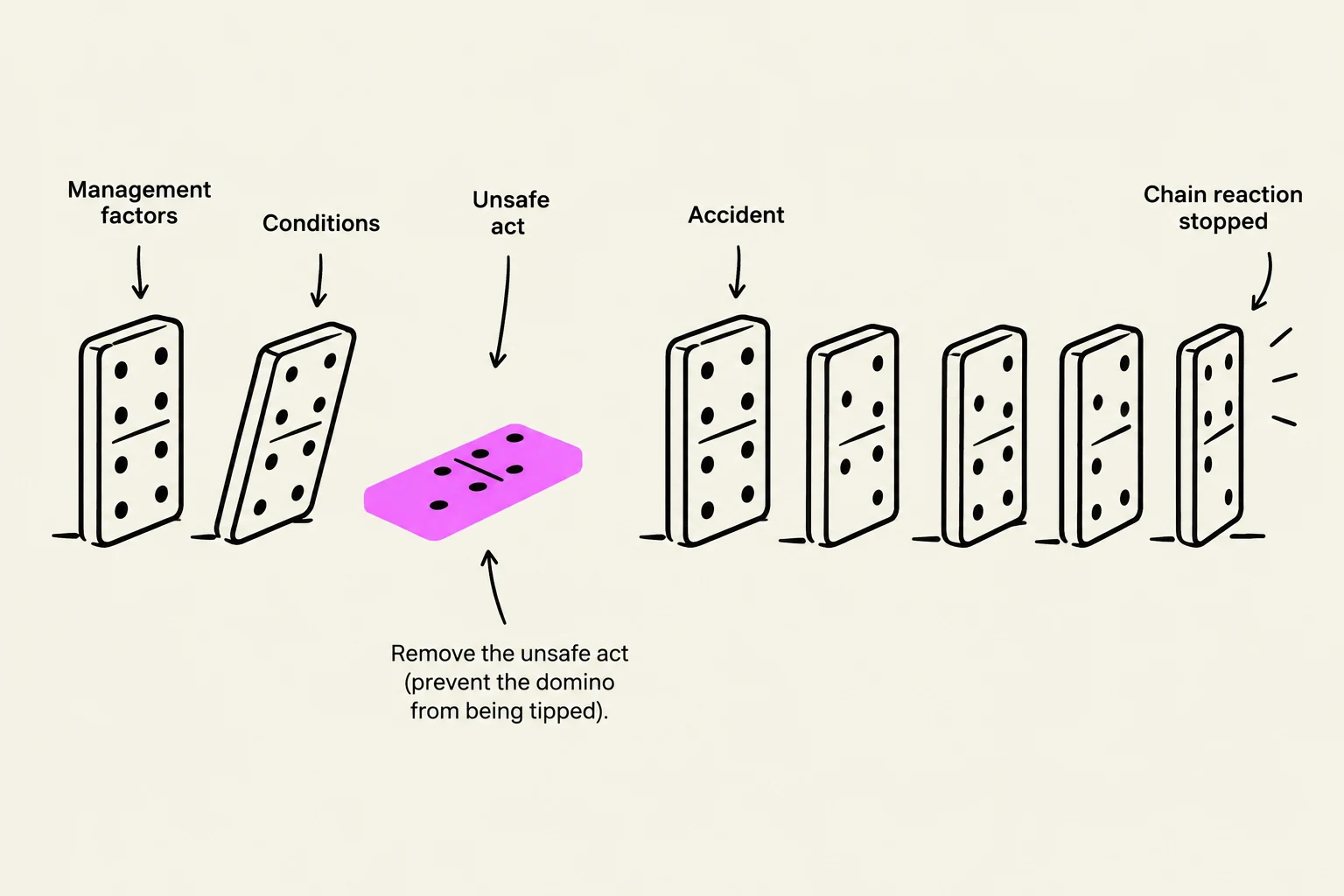
One of the earliest and most influential models is the Domino Theory, developed by Herbert W. Heinrich in the 1920s. Heinrich’s research into industrial accidents led to the "10 Axioms of Industrial Safety" and suggested that accidents occur in a sequence, much like a row of falling dominoes.
Heinrich’s findings were groundbreaking for his time, suggesting that the vast majority of accidents are preventable. His study indicated that:
88% of industrial accidents are caused by unsafe acts committed by workers.
10% are caused by unsafe conditions.
Only 2% of industrial accidents are truly unavoidable.
The core idea is that if you remove one "domino" (such as an unsafe act), you can break the chain and prevent the final injury from occurring.
A domino effect illustration showing how management factors and conditions can lead to an accident, which can be prevented by removing the unsafe act.
Human Factors Theory
While the Domino Theory focuses on a sequence of events, the Human Factors Theory looks deeper into the psychological and physiological reasons why humans make mistakes. This theory suggests that human error is often driven by three broad factors:
Overload: This occurs when there is an imbalance between a person's capacity and the load they are carrying at a given time. This could be physical fatigue, mental stress, or excessive workload.
Inappropriate Response/Incompatibility: This refers to how a person reacts to a situation. For example, if a worker detects a hazardous condition but fails to take action to correct it, they have responded inappropriately.
Inappropriate Activities: This involves errors resulting from performing tasks that the worker is not prepared for, such as undertaking a task they do not know how to do.
Exam Tip: When analyzing a case study, look for "Overload" if the worker is stressed or tired, and "Inappropriate Activities" if the worker lacks the training or skill for the specific task.
Accident/Incident and Epidemiological Theories
As safety science evolved, new models began to account for organizational and environmental complexities.
Accident/Incident Theory
This theory introduces a "systems failure" component. It posits a causal relationship between management decisions or behaviors and workplace safety. It establishes that management plays a central role in accident prevention; if management decisions prioritize speed over safety, the system is primed for failure.
Epidemiological Theory
The Epidemiological Theory views accidents through the lens of host and environment. It focuses on two key components:
Predisposition characteristics: Internal factors related to the individual.
Situational characteristics: External factors related to the environment.
Together, these characteristics determine whether a situation will result in an accident or if the conditions will remain safe.
Systems Theory
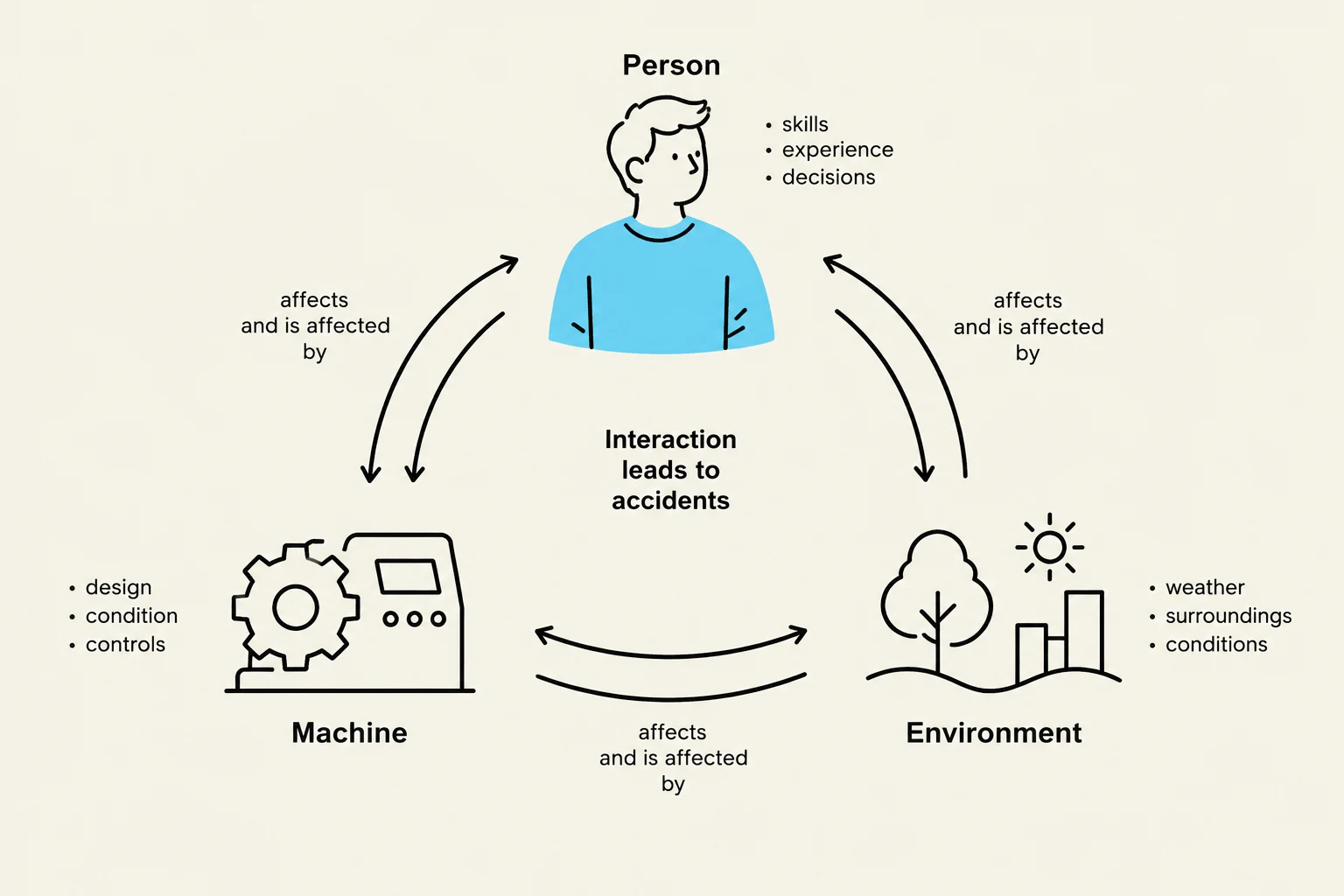
Systems Theory takes a holistic view, suggesting that an accident is not just a human error or a machine failure, but a failure of the interaction between components. In this model, an accident occurs within a system comprised of three primary elements:
The Person (Host)
The Machine (Agency)
The Environment
The likelihood of an accident is determined by how these three components interact. By changing the patterns of these interactions—such as improving machine guarding or enhancing environmental lighting—the probability of an accident can be reduced.
Diagram illustrating the interaction between a person, machine, and environment, which can lead to accidents. Factors influencing each element are also depicted.
Behavioural Theory and Behaviour-Based Safety (BBS)
The Behavioural Theory focuses on the idea that certain human behaviors are desired while others should be avoided. This is the foundation of Behaviour-Based Safety (BBS).
BBS relies on the principle of reinforcement. By using incentives and rewards, organizations can promote positive, safe behaviors and discourage unsafe ones. This approach shifts the focus from "fixing the machine" to "reinforcing the habit."
Combination Theory
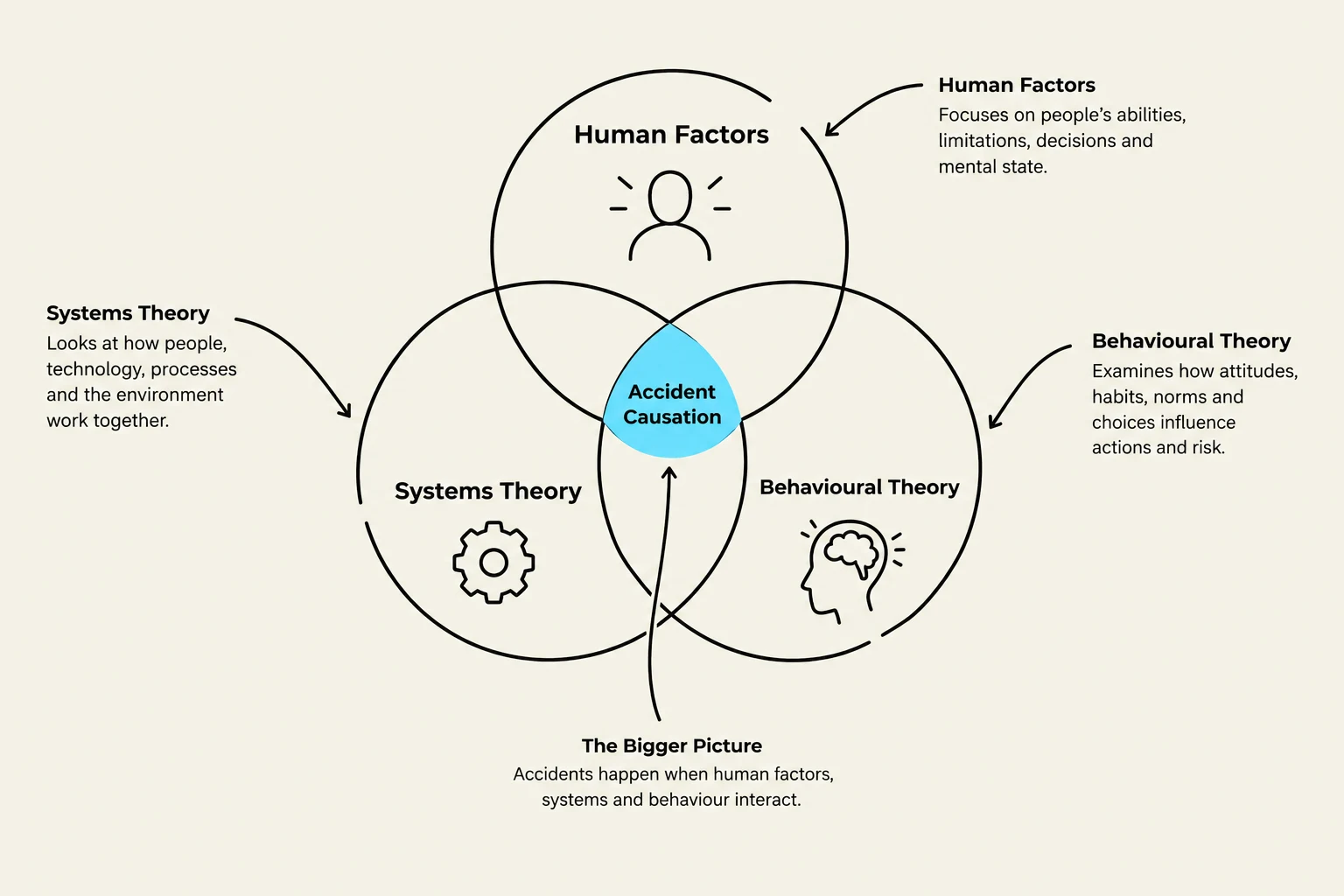
In reality, accidents are rarely caused by a single factor. The Combination Theory suggests that the actual cause of an accident is often best explained by combining multiple models. For instance, an accident might involve a management failure (Accident/Incident Theory), leading to worker overload (Human Factors Theory), which results in an unsafe act (Domino Theory).
This diagram illustrates the interaction of Human Factors, Systems Theory, and Behavioural Theory in accident causation, emphasizing that accidents occur when these elements intersect.
Summary Table: Comparison of Theories
Theory
Primary Focus
Key Driver of Accidents
Domino
Sequence of events
Unsafe acts and conditions
Human Factors
Individual error
Overload, inappropriate response, or activities
Accident/Incident
Management
Management decisions and system failures
Epidemiological
Host/Environment
Predisposition and situational characteristics
Systems
Interactions
Interaction between Person, Machine, and Environment
Behavioural
Human action
Lack of reinforcement for safe behaviors
Keep reading for free.
Create an account to finish this reading and make it part of your study routine.