


Grief is a universal human experience, yet it is also one of the most deeply individualized and culturally complex phenomena we encounter. While the occurrence of loss—whether of a person, a relationship, or a significant life element—is a constant of the human condition, the way it is felt, expressed, and integrated into a person's life varies wildly based on race, gender, religion, and social construction. To study grief, we must first distinguish between three often-interchanged terms that describe different dimensions of the experience:
- Grief: The internal, holistic, and emotional/physical reaction to loss. It affects the person cognitively, spiritually, and even physiologically.
- Bereavement: The objective state of having experienced a loss and the subsequent period of adaptation.
- Mourning: The outward, public, or interpersonal expression of grief, often facilitated through cultural rituals like funerals.
Study Tip: In clinical exams, remember that grief is what you feel (internal), bereavement is the status of being a survivor (the state), and mourning is what you do or show (the external ritual).
The Classical Era: Psychoanalytic Perspectives and "Grief Work"
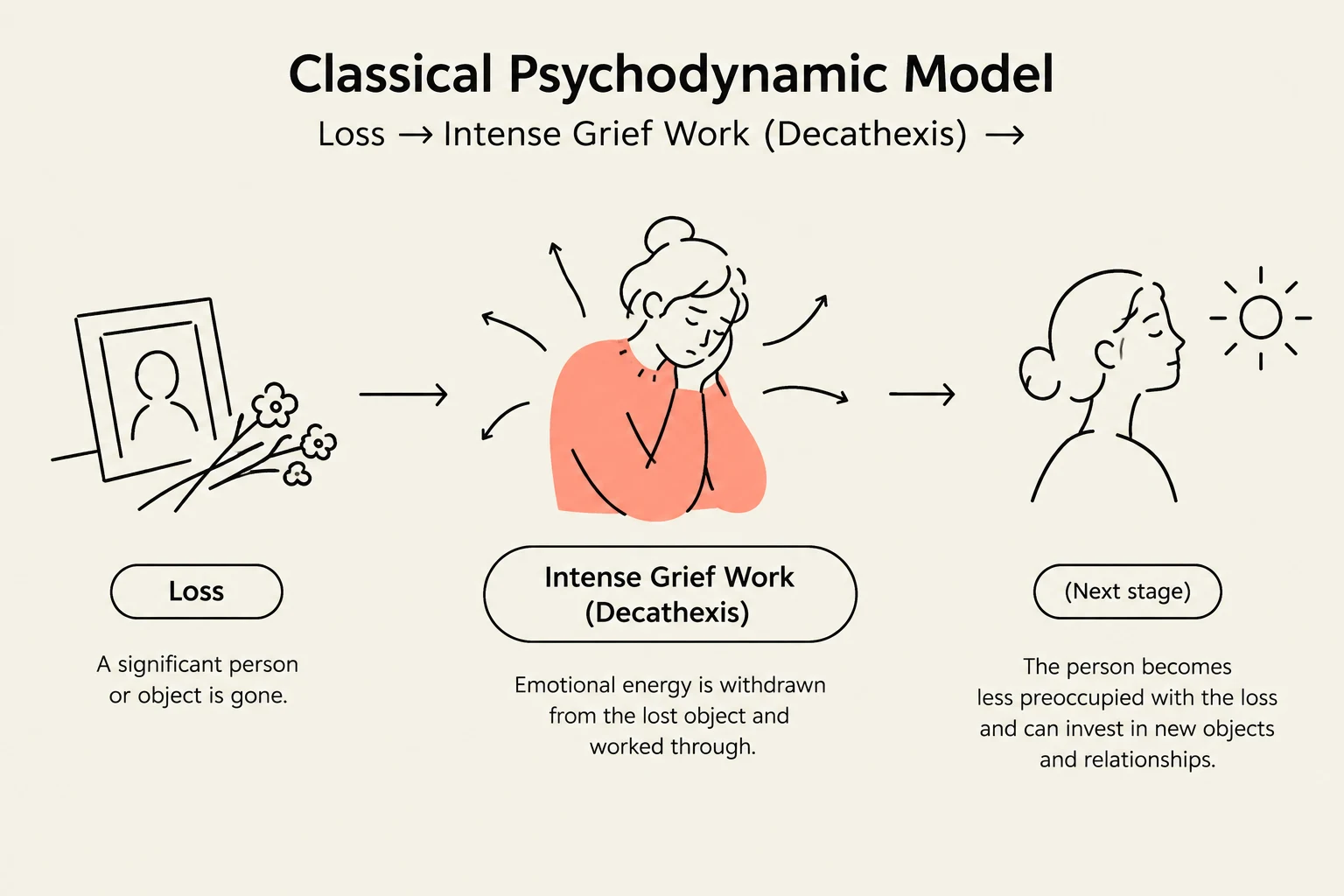
Early theoretical models were heavily influenced by the psychoanalytic tradition, most notably by Sigmund Freud. Freud proposed that the primary task of the bereaved is grief work. This process requires an intense psychological effort to "decathect"—essentially to break the emotional bonds or attachments to the deceased.
According to this view, a person has a limited amount of psychic energy. If they remain "fixated" on the lost person, they cannot invest that energy into new relationships or future goals. Consequently, early theorists like Lindemann and Parkes viewed acute grief as a potentially disabling condition. They often suggested that if grief lasted too long, it became pathological grief or complicated grief. In these classical models, "resolution" was synonymous with "detachment" and "moving on".
Keep reading for free.
Create an account to finish this reading and make it part of your study routine.
Continue reading freeAlready have an account? Log in
Updated