The Wagner Act, Court-Packing, and the Constitutional Revolution of 1937
Examines the historical context of the Wagner Act, FDR's court-packing plan, and the subsequent "Constitutional Revolution of 1937" which shifted the Supreme Court's stance on economic regulation and laid groundwork for future civil rights advancements.
The presidency of Franklin D. Roosevelt (FDR) marked one of the most transformative periods in American legal and economic history. Faced with the devastation of the Great Depression, FDR sought to implement sweeping New Deal programs to stabilize the economy and provide relief to citizens. However, his efforts faced a massive obstacle: a deeply conservative Supreme Court that frequently struck down government intervention, leaving the administration "helpless to improve economic problems". This tension between the executive branch's desire for reform and the judiciary's commitment to traditional interpretations of the Constitution set the stage for a monumental legal showdown.
The Rise of Labor Power: The Wagner Act
As part of the New Deal, the federal government moved to empower the working class through significant legislative reforms. The most critical of these was the Wagner Act of 1935.
The Wagner Act was designed to fundamentally shift the balance of power between employers and employees by establishing two key principles:
The Right to Organize: It guaranteed workers the right to organize into unions and bargain collectively with their employers.
Regulation of Unfair Practices: It defined specific "unfair labor practices" that employers were prohibited from committing.
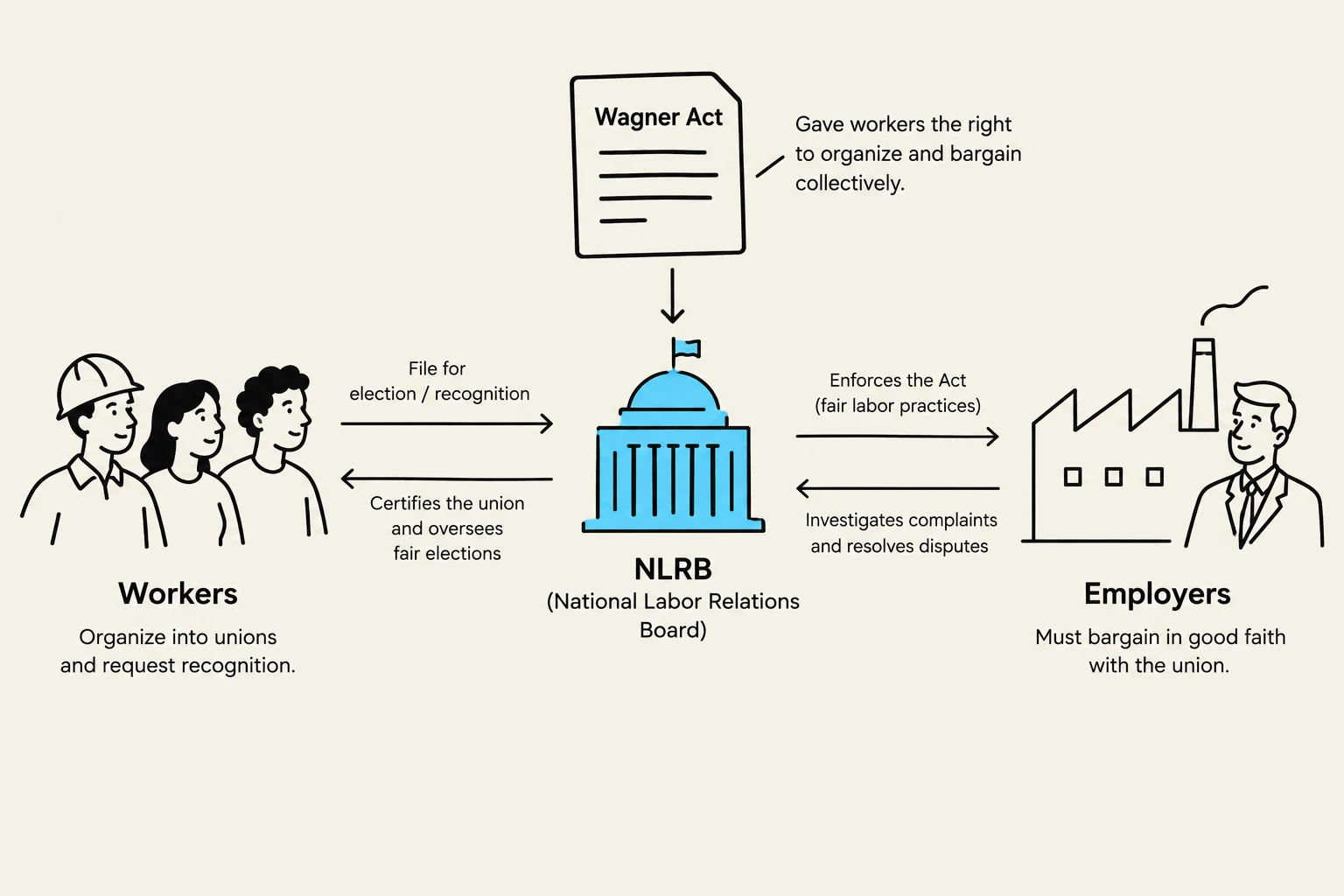
To enforce these new rules, the act created the National Labor Relations Board (NLRB). The NLRB served as a regulatory body that listened to complaints from workers and possessed the authority to issue "cease-and-desist" orders to stop companies from violating labor laws.
This diagram illustrates the process by which workers can organize into unions, seek recognition, and engage in collective bargaining, with the National Labor Relations Board (NLRB) overseeing fair elections and enforcing labor practices under the Wagner Act.
Exam Tip: When studying the Wagner Act, remember that its primary purpose was to empower labor through collective bargaining and to provide a federal mechanism (the NLRB) to punish unfair employer practices.
The Judicial Conflict and the Court-Packing Plan
Despite the passage of the Wagner Act, the Supreme Court remained a bastion of conservatism. For several years, the Court continued to block various pieces of New Deal legislation intended to regulate the economy.
In response to this judicial resistance, FDR proposed a controversial maneuver known as the "court-packing plan". His strategy was to expand the size of the Supreme Court by adding one new justice for every sitting justice over the age of 70, potentially adding up to six more justices. While the plan was intended to ensure the survival of his economic reforms, it was seen by many as a direct threat to the independence of the judiciary.
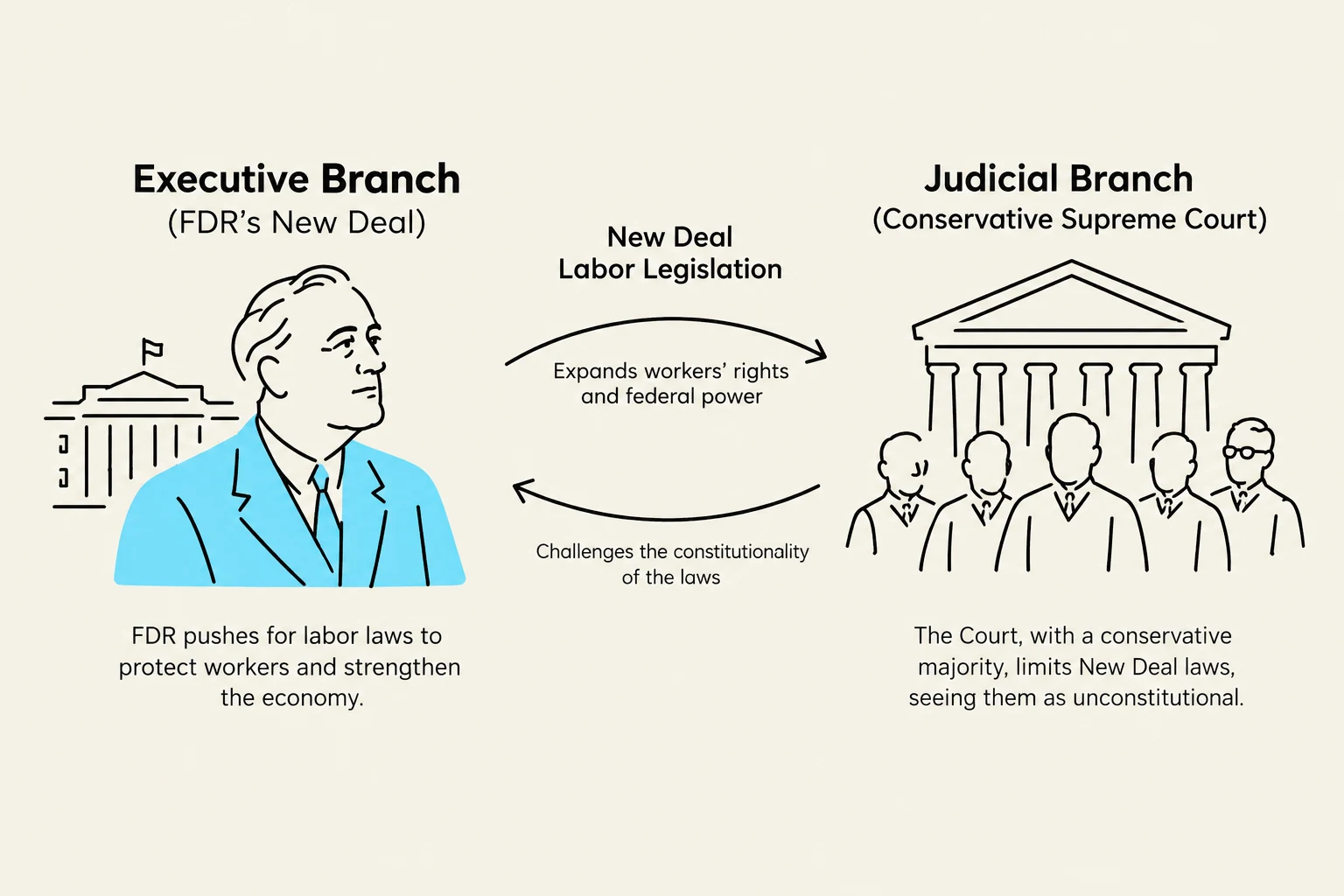
This illustration depicts the interaction between the Executive Branch, represented by FDR's New Deal policies, and the Judicial Branch, specifically the Supreme Court, concerning New Deal labor legislation.
The Constitutional Revolution of 1937
The political pressure from FDR—which some historians suggest was a way of "threatening" the Court—eventually led to a dramatic shift in judicial philosophy. In 1937, the Supreme Court underwent a "change of heart".
This shift was characterized by two major changes:
Economic Regulation: The Court stopped blocking legislation designed to regulate and stimulate the national economy.
Preferred Freedoms: The Court began to increase its scrutiny of laws that infringed upon "preferred freedoms," such as speech and assembly.
This period is often referred to as the "Constitutional Revolution of 1937". Over the following seven years, FDR was able to replace eight justices through retirements, gradually installing more liberal-leaning judges. This shift moved the Court toward a decades-long liberal tone, which eventually provided the legal foundation for the Civil Rights Revolution of the 1940s, 50s, and 60s (notably seen in cases like Brown v. Board of Education).
Key Concept: The "Constitutional Revolution" refers to the moment the Court stopped using the Commerce Clause and other doctrines to strike down economic regulations, effectively allowing the modern regulatory state to exist.
The Backlash: Taft-Hartley and the End of the Leftward Motion
The momentum of the New Deal did not last indefinitely. As the economy began to improve and New Deal programs started working, the political landscape shifted.
The expansion of labor power faced a significant legislative check in 1947 with the passage of the Taft-Hartley Act. This act was designed to weaken the influence of the Wagner Act by placing new restrictions on unions. One of the most impactful provisions of Taft-Hartley was allowing states to pass "right-to-work" laws, which were intended to break union power. Today, 26 states have adopted such laws.
Furthermore, the "leftward motion" of the Court began to stall in 1937 due to political opposition. Conservative Democrats, particularly those from the South, began to oppose the expansion of federal power, largely because they feared it would threaten the system of segregation.
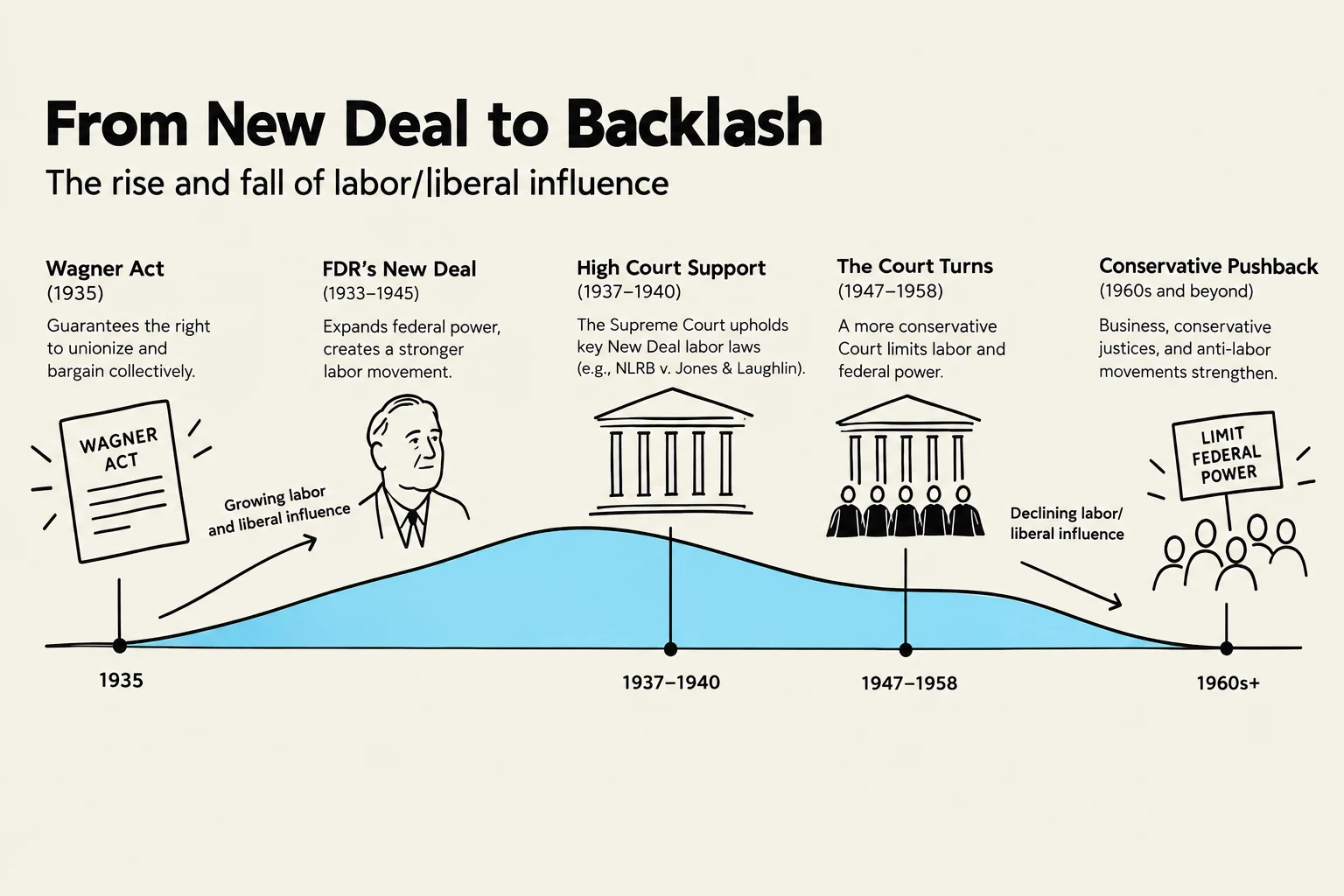
A timeline illustrating the rise and fall of labor and liberal influence in the United States, from the New Deal era to the conservative pushback.
Summary Table: Labor Legislation Comparison
Feature
Wagner Act (1935)
Taft-Hartley Act (1947)
Primary Goal
Empower workers and unions
Restrict union power
Key Mechanism
Created the NLRB
Allowed "right-to-work" laws
Impact on Unions
Strengthened collective bargaining
Weakened union influence
Keep reading for free.
Create an account to finish this reading and make it part of your study routine.