The U.S. Constitution: From Articles of Confederation to Ratification
Explore the transition from the weak Articles of Confederation to the U.S. Constitution, covering key principles, the Constitutional Convention, and the Federalist vs. Anti-Federalist debate.
The journey of the United States from a collection of loosely connected colonies to a unified nation was not a smooth transition. It was a turbulent process defined by fear of tyranny, economic instability, and intense political debate. To understand how the American government functions today, one must first understand the failures of its first attempt at governance and the revolutionary principles that eventually replaced it.
The Articles of Confederation: A Weak Foundation
Following the Revolutionary War, the newly independent states were deeply suspicious of centralized power. Having just escaped the rule of King George III, the founders were terrified of creating a new "tyrant" in the form of a strong national government. To prevent this, they adopted the Articles of Confederation, which prioritized state sovereignty—the idea that individual states held the ultimate power and authority.
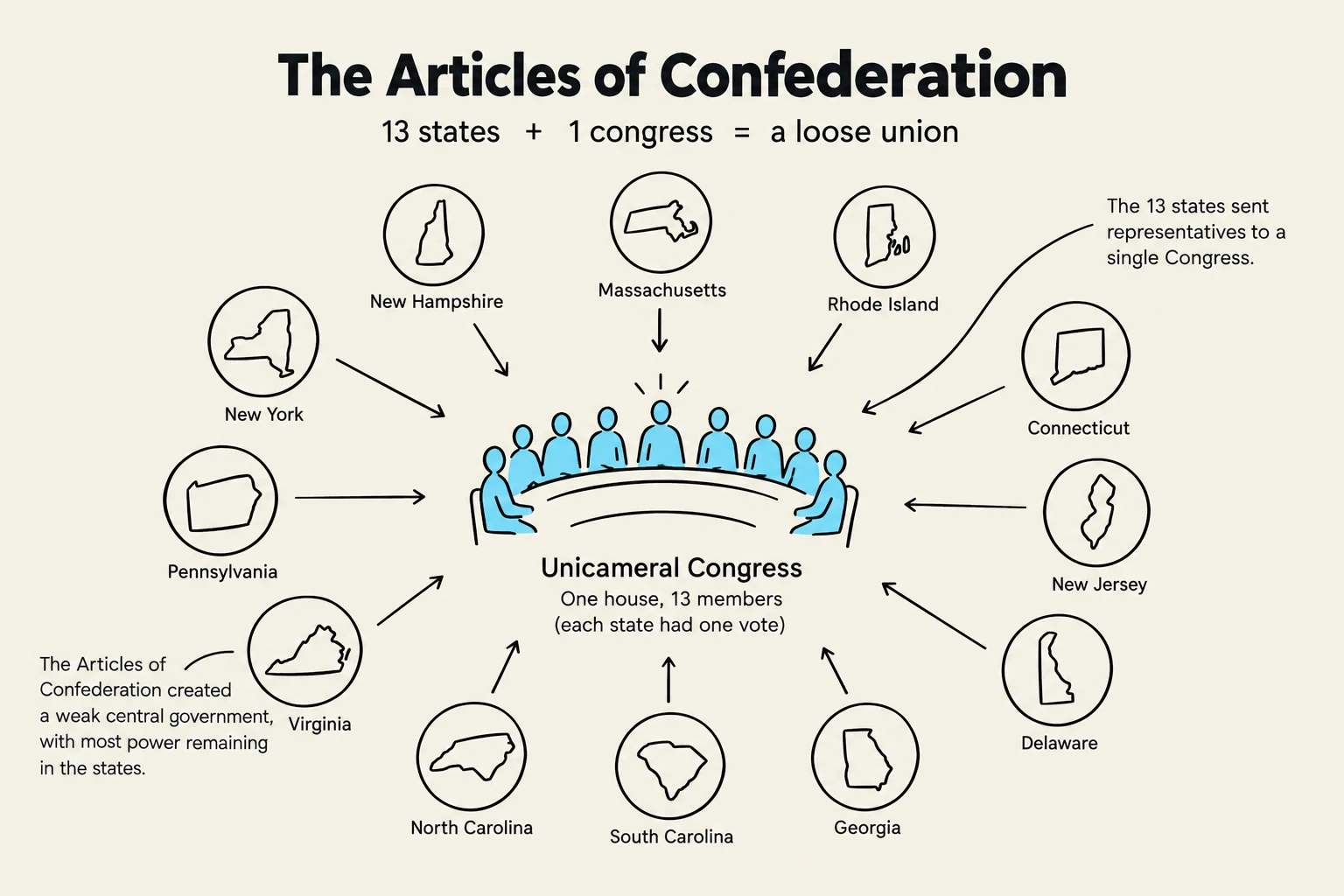
Under the Articles, the national government was intentionally crippled. It consisted only of a unicameral Congress, meaning there was only one legislative chamber. There was no President to enforce laws and no federal court system to settle disputes between states. This structure led to several critical weaknesses:
No Power to Tax: Congress could request money from states, but it had no way to force them to pay.
Trade Chaos: The national government could not regulate commerce between states, leading to economic friction.
Inefficient Voting: Every state received exactly one vote, regardless of size.
Rigid Amendment Process: Changing the Articles required a unanimous vote from all 13 states, making progress nearly impossible.
A diagram illustrating the structure of the government under the Articles of Confederation, showing 13 states represented in a unicameral Congress.
Despite these flaws, the Articles were not a total failure. The Northwest Ordinance (1787) stands as its most significant achievement, providing an orderly system for admitting new territories into the Union as equal states.
Exam Tip: If you are asked why the Articles of Confederation failed, focus on the lack of central authority to tax, regulate trade, or maintain order.
The breaking point came with Shays’ Rebellion in 1786. When debt-ridden farmers in Massachusetts revolted, the national government found itself powerless to intervene because it lacked a standing army. This uprising served as a wake-up call: the nation was too unstable to survive under the Articles.
The Constitution: A New Vision
In 1787, delegates met to draft a new framework: the U.S. Constitution. The introduction to this document, the Preamble, serves as a mission statement that outlines six core goals: to form a more perfect union, establish justice, ensure domestic tranquility, provide for the common defense, promote the general welfare, and secure the blessings of liberty.
The Preamble introduces several foundational principles of American government:
Popular Sovereignty: By beginning with "We the People," the Constitution establishes that power comes from the citizens, not a monarch.
Limited Government: The government is restricted to only those powers granted to it by the people.
Rule of Law: No one, including government leaders, is above the law.
To prevent any single entity from seizing total control, the Framers implemented a complex system of structural safeguards:
Separation of Powers: Dividing the federal government into three distinct branches (Legislative, Executive, and Judicial).
Checks and Balances: Giving each branch the ability to limit the power of the other two.
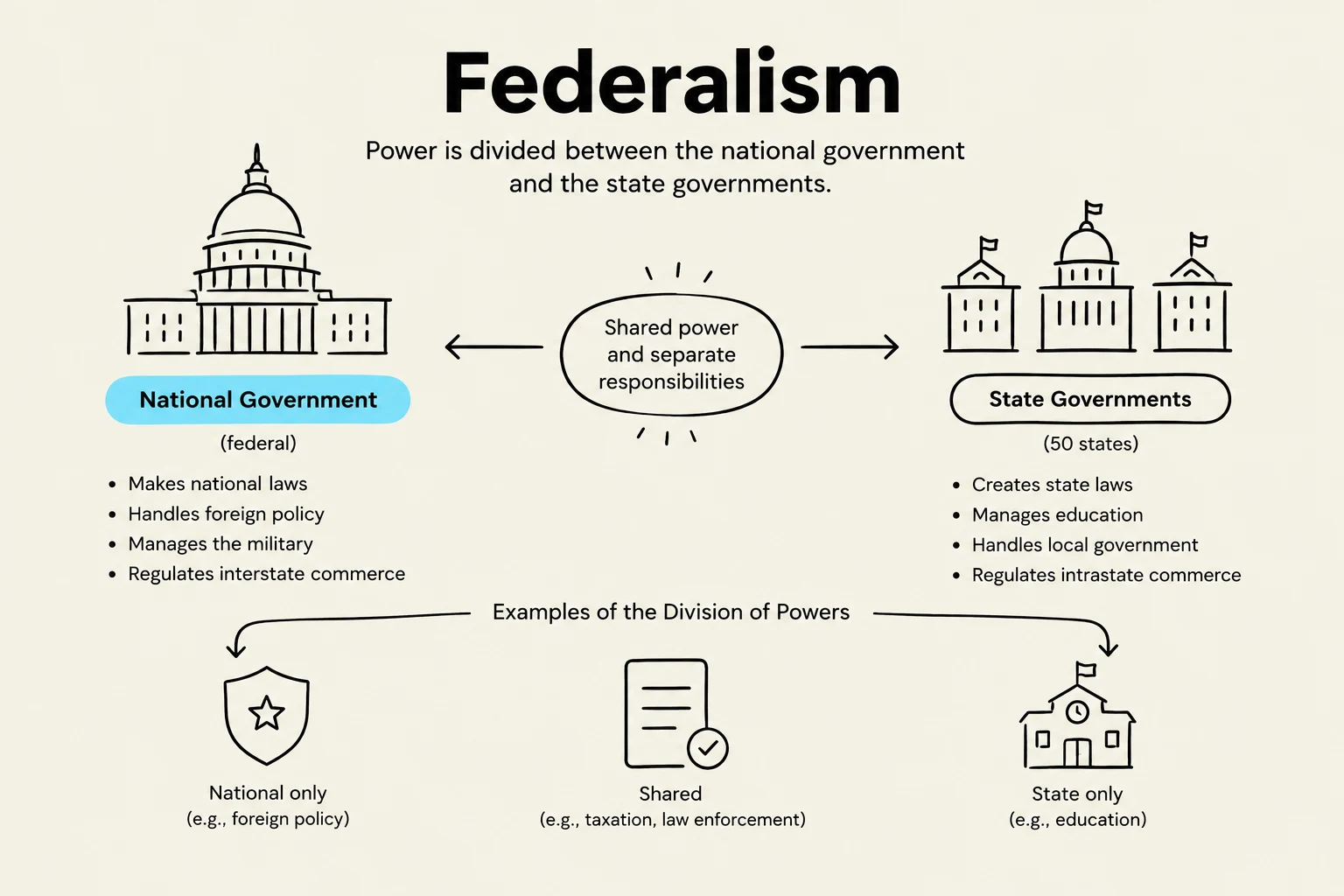
Federalism: The division of power between the national government and the state governments.
This diagram illustrates the concept of federalism, explaining how power is divided between national and state governments, with examples of their respective and shared responsibilities.
Within this federalist system, powers are categorized into two types. Enumerated Powers are those specifically granted to the national government, while Reserved Powers are those kept by the states.
The Great Debate: Federalists vs. Anti-Federalists
Even after the Constitution was written, it faced a massive hurdle: ratification. For the document to become law, 9 out of the 13 states had to officially approve it. This triggered a fierce national debate between two factions.
The Federalists
The Federalists, led by figures like Alexander Hamilton, James Madison, and John Jay, argued for immediate ratification. They believed a strong central government was essential for economic stability and national security. To persuade the public, they authored The Federalist Papers, a series of influential essays defending the new Constitution.
The Anti-Federalists
The Anti-Federalists, including leaders like Patrick Henry, feared that a strong central government would inevitably lead to tyranny. They worried that a powerful President might act like a king and that the states would lose their autonomy. Their primary grievance was the absence of a specific list of protections for individual citizens.
Feature
Federalists
Anti-Federalists
Main Position
Supported immediate ratification
Opposed or wanted to rewrite the Constitution
National Power
Wanted a strong central government
Feared tyranny and loss of state power
The Executive
Supported a strong President
Feared a President would become a dictator
Key Leaders
Hamilton, Madison, Jay
Patrick Henry, George Mason
The Compromise: The Bill of Rights
The deadlock was eventually broken through a crucial compromise. The Federalists promised that once the Constitution was ratified, the very first order of business would be to add a Bill of Rights—a set of amendments explicitly designed to protect individual liberties from government abuse. This promise satisfied the Anti-Federalists and secured the votes needed to establish the United States under the Constitution.
Keep reading for free.
Create an account to finish this reading and make it part of your study routine.