The U.S. Cabinet Appointment Process and the Principal-Agent Problem
An explanation of the constitutional framework, selection, vetting, and Senate confirmation process for U.S. Cabinet appointments, focusing on the Principal-Agent Problem and its implications for bureaucratic control and accountability.
When a new President is inaugurated, the transition of power extends far beyond the Oval Office. To implement their policy agenda, the President must assemble a team of experts and loyalists to lead the various departments of the federal bureaucracy. This process—the appointment of Cabinet members and high-level officials—is a critical intersection of executive ambition and legislative oversight. It is not merely a hiring process; it is a constitutional dance designed to balance the President's need for efficient governance with the Senate's duty to provide checks and balances.
The Constitutional Framework: Advice and Consent
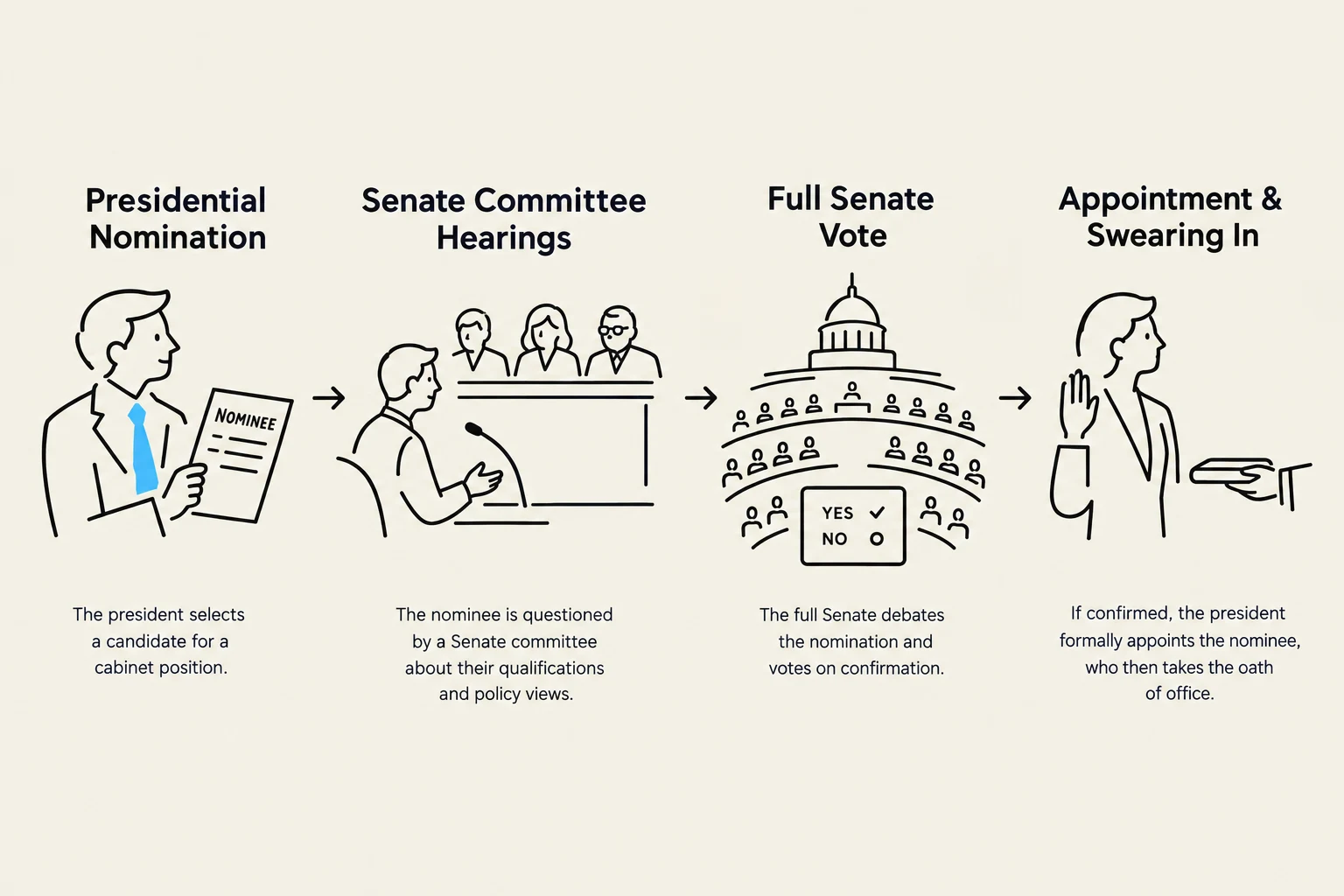
The authority for the appointment process is rooted in Article II of the U.S. Constitution. While the President has the power to nominate individuals for positions such as Secretary of State, Secretary of Defense, and Attorney General, these nominations are not unilateral. The Constitution mandates that the President must seek the "Advice and Consent" of the Senate.
This means that a nomination is only a proposal. For a nominee to take office, they must undergo a rigorous vetting process, participate in public hearings, and ultimately receive a majority vote in the Senate. This structure ensures that the most powerful members of the executive branch are not chosen solely based on personal loyalty, but are also subject to the scrutiny of the people's representatives.
Exam Tip: Remember that "Advice and Consent" refers specifically to the Senate's role. The House of Representatives has no formal role in the confirmation of executive branch officials.
This illustration outlines the process of a presidential nomination for a cabinet position, including Senate committee hearings, a full Senate vote, and the final appointment and swearing-in ceremony.
The Selection and Vetting Phase
Before a name is ever sent to the Senate floor, a massive internal operation occurs within the White House and the various federal agencies. The President's goal is to find individuals who possess both the technical competence to run a massive bureaucracy and the political alignment necessary to carry out the administration's specific goals.
The vetting process typically involves:
Background Checks: Conducted by the FBI to ensure there are no legal or ethical liabilities.
Financial Disclosures: Nominees must reveal their assets to prevent conflicts of interest.
Policy Alignment: Ensuring the nominee's past stances and public statements align with the President's platform.
This phase is where the President attempts to solve the "Principal-Agent Problem" before it even begins. The President (the Principal) wants to ensure that the person they hire (the Agent) will act in the President's interest rather than pursuing their own personal or departmental interests.
The Senate Confirmation Process
Once a nomination is formally submitted, the responsibility shifts to the Senate. The process is usually managed by the committee with jurisdiction over the specific department (for example, the Senate Foreign Relations Committee handles the Secretary of State).
Committee Hearings and Scrutiny
The committee holds hearings where the nominee testifies under oath. Senators use this time to question the nominee on their qualifications, past controversies, and intended policy directions. These hearings are often televised, making them a significant tool for public accountability and, occasionally, political theater.
The Floor Vote
If the committee approves the nominee, the nomination moves to the full Senate floor. A simple majority vote is required for confirmation. However, in recent years, the use of the filibuster and other procedural hurdles has changed the political landscape of these votes, sometimes requiring more than a simple majority to reach a final conclusion.
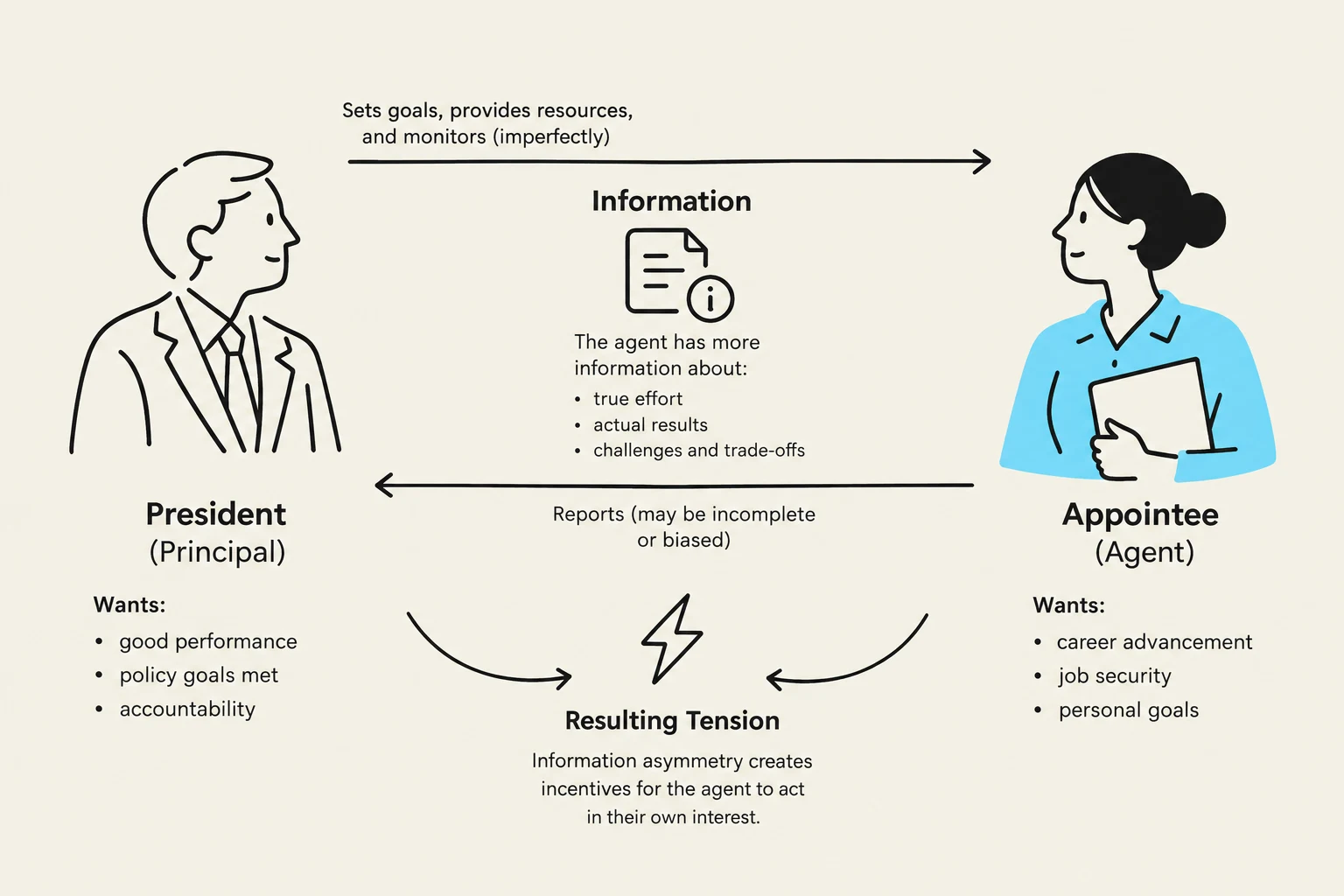
This diagram illustrates the principal-agent problem, where a principal (President) delegates tasks to an agent (Appointee). Information asymmetry, where the agent has more information than the principal, can lead to a resulting tension as the agent may act in their own interest.
Understanding the Principal-Agent Problem in Appointments
A central concept in studying the bureaucracy is the Principal-Agent Problem. In the context of the Cabinet, the President is the Principal and the Cabinet Secretary is the Agent.
The problem arises because of two main factors:
Information Asymmetry: The Agent (the Secretary) often possesses much more specialized, technical information about their department than the Principal (the President) does.
Conflicting Incentives: The Agent may have their own goals—such as expanding their department's budget or pursuing a specific ideological agenda—that do not perfectly align with the President's goals.
To mitigate this, the appointment process acts as a "screening mechanism." By subjecting nominees to Senate scrutiny, the system attempts to filter out individuals who might be too independent or too prone to "agency drift"—the tendency of an agent to deviate from the principal's instructions.
The relationship can be expressed through the lens of utility maximization. If Up is the utility of the President and Ua is the utility of the Agent, the goal of a successful appointment is to minimize the divergence:
Minimize ∣Up−Ua∣
However, because the Agent's utility Ua is often hidden from the Principal, the President must rely on the appointment and subsequent oversight to maintain control.
This diagram illustrates the process of presidential appointment, agency action, congressional oversight, and the cyclical nature of government functions.
Summary of the Process
The Cabinet appointment process is a vital component of the American system of checks and balances. It serves three primary functions:
Executive Function: It allows the President to build a leadership team to execute the law.
Legislative Function: It provides the Senate with a mechanism to vet and potentially block executive power.
Bureaucratic Control: It serves as the first line of defense against the Principal-Agent problem, attempting to ensure that the massive machinery of the federal government remains responsive to the elected leadership.
Through this complex interplay of nomination, vetting, and confirmation, the United States attempts to ensure that those wielding significant public power are both capable and accountable.
Keep reading for free.
Create an account to finish this reading and make it part of your study routine.