The Tricarboxylic Acid (TCA) Cycle and Electrochemical Potential
An in-depth explanation of the Tricarboxylic Acid (TCA) cycle, also known as the Krebs cycle, detailing its eight enzymatic reactions, its role in cellular metabolism, and the thermodynamic principles of electrochemical potential governing membrane transport. Covers chemical potential, electric potential, mitochondrial
The Tricarboxylic Acid (TCA) cycle, also known as the Krebs cycle, represents the central hub of cellular metabolism. It is a series of eight enzymatic reactions that complete the oxidative catabolism of glucose by fully oxidizing acetyl groups to CO2. Beyond energy production, the cycle serves as a critical junction for biosynthesis, providing carbon skeletons for the production of fatty acids, amino acids, and nucleotides. To understand how this cycle functions and how its intermediates are transported, we must first examine the thermodynamic principles of electrochemical potential.
Thermodynamics of Membrane Transport
For a cell to function, it must move metabolites across membranes. This movement is governed by the laws of thermodynamics, specifically the concept of potential.
Chemical and Electric Potential
When a molecule (A) moves from one side of a membrane to another, its movement is influenced by its concentration gradient, known as the chemical potential, and the charge difference across the membrane, known as the electric potential.
The change in free energy (ΔG) for the transport of a molecule based solely on its concentration is:
ΔGA=RTln[A]out[A]in
If the concentration is higher outside than inside, the transfer is spontaneous (ΔG<0).
However, for charged ions, we must account for the electric potential (ΔΨ), which is the charge differential across the membrane. The total energy change is defined by the electrochemical potential:
ΔGA=RTln[A]out[A]in+ZAFΔΨ
Where ZA is the charge of the ion, F is Faraday's constant, and ΔΨ is the membrane potential.
Mitochondrial Membrane Potentials
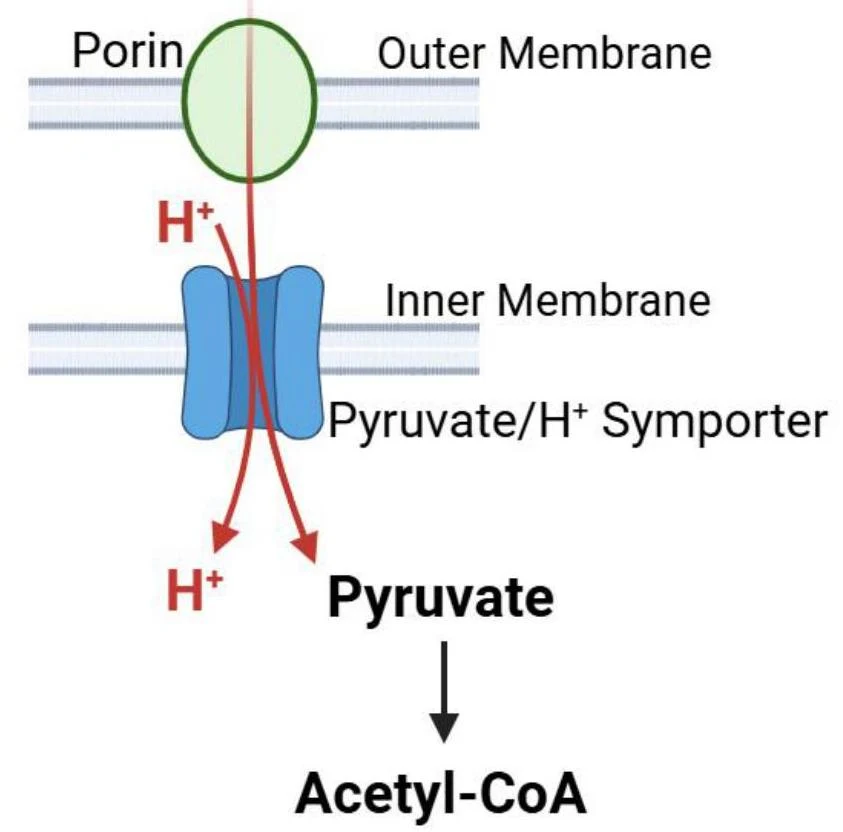
In the mitochondria, the inner membrane maintains a significant electrochemical gradient. For example, the proton gradient across the mitochondrial membrane is approximately -220mV. This gradient is essential for driving the import of metabolites. A key example is the Pyruvate/H+ Symporter, which uses the proton gradient to power the entry of pyruvate into the mitochondrial matrix.
Diagram illustrating the transport of pyruvate and protons across the inner mitochondrial membrane via a symporter, leading to the formation of Acetyl-CoA.
Exam Tip: Remember that a disrupted mitochondrial membrane potential can lead to impaired biochemical processes and is often a marker of mitochondrial pathology.
The Gateway: Pyruvate Dehydrogenase Complex
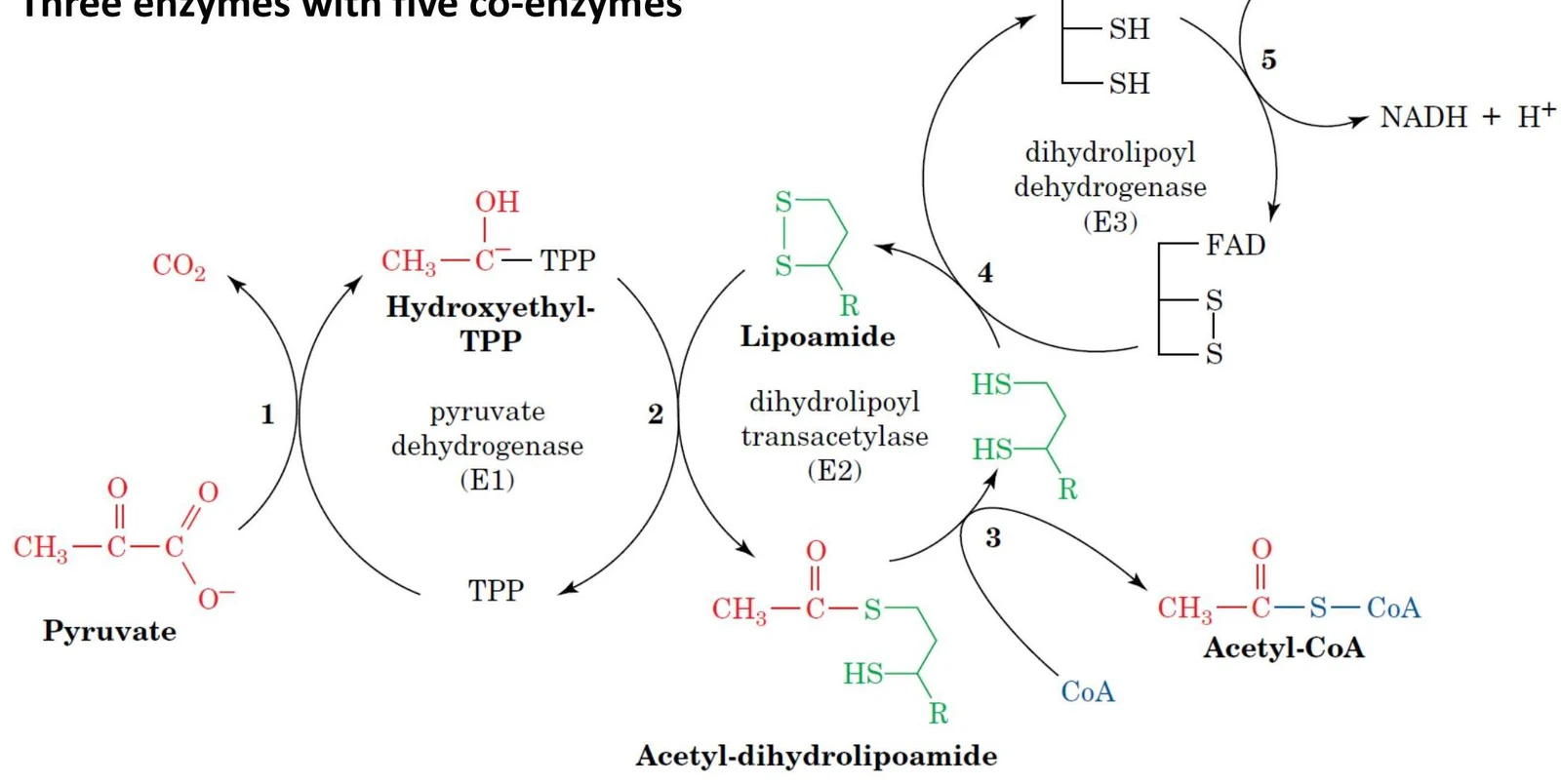
Before the TCA cycle begins, pyruvate (the product of glycolysis) must be transported into the mitochondria and converted into a form the cycle can use. This is achieved by the Pyruvate Dehydrogenase Complex (PDHC), which performs an oxidative decarboxylation to convert pyruvate into Acetyl-CoA.
This diagram illustrates the biochemical pathway involving pyruvate dehydrogenase complex, which converts pyruvate to acetyl-CoA, a key step in cellular respiration. It shows the roles of coenzymes like TPP, lipoamide, and FAD in the enzymatic reactions.
The Eight Steps of the TCA Cycle
The TCA cycle begins when the 2-carbon Acetyl-CoA enters the cycle by combining with a 4-carbon molecule, oxaloacetate (OAA).
1. Formation of Citrate
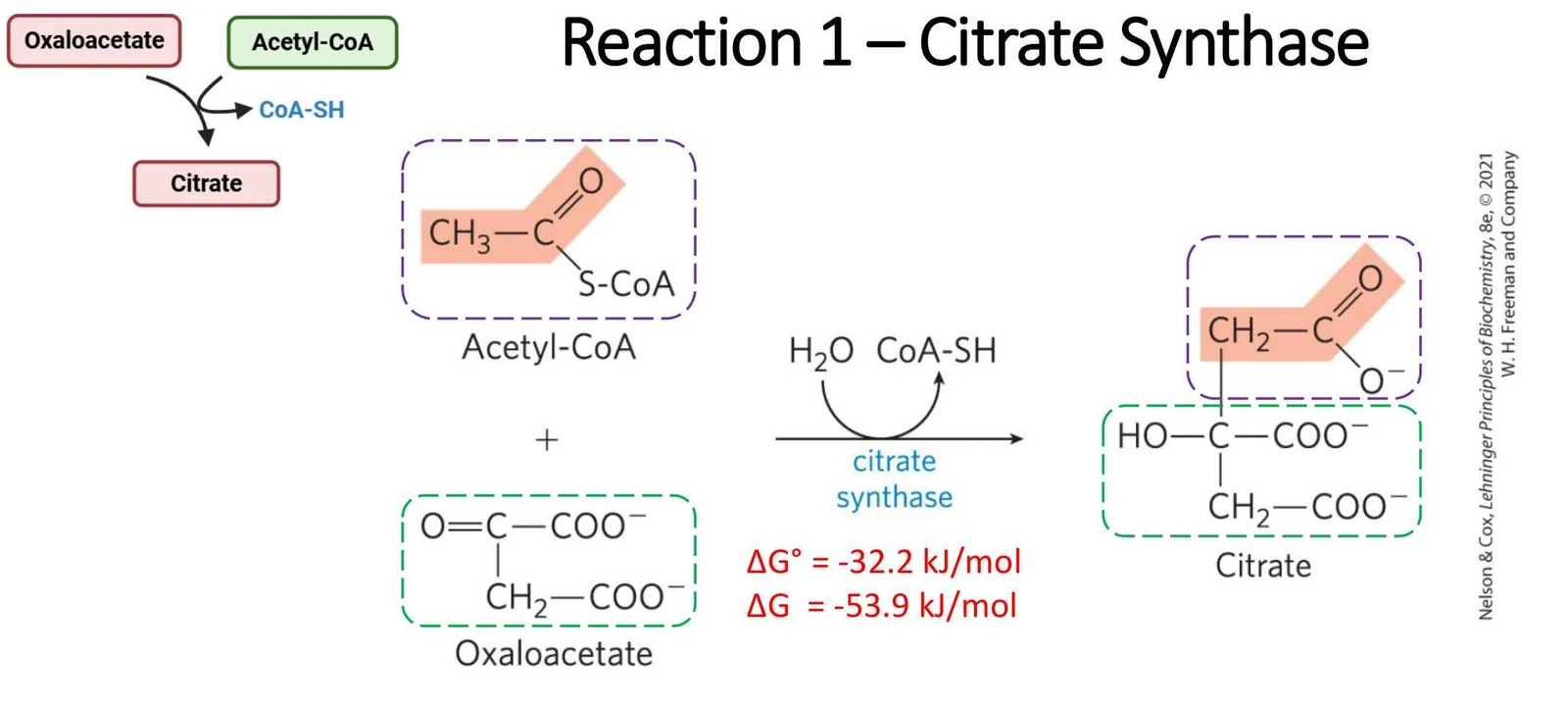
The enzyme Citrate Synthase catalyzes the first step: the condensation of Acetyl-CoA and oxaloacetate to form the 6-carbon molecule citrate. This reaction is irreversible and highly regulated because it involves the hydrolysis of a high-energy thioester bond in Acetyl-CoA.
The reaction catalyzed by citrate synthase involves the condensation of acetyl-CoA and oxaloacetate to form citrate, releasing CoA-SH and water. The standard free energy change (ΔG°) for this reaction is -32.2 kJ/mol, and the actual free energy change (ΔG) is -53.9 kJ/mol.
2. Isomerization via Aconitase
Citrate is a tertiary alcohol and is not easily oxidized. Therefore, the enzyme Aconitase isomerizes citrate into isocitrate. This enzyme utilizes an iron-sulfur cluster to maintain stereospecificity, moving the hydroxyl group specifically to the pro-R arm of the molecule.
3. First Oxidative Decarboxylation
Isocitrate Dehydrogenase catalyzes the first oxidative decarboxylation of the cycle. This step converts isocitrate into a 5-carbon metabolite (α-ketoglutarate) and produces the first molecule of NADH.
4. Second Oxidative Decarboxylation
The α-Ketoglutarate Dehydrogenase Complex performs a second oxidative decarboxylation, converting α-ketoglutarate into the 4-carbon Succinyl-CoA. This reaction is also irreversible and regulated.
5. Substrate-Level Phosphorylation
Succinyl-CoA Synthetase cleaves the high-energy thioester bond of Succinyl-CoA to produce Succinate. This process is known as substrate-level phosphorylation because the energy released is used to generate GTP.
6. Oxidation of Succinate
Succinate Dehydrogenase oxidizes succinate to fumarate, reducing FAD to FADH2 in the process. Interestingly, this enzyme is also Complex II of the Electron Transport Chain (ETC).
7. Hydration of Fumarate
The enzyme Fumarase catalyzes the reversible hydration of the double bond in fumarate to produce Malate.
8. Regeneration of Oxaloacetate
In the final step, Malate Dehydrogenase oxidizes malate back into oxaloacetate, producing the final molecule of NADH and allowing the cycle to restart.
Redox Chemistry and Reduction Potentials
The ability of these enzymes to transfer electrons depends on standard reduction potentials (εo′). The free energy change of a redox reaction is related to the difference in reduction potentials between the electron donor and acceptor:
ΔG∘′=−nFΔεo′
Where Δεo′=εo′(acceptor)−εo′(donor).
This explains why different electron carriers are used. For example, the oxidation of succinate to fumarate has a reduction potential that makes NAD+ a poor acceptor, necessitating the use of FAD instead.
Half-Reaction
εo′ (V)
Fumarate + 2 H⁺ + 2 e⁻ ⇌ succinate
0.031
FAD + 2 H⁺ + 2 e⁻ ⇌FADH2
-0.040
NAD+ + H⁺ + 2 e⁻ ⇌NADH
-0.315
Summary of the TCA Cycle
For every single turn of the cycle, the following are produced:
3 NADH
1 FADH2
1 GTP
2 CO2
These electron carriers (NADH and FADH2) are then sent to the Electron Transport Chain to generate the bulk of the cell's ATP.
Summary Table: The "Triad" of Reversibility
While reactions 6, 7, and 8 (Succinate Dehydrogenase, Fumarase, and Malate Dehydrogenase) are technically reversible, they are driven forward in the cell by the high flux of metabolites coming from the three highly exergonic, irreversible reactions: Citrate Synthase, Isocitrate Dehydrogenase, and α-Ketoglutarate Dehydrogenase.
Keep reading for free.
Create an account to finish this reading and make it part of your study routine.