


In an ideal world, every person would have unlimited access to everything they desire: gourmet food, high-tech gadgets, luxury housing, and endless leisure time. However, we do not live in that world. We live in a world defined by a single, inescapable reality that forces every society—regardless of whether it is wealthy or developing—to make difficult choices.
The Root of the Problem: Scarcity
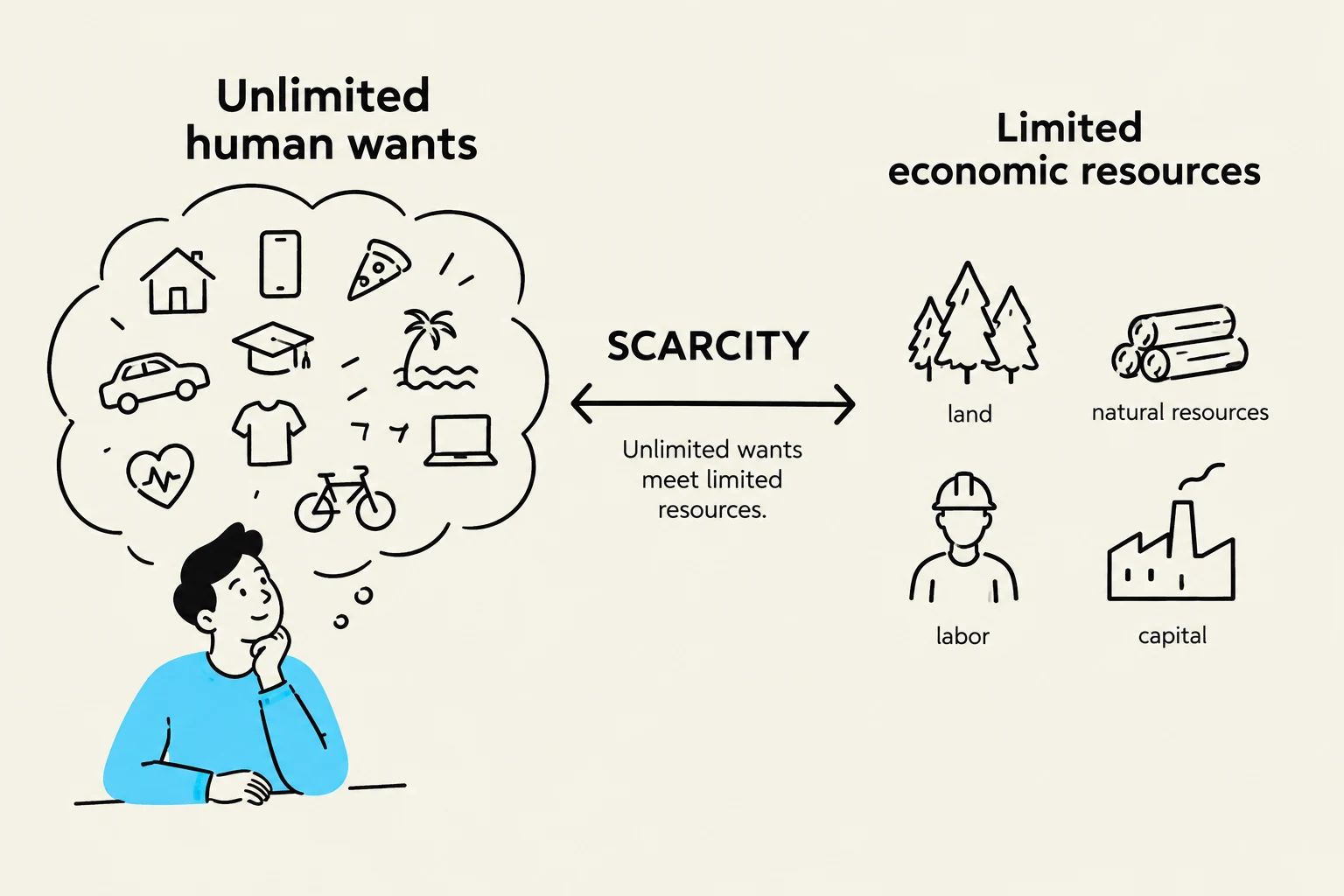
To understand why economics exists, we must first understand the concept of scarcity. Scarcity is the fundamental economic problem: human wants are virtually unlimited, but the resources available to satisfy those wants (such as land, labor, capital, and entrepreneurship) are finite.
Because we cannot have everything, we must choose. Every time a choice is made, something else is given up. This tension between infinite desires and finite resources is what necessitates an organized system of decision-making. Whether a nation is a global superpower or a small island economy, the pressure of scarcity remains the same.
Exam Tip: Remember that scarcity is not the same as "poverty." Even the wealthiest nations face scarcity because their resources, while vast, are still limited compared to the total potential wants of their citizens.
The Three Fundamental Economic Questions
Because scarcity forces us to make choices, every society must develop a method to decide how to allocate its limited resources. This decision-making process is distilled into three fundamental economic questions:
Keep reading for free.
Create an account to finish this reading and make it part of your study routine.
Continue reading freeAlready have an account? Log in
Updated