Examines how drug prohibition, rather than the substances themselves, drives violence, economic inequality, and systemic bias, disproportionately affecting vulnerable populations. Discusses alternatives like harm reduction and decriminalization.
When discussing the "dangers" of drugs, public discourse often focuses on the pharmacological effects of the substances themselves. However, a growing body of research suggests that many of the most severe harms—including lethal violence, the spread of infectious diseases like HIV and Hepatitis C, and the rise of organized criminal networks—are not inherent to the drugs, but are direct consequences of drug prohibition. By criminalizing substances, society creates high-profit, high-risk black markets that drive violence and disproportionately impact the most vulnerable members of the population.
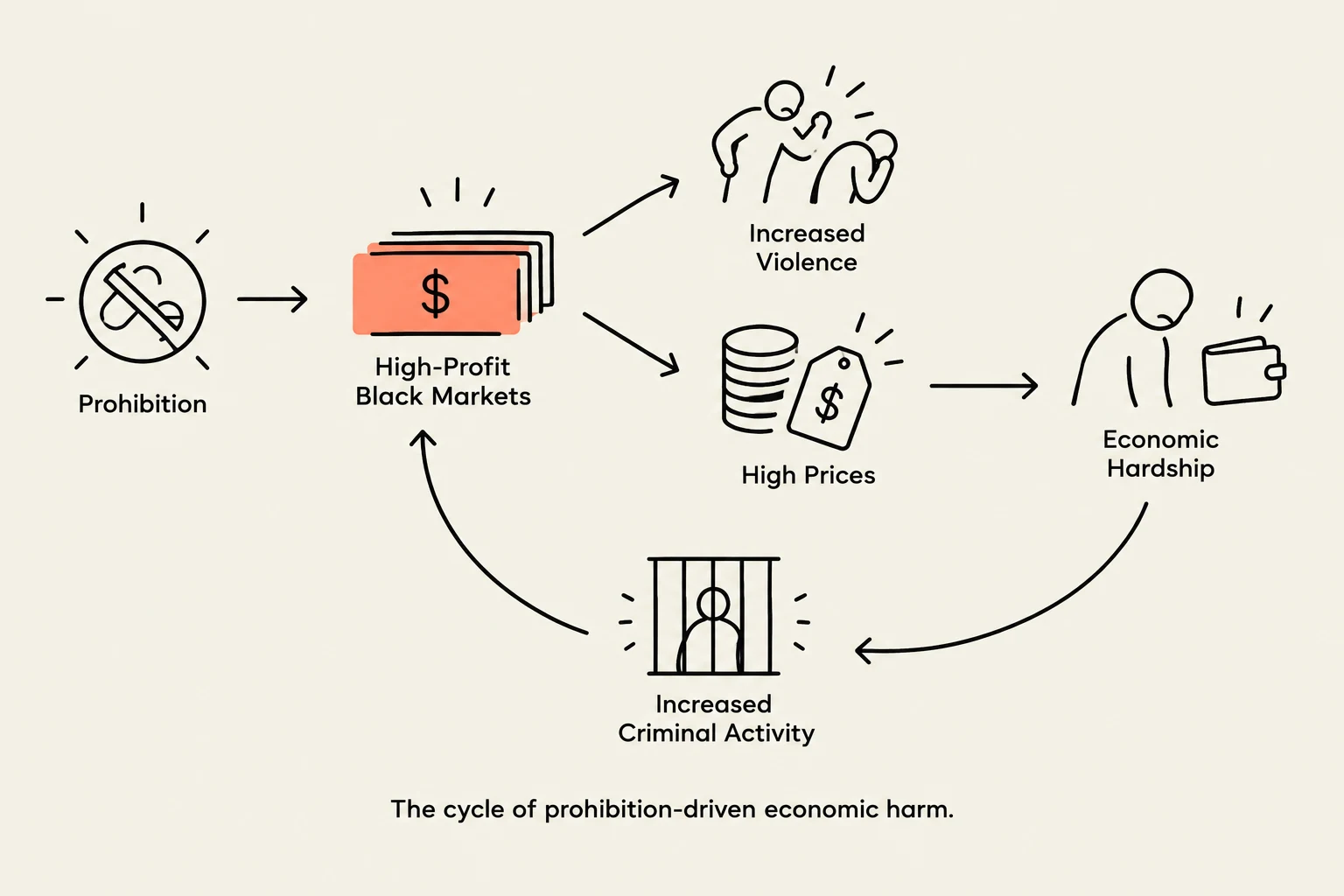
The cycle of prohibition-driven economic harm.
The Drivers of Social Devastation
Prohibition creates a cycle of harm that extends far beyond the individual user. One of the primary drivers of this devastation is economic inequality. Because illegal drugs are subject to high prices due to their illicit status, individuals facing economic hardship may resort to theft or violence to fund their usage. In contrast, middle-class individuals often have the financial stability to manage addictions without engaging in criminal activity, creating a class-based divide in how drug use is experienced and punished.
Furthermore, the root causes of addiction are frequently misunderstood. While drugs are often ideologically linked to "immorality" or social decline, research indicates that addiction is more closely tied to:
Social isolation
Childhood abuse and trauma
Economic circumstances
Study Tip: When analyzing social issues, distinguish between the substance (the pharmacological agent) and the system (the legal and economic framework surrounding it). Most modern sociological research focuses on the systemic harms of prohibition rather than the drugs themselves.
Racial Bias and the "Self-Fulfilling Prophecy"
Perhaps the most profound harm of drug prohibition is its impact on racialized communities. In many societies, drug laws are applied through a lens of racial bias in policing, which transforms social issues into criminal justice crises.
In Canada, for example, the "War on Drugs" has been used as a tool to manage and control Black populations. This is often achieved through racial profiling—a practice where law enforcement targets individuals based on stereotypes rather than evidence of a crime. This creates what experts call a "self-fulfilling prophecy": the more a specific group is surveilled and targeted, the more likely they are to be caught for offenses that are actually widespread across all demographics.
The consequences of this bias are staggering:
Disproportionate Incarceration: In Ontario, Black youth are incarcerated at a rate four times higher than white youth.
Systemic Surveillance: Practices like "carding" (or street checks) allow police to create massive databases of racialized individuals, infringing on their ability to move freely in public spaces.
Intergenerational Trauma: The removal of parents from communities through incarceration leads to long-term social and economic instability for families.
Systemic Economic Marginalization
This graph compares the public funds allocated to incarceration costs versus social investment in programs addressing the root causes of addiction. It indicates that approximately 80-90% of public funds are spent on housing inmates and running prisons, while only about 5-10% is allocated to social reintegration and support programs.
The intersection of drug laws and systemic economic marginalization creates a trap for many. Law enforcement efforts often focus on minor suppliers and couriers—individuals who are frequently poor and vulnerable. While these arrests are highly visible, they have a negligible impact on the actual availability of drugs on the market, as the high-level criminal networks remain largely untouched.
Instead of addressing the economic roots of crime, the state often invests in "tough on crime" policies. This results in a massive diversion of public funds:
High Incarceration Costs: In Canada, it costs significantly more to house an inmate than to fund social reintegration programs.
Loss of Human Capital: Incarceration strips individuals of their ability to participate in social, economic, and political life, making it nearly impossible to escape the cycle of poverty.
Moving Toward Harm Reduction and Decriminalization
Given the documented failures of the carceral approach, medical, legal, and human rights experts are increasingly advocating for a paradigm shift. The goal is to move away from punitive measures and toward harm reduction and decriminalization.
Evidence-Based Alternatives
Rather than treating drug use as a criminal matter, proposed models suggest treating illicit substances with social policies similar to those used for tobacco or dangerous foods. Key strategies include:
Decriminalization: Removing criminal penalties for non-violent drug offenses to reduce the burden on the justice system and prevent the creation of criminal records for minor infractions.
Regulation: Bringing drug production and sale into a regulated framework to ensure quality control and reduce the violence associated with black markets.
Harm Reduction Materials: Distributing tools (such as clean needles or supervised injection sites) to prevent the spread of disease and reduce overdose deaths.
The Scale of the Issue
It is important to note that the vast majority of drug users do not experience "problem drug use." Scientific evidence from 2014 showed that of 246 million global drug users, only 11 percent experienced significant issues. This suggests that the "crisis" is often a matter of how society responds to use, rather than the scale of use itself.
Summary Concept:Harm Reduction focuses on minimizing the negative consequences of drug use (e.g., preventing HIV or overdose) rather than demanding immediate, total abstinence through punishment.
By shifting the focus from punishment to support, societies can begin to address the underlying issues of trauma, poverty, and inequality that drive substance use, ultimately creating safer and more just communities for everyone.
Keep reading for free.
Create an account to finish this reading and make it part of your study routine.