The Slippery Slope: Fear of Concession and Radicalization of Reform
Examines the 'slippery slope' argument as a psychological driver for ruling classes during social upheaval, particularly in the French Revolution. It details how fears of escalating demands from concessions led to resistance against reform, contrasting elite and worker perspectives on social stability and change.
In the study of political history and sociology, few rhetorical devices are as pervasive as the "slippery slope" argument. This logic suggests that a relatively small first step will inevitably lead to a chain of related (and typically negative) events, culminating in a significant and often catastrophic outcome. While often used as a logical fallacy in modern debates, the slippery slope was a very real and potent psychological driver for the ruling classes during eras of intense social upheaval, such as the French Revolution.
For those in power, the debate was rarely about the merits of a single reform; instead, it was about the perceived momentum of change. The central fear was that granting minor concessions to the working class would not satisfy their hunger for justice, but would instead act as a catalyst for radical economic demands that could dismantle the existing social order entirely.
The Logic of the Slope
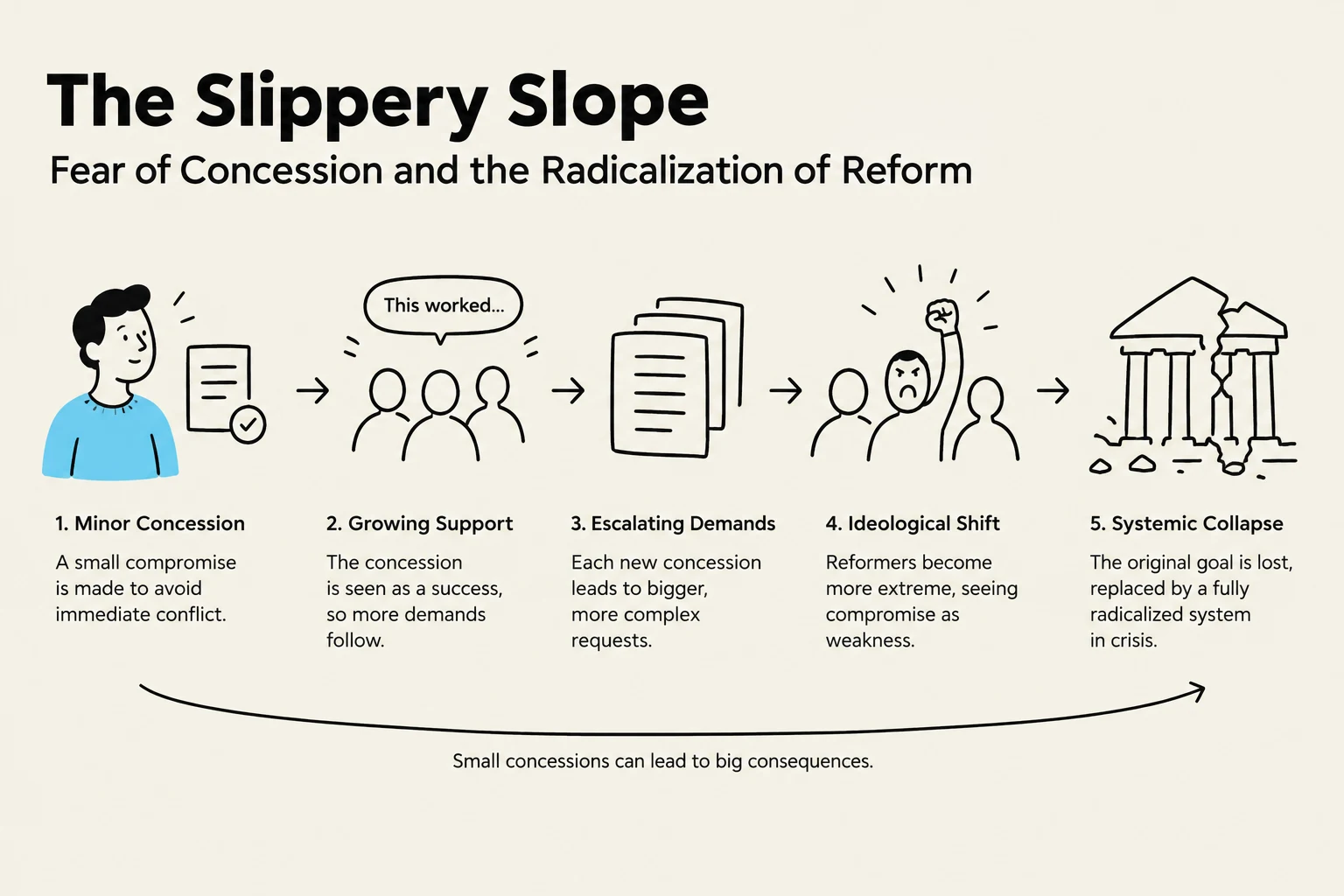
To understand why the ruling class viewed reform as a danger, one must understand the mechanics of the slippery slope argument. In a political context, the argument follows a specific progression:
The Concession: A small, seemingly reasonable demand is made (e.g., shorter working hours or higher wages).
The Precedent: Granting this demand establishes a legal or moral precedent that the ruling class is "negotiable."
The Escalation: Once the precedent is set, workers feel empowered to demand more significant changes (e.g., ownership of the means of production).
The Collapse: The cumulative effect of these demands leads to the total dissolution of the current economic and political hierarchy.
A diagram illustrating the concept of the slippery slope, where initial minor concessions can lead to escalating demands, ideological shifts, and ultimately systemic collapse.
Exam Tip: When analyzing historical texts, distinguish between the logical slippery slope (which claims a connection without proof) and the political slippery slope (where the fear is based on the actual mobilization of social movements).
Historical Context: The French Revolution and Beyond
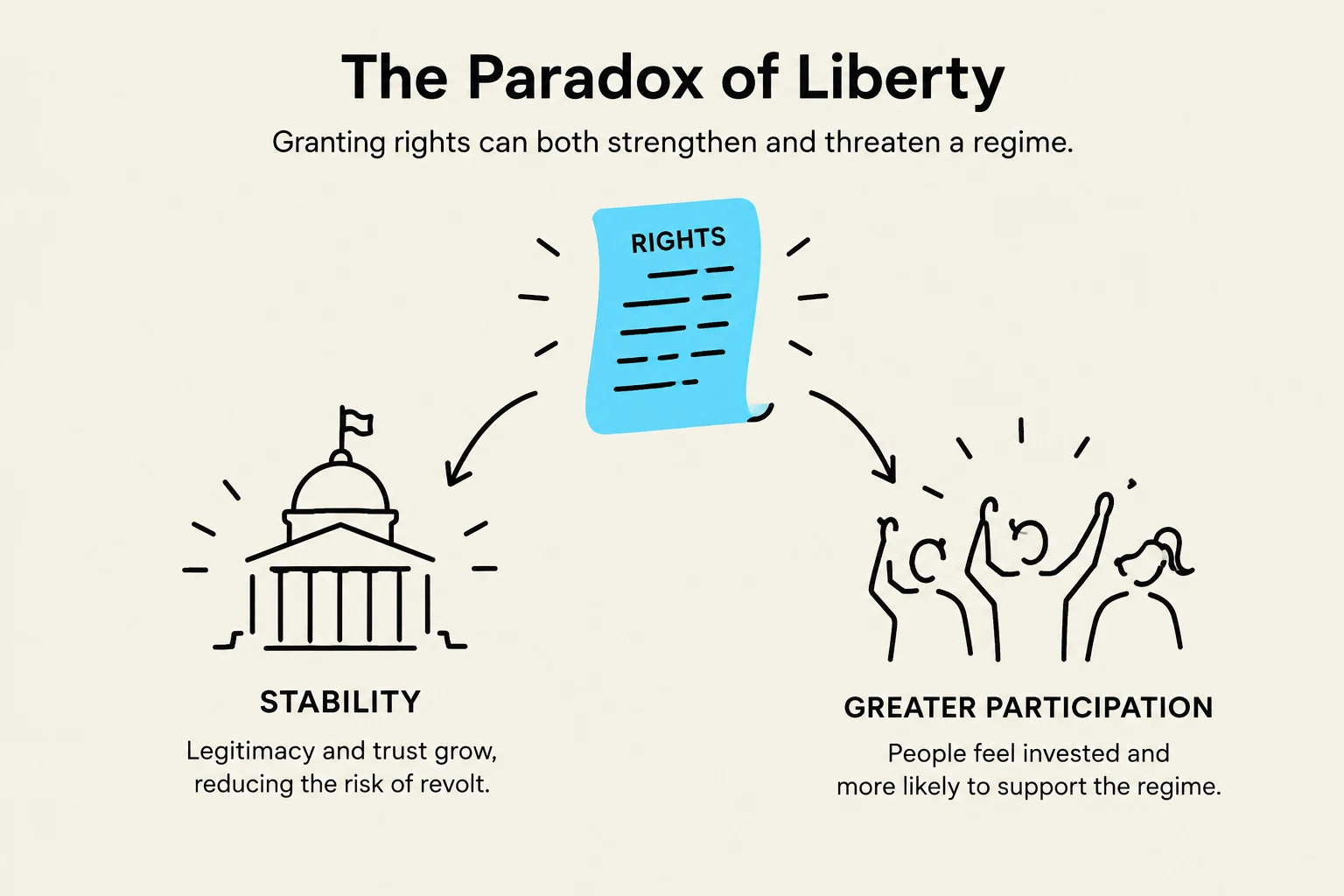
The tension between reform and revolution is perhaps most visible in the study of the French Revolution. During this period, the paradox of liberty became a central theme: the very rights intended to liberate the citizenry often created the friction necessary to ignite radicalism.
The ruling aristocracy and the burgeoning bourgeoisie often found themselves in a defensive crouch. They recognized that the demands of the Third Estate were not static. A demand for "taxation with representation" could easily morph into a demand for the total abolition of feudal privileges. This created a paradox: if the state refused to reform, it risked a violent explosion; if it did reform, it risked a slow, unstoppable slide toward radicalism.
The Paradox of Liberty illustrates how granting rights can lead to both increased stability and greater participation in a regime, but also potentially threaten it.
The Economic Dimension: From Rights to Ownership
The slippery slope was most acute when discussing economic rights. For the ruling class, there is a fundamental difference between distributive reforms and structural reforms.
Distributive Reforms: These involve changing how existing wealth is shared (e.g., higher minimum wages, social safety nets).
Structural Reforms: These involve changing who owns the wealth and the institutions that manage it (e.g., nationalization of industry, land redistribution).
The fear held by the elite was that distributive reforms were merely "gateway" demands. They believed that once the working class achieved a baseline of economic security, their focus would shift from improving their condition within the system to replacing the system itself.
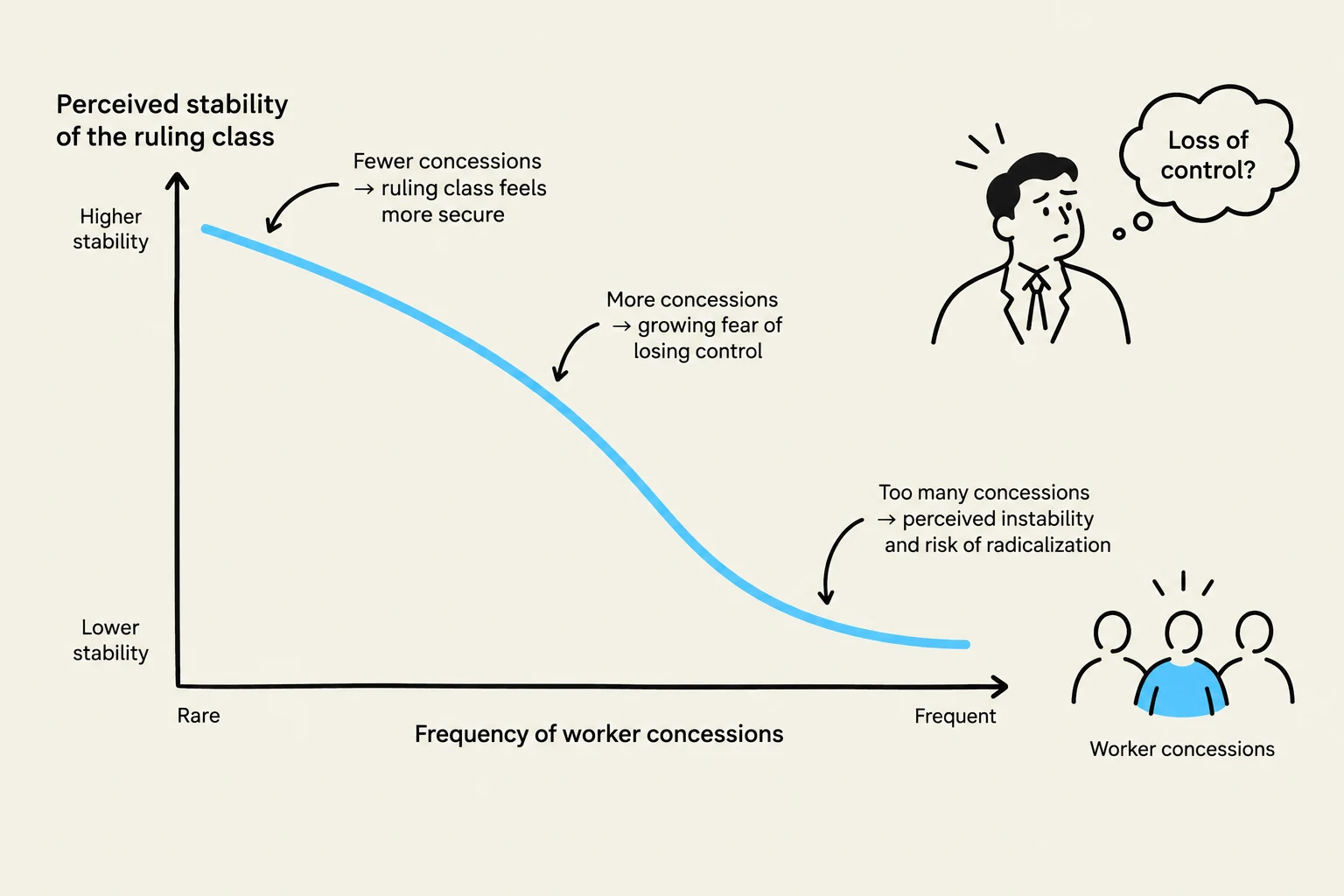
To visualize this tension, consider the following relationship between reform intensity and systemic stability:
Stability∝Rate of Radicalization1
If the rate of radicalization (the speed and depth of new demands) exceeds the state's ability to absorb those demands through reform, the system enters a state of volatility.
This graph illustrates the relationship between the frequency of worker concessions and the perceived stability of the ruling class, suggesting that while fewer concessions can increase perceived security, too many can lead to instability and radicalization.
Summary for Students
When studying the history of social movements and class struggle, remember that the "slippery slope" is not just a fallacy to be avoided in debate; it was a strategic worldview used by those in power to justify the maintenance of the status quo.
Concept
Ruling Class Perspective
Worker/Radical Perspective
Minor Reform
A dangerous precedent that invites more demands.
A necessary step toward justice and survival.
Social Stability
Maintained through strict adherence to existing hierarchies.
Maintained through the equitable distribution of resources.
The "Slope"
An inevitable descent into chaos and loss of property.
A ladder of progress toward greater rights and liberty.
By understanding this dichotomy, students can better analyze why historical periods of reform are often accompanied by intense reactionary movements and why "compromise" is frequently viewed as a losing battle by both sides.
Keep reading for free.
Create an account to finish this reading and make it part of your study routine.