The Six Core Principles of Economics: An Introduction to Economic Thinking
Explore the fundamental principles of economics, including scarcity, opportunity cost, incentives, economic systems, voluntary trade, and the long-term consequences of choices. This guide provides a framework for understanding economic decision-making.
Economics is often misunderstood as merely the study of money, wealth, and finance. While these topics are certainly part of the field, the true essence of economics is much broader: it is the study of choices. Specifically, it examines how individuals and groups make decisions in a world of scarcity, where people cannot have everything they want.
By learning the "economic way of thinking," you gain a logical and objective framework to analyze human behavior and societal problems. This framework is built upon six core principles that serve as the foundation for understanding how the world functions.
1. People Make Choices
The most fundamental principle is that economic activity is driven by decision-making. Every day, individuals make thousands of decisions, ranging from trivial matters like which socks to wear to complex life choices like pursuing higher education or buying a home. Some research even suggests that the average adult makes approximately 35,000 conscious decisions in a single day.
Because we live in a world of scarcity—a condition where wants and needs exceed the available resources—we are forced to choose between different options. Whether it is a person deciding how to spend their afternoon or a nation deciding how to allocate its budget, the act of choosing is central to the human experience.
2. All Choices Involve Costs
Since resources like time, money, and energy are limited (known as constraints), every choice requires a trade-off. A trade-off is the act of giving up one thing in order to gain something else.
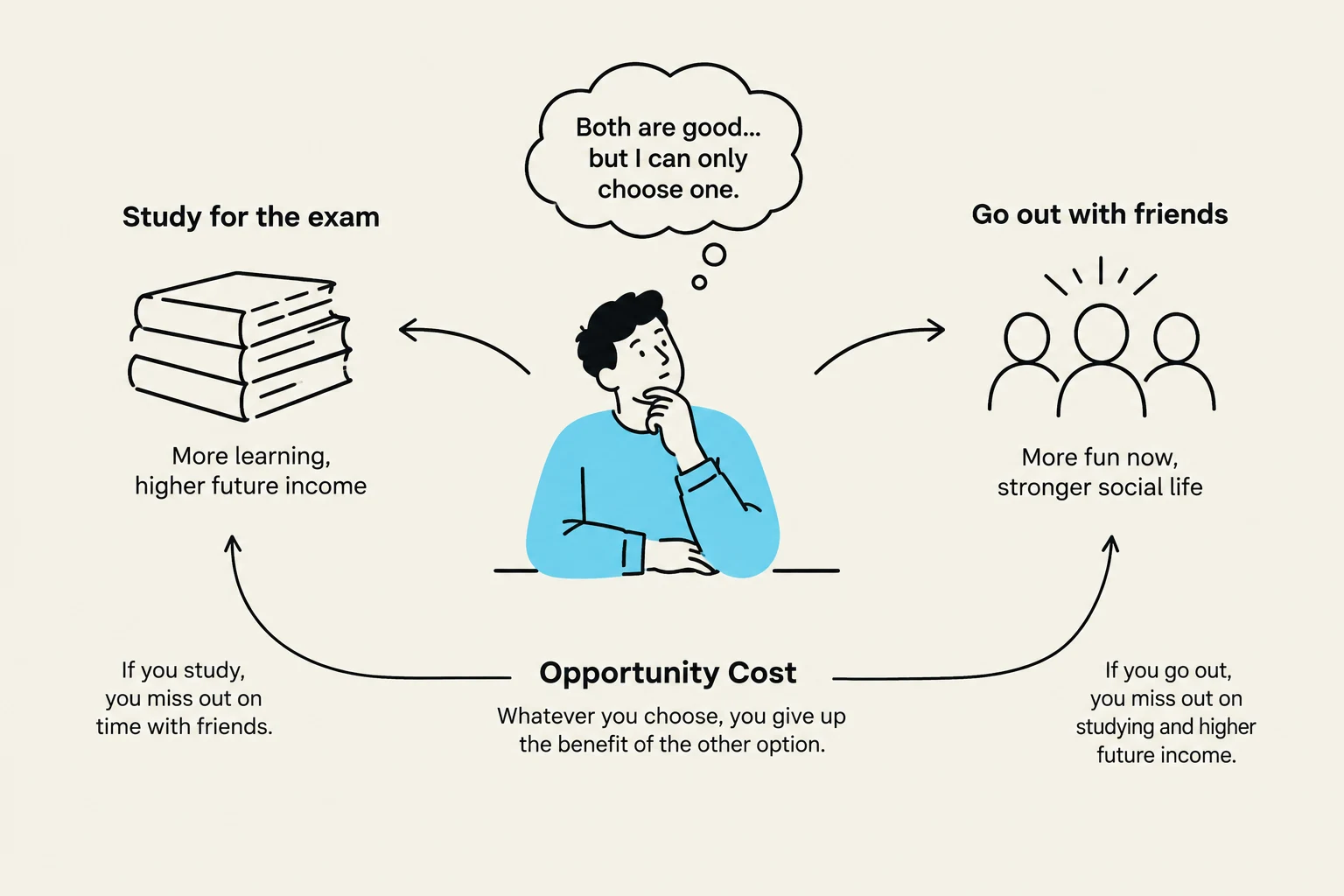
This leads directly to the concept of opportunity cost. The opportunity cost is the value of the next best alternative that you must give up to pursue a certain action. It is important to remember that costs are not always monetary; they can be non-monetary, such as the time lost while waiting in line.
Worked Example: The Cost of Time
Imagine you are a business traveler spending 30 minutes in an airport security line. If your time is valued at $20 per hour, the non-monetary opportunity cost of that delay is:
Opportunity Cost=0.5 hours⋅$20/hour=$10
While you didn't "spend" ten dollars, you sacrificed ten dollars' worth of time that could have been used for other productive activities.
This diagram illustrates the concept of opportunity cost, showing the trade-offs between studying for an exam and socializing with friends.
3. People Respond to Incentives in Predictable Ways
An incentive is a reward that makes a person better off or a penalty that makes them worse off. Because humans generally act to improve their well-being, they respond to these stimuli in predictable patterns.
For example, if the price of milk doubles, people are likely to buy less of it. If a government offers a tax credit for buying electric vehicles, more people will likely purchase them. Incentives can be used by policymakers to encourage positive behaviors (like saving money through higher interest rates) or discourage negative ones (like using taxes to reduce certain activities).
4. Economic Systems Influence Choices and Incentives
While individuals make choices, the broader economic system provides the rules and methods that influence those choices to achieve a "greater good". Different societies use different mechanisms to motivate people to work and produce goods:
Tradition: Some economies rely on long-standing customs where jobs are passed down through generations.
Financial Incentives: Many modern economies use wages to attract workers to specific fields. For instance, if there is a shortage of doctors, the rising income potential will entice more people to enter medical school.
Government Mandates: In some systems, the government may use quotas or direct assignments to ensure that essential services are staffed.
5. People Gain When There is Voluntary Trade
Trade is the exchange of goods or services for money or other goods. A critical distinction in economics is between voluntary trade and coercion.
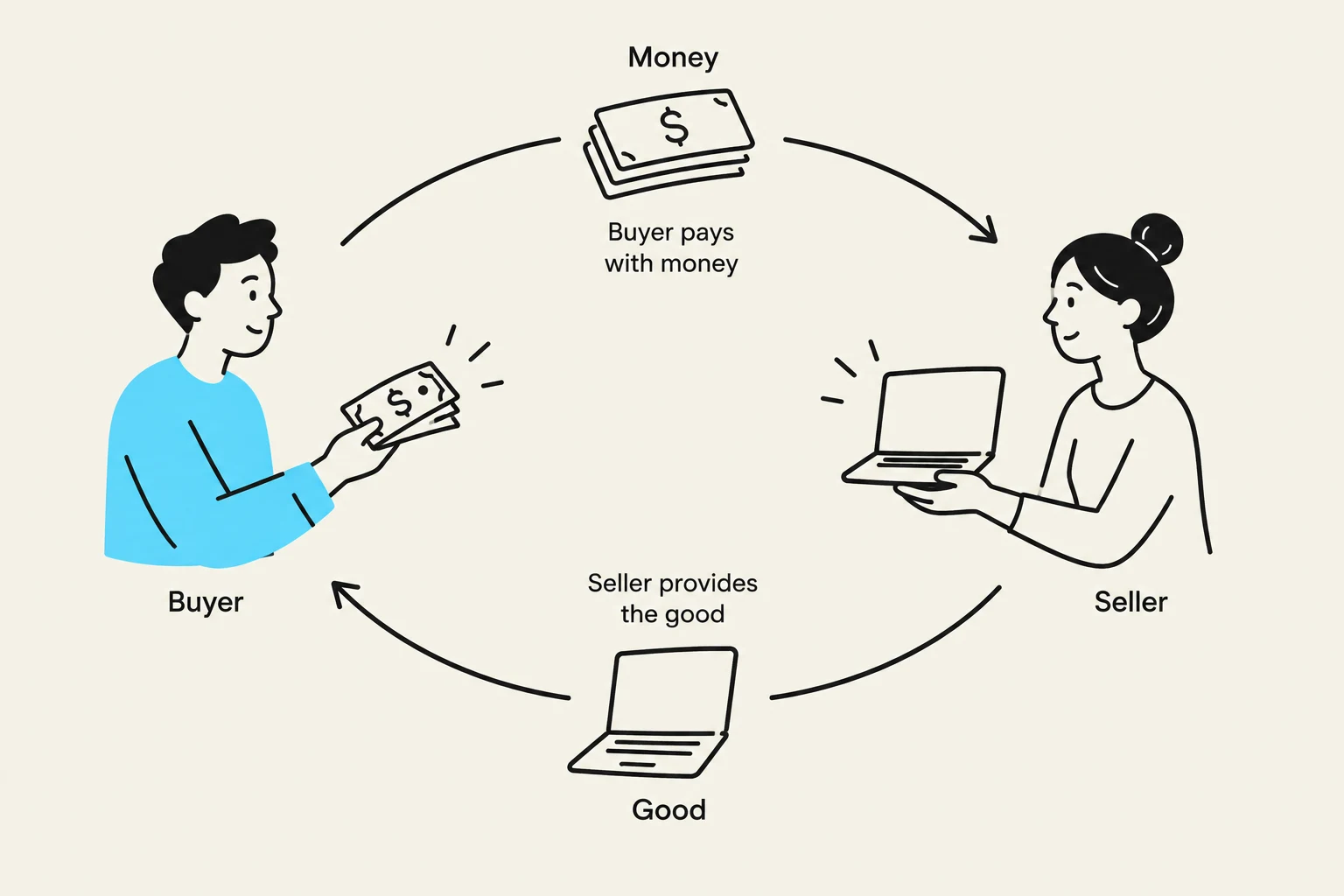
In a voluntary trade, all parties participate because the transaction is mutually beneficial; both the buyer and the seller feel they are better off after the exchange. This process improves our standard of living by allowing us to specialize in what we do best and trade for the rest. In contrast, coercion involves forcing a party into a transaction, which leaves at least one person worse off.
This diagram illustrates a basic transaction cycle where a buyer exchanges money for a good provided by a seller.
6. The Consequences of Choices Lie in the Future
Finally, we must recognize that many decisions have long-term impacts that are not immediately visible. While some choices are inconsequential (like choosing a sandwich for lunch), others can have massive societal or environmental repercussions.
A classic example is the use of single-use plastics. Choosing a plastic bag at the grocery store may seem convenient in the moment, but the long-term consequence is the accumulation of plastic debris in our oceans, which devastates marine life. By understanding this principle, we can better evaluate how our current actions shape the world for future generations.
Summary Table: The Economic Way of Thinking
Principle
Core Concept
Choices
Scarcity forces us to decide between alternatives.
Costs
Every choice has an opportunity cost (the next best thing lost).
Incentives
People react to rewards and penalties in predictable ways.
Systems
Economic structures shape how incentives work.
Trade
Voluntary exchange makes all participants better off.
Future
Current decisions create long-term consequences.
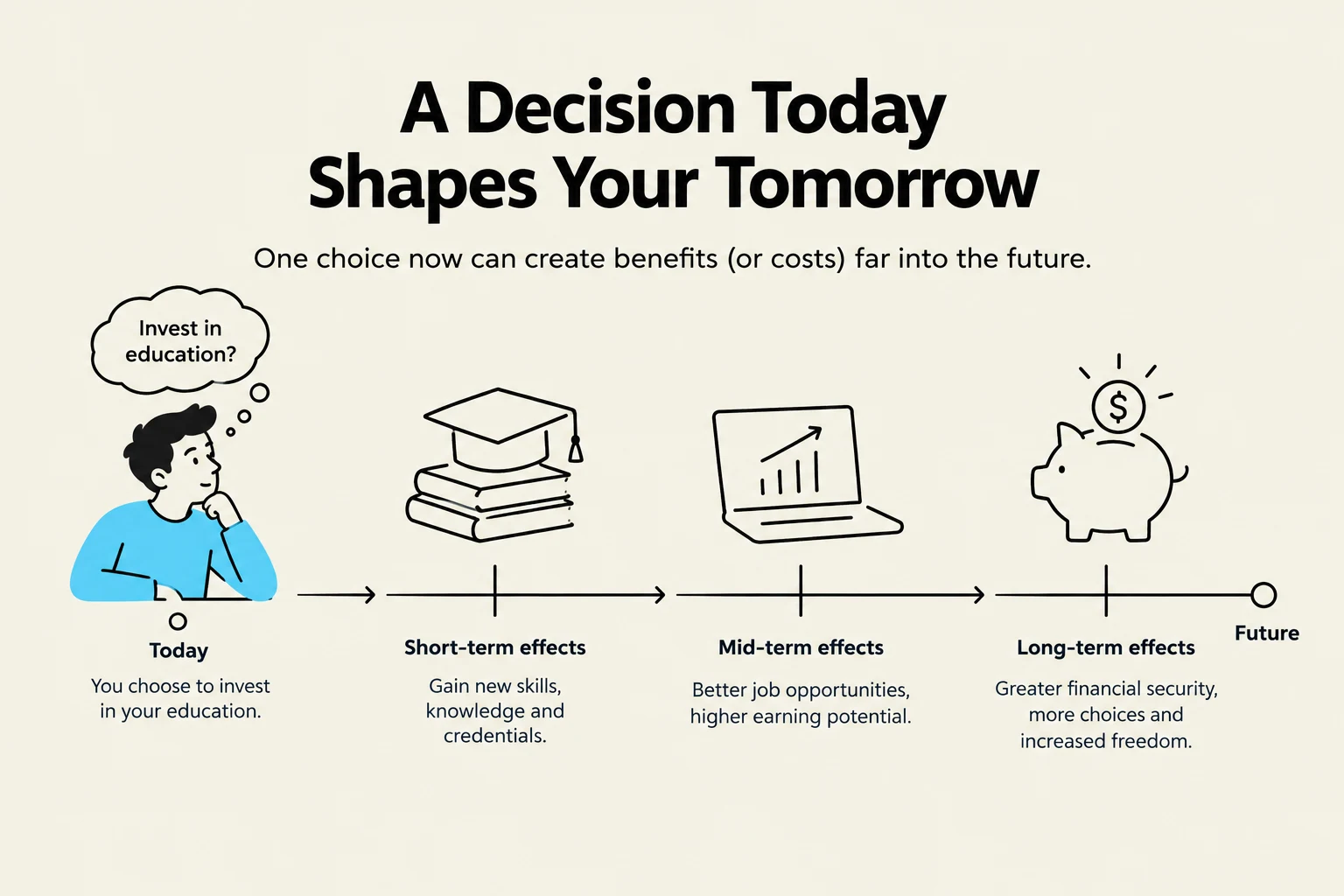
This illustration depicts the long-term benefits of investing in education, showing how a decision made today can lead to short-term gains in skills and knowledge, mid-term improvements in job opportunities and earning potential, and ultimately, long-term financial security and freedom.
Keep reading for free.
Create an account to finish this reading and make it part of your study routine.