In contemporary Canada, the assertion of Indigenous sovereignty is often met not with diplomatic negotiation, but with the sophisticated machinery of the state. While much of the public discourse focuses on the "war on terror" as a tool for international security, these same resources and legal frameworks have been redirected inward. This shift has facilitated the rise of a "security state"—a sprawling, integrated network of national security agencies, policing bodies, public bureaucracies, and private industry partners. Far from being a neutral provider of public safety, this apparatus functions to protect the interests of extractive capitalism and the ongoing structures of settler colonialism.
Understanding Settler Colonialism and the "Logic of Elimination"
To understand why the state targets Indigenous movements, one must distinguish between traditional colonialism and settler colonialism. While traditional colonialism often focuses on the exploitation of labor and resources from a distance, settler colonialism is characterized by the desire to replace Indigenous societies with a new settler-majoritarian polity.
This process operates through what scholars call a "logic of elimination". This is not necessarily a series of discrete, violent events, but a structural process aimed at the disappearance of Indigenous peoples as distinct political and social entities. This elimination is achieved through two primary mechanisms:
Land Theft: The systematic dispossession of Indigenous territories to facilitate the extraction of wealth through mining, pipelines, and forestry.
Subjectivity Production: The creation of a "post-colonial imaginary"—a national myth that Canada is a "post-colonial" or "raceless" society. By claiming that colonialism is a thing of the past, the state can treat any assertion of Indigenous autonomy as an "abnormal" or criminal disruption of the modern order.
Study Tip: When analyzing settler colonialism, remember that it is a structure, not an event. It is an ongoing process of land acquisition and the management of Indigenous populations to ensure settler dominance.
The Security State and the "War on Terror"
The modern expansion of the security state has been heavily fueled by the discourses of the "war on terror". While originally intended to combat international terrorism, the legal and financial resources of this era have been repurposed for domestic social control.
By utilizing labels such as "Aboriginal extremism" and identifying Indigenous lands as "critical infrastructure," the state can reframe political resistance to resource extraction as a threat to national security. This allows the state to bypass traditional criminal law and employ the more aggressive, secretive, and pre-emptive powers of national security agencies.
The Fusion Centre Approach
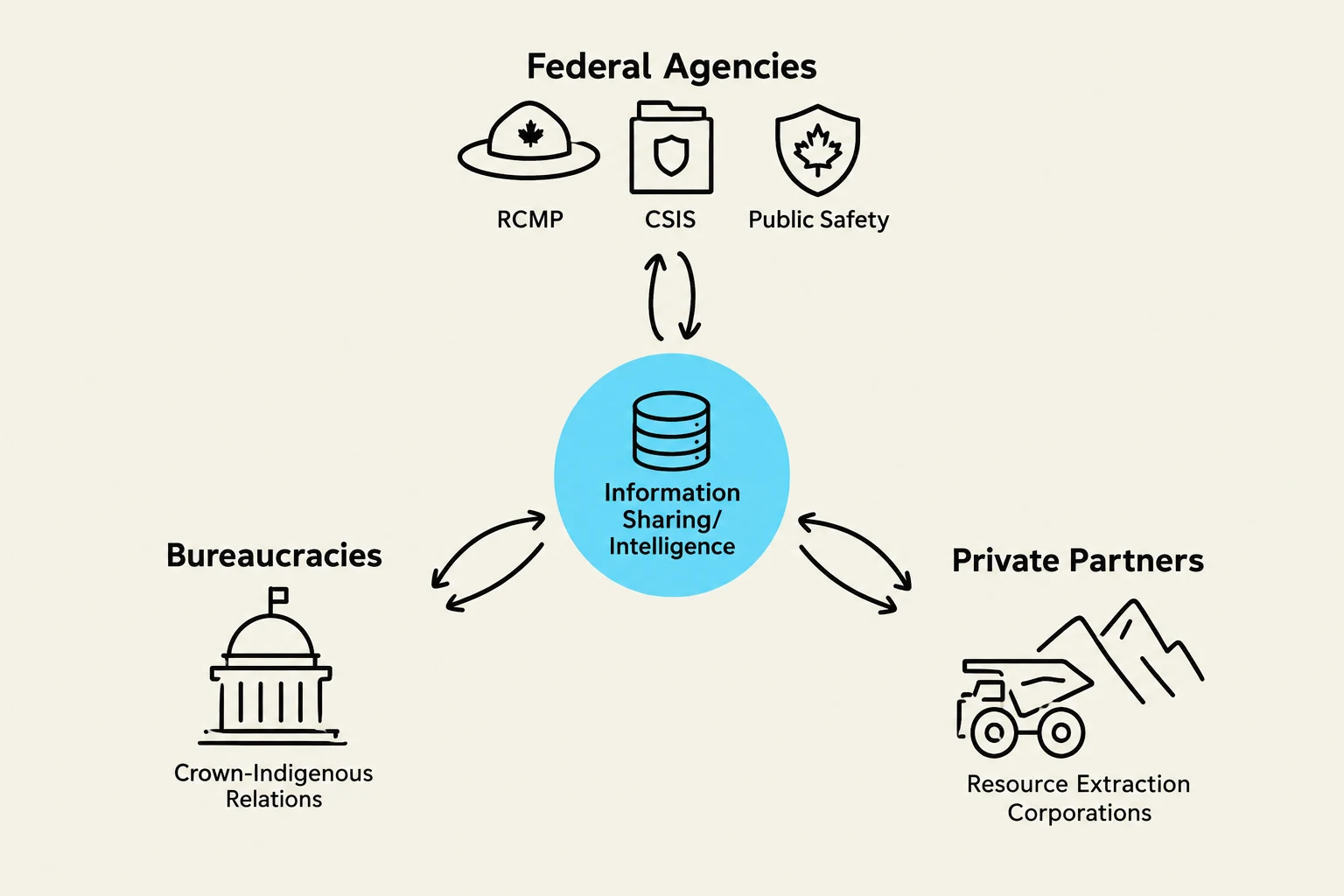
This diagram illustrates the flow of information and intelligence sharing between Federal Agencies (RCMP, CSIS, Public Safety), Bureaucracies (Crown-Indigenous Relations), and Private Partners (Resource Extraction Corporations).
A defining feature of this new era is the "fusion centre" approach. This is a model of "integrated" policing where information is shared seamlessly across a massive network of actors, including:
Federal Agencies: The RCMP, Canadian Security Intelligence Service (CSIS), and Public Safety Canada.
Bureaucracies: The Indian Affairs bureaucracy (now split into Crown-Indigenous Relations and Indigenous Services).
Private Partners: Industry and corporate entities involved in resource extraction.
This integration ensures that intelligence gathered on an activist is not confined to a single police file but is circulated through various databanks, making it available to "front-line officers, divisional analysts, and law enforcement partners" indefinitely.
Case Study: Project sITKA and Intelligence-Led Surveillance
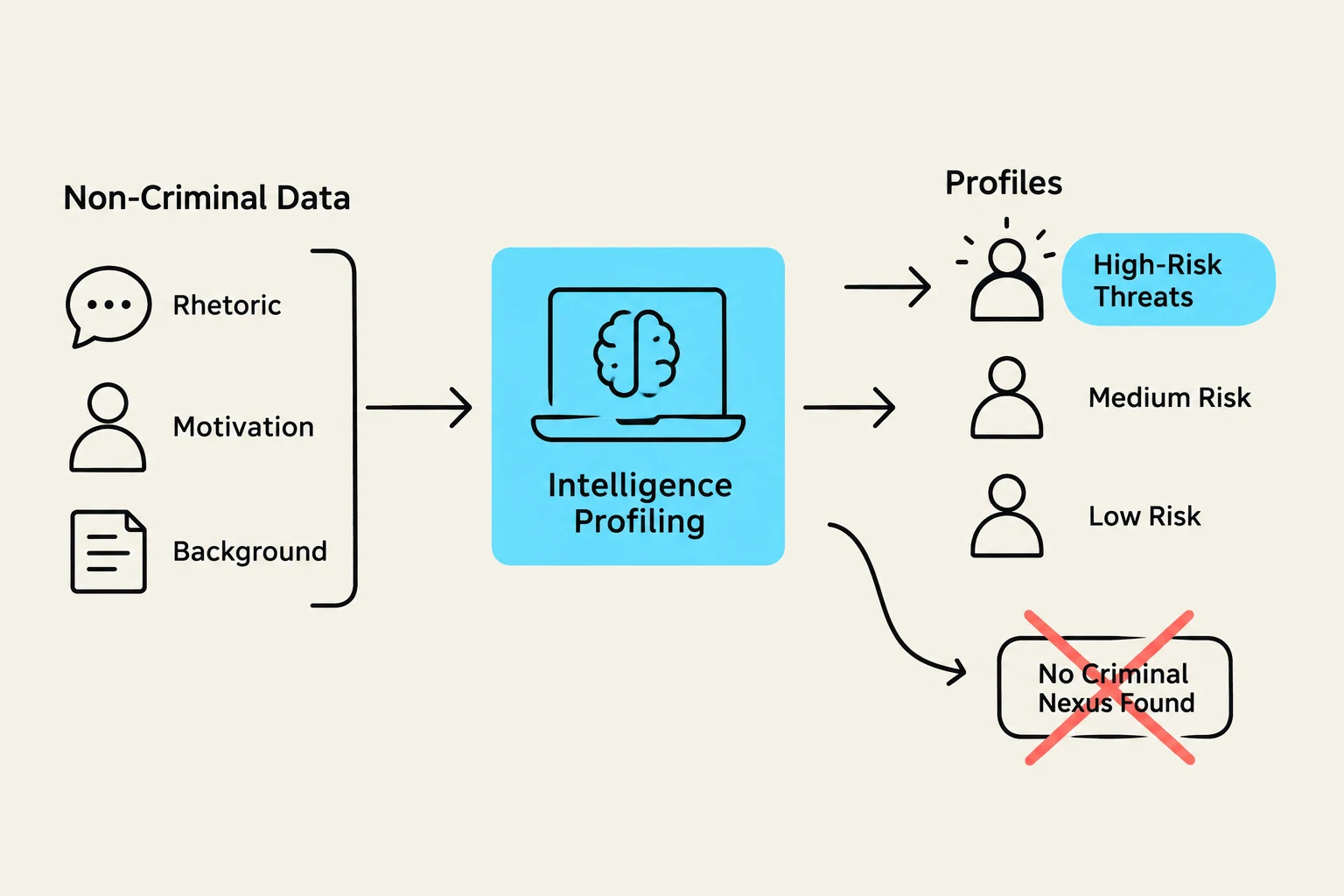
This diagram illustrates a process of intelligence profiling using non-criminal data to categorize individuals into risk profiles, including high-risk threats, medium risk, low risk, or no criminal nexus found.
The mechanics of this surveillance regime are best illustrated by Project sITKA, a secret RCMP investigation into Indigenous activism. Launched in response to a resurgence in Indigenous movements—such as Idle No More and resistance to natural resource development—the project aimed to identify "core subjects" who posed a threat to the status quo.
The project utilized intelligence-led surveillance to create extensive profiles of 313 individuals. These profiles were not based on evidence of actual crimes, but on the individuals' "background, motivation and rhetoric".
Project sITKA Data Points
Description
Total Individuals Profiled
313
Classified as "High-Risk"
89
Primary Interest
Natural resource development (pipelines, mining, shale gas)
Methodology
Evaluation of "volatile, disruptive, or passive" behaviors
Despite the RCMP admitting they found "no intentional criminal nexus" and "no known evidence" that these individuals posed a direct threat to critical infrastructure, 89 people were nonetheless classified as high-risk threats. This demonstrates how the security state uses surveillance to pre-emptively disrupt self-determination and movements that challenge extractive capitalism.
Conclusion: The Path Toward Decolonization
The security state functions as a mechanism to safeguard the "settler colonial present" by transforming political resistance into national security threats. By framing Indigenous sovereignty as "extremism," the state attempts to make the demand for land rights and autonomy "unspeakable" within the framework of Canadian law.
Ultimately, the conflict between the security state and Indigenous Peoples cannot be resolved through mere "policing reform" or "increased oversight". Because the security state is an integral component of the settler colonial structure, true resolution requires decolonization—a process that necessitates the centering of Indigenous sovereignty and the dismantling of the pervasive surveillance regimes that seek to eliminate it.
Key Concept Summary:
Security State: An integrated network of agencies and industry partners using surveillance to protect settler interests.
Extractive Capitalism: The economic driver that necessitates the policing of Indigenous land defenders.
Self-Determination: The political goal of Indigenous movements that the security state seeks to neutralize.
Keep reading for free.
Create an account to finish this reading and make it part of your study routine.