The SDU Dilemma: Housing Rights and Policy in Hong Kong
Examines the issue of sub-divided units (SDUs) in Hong Kong, exploring the conflict between property rights and the right to housing, market and government failures contributing to the problem, and policy responses including regulatory measures, increased housing supply, and community support.
In the dense urban landscape of Hong Kong, a unique and controversial housing phenomenon has emerged: the sub-divided unit (SDU). While not explicitly defined in the Buildings Ordinance, these units are commonly understood as domestic flats that have been partitioned into two or more self-contained smaller units for rental purposes. For many low-income residents, these units represent the only "affordable" option in a city where the private rental market has seen prices double in a single decade. However, this market response to housing unaffordability brings with it profound questions regarding legal safety, the clash of fundamental rights, and the effectiveness of government intervention.
The Reality of Sub-divided Units: Safety and Market Failure
The proliferation of SDUs is a symptom of two simultaneous failures: market failure and government failure. Market failure is evident in the widening gap between private housing rents and median household income; between 2009 and 2019, the rent index rose from 95.4 to 200.1, far outstripping the 69.05% increase in median income. Simultaneously, government failure is seen in the long waiting lists for Public Rental Housing (PRH), which reached over 245,200 applications with an average waiting time of 6.1 years as of March 2022. This lack of public supply, coupled with a deep-rooted shortage of "spade-ready" land, forces low-income dwellers into the SDU market.
The physical reality of these units often compromises the "right to housing" in terms of habitability and safety. Sub-dividing a flat typically involves destroying original partition walls and installing new electrical wiring, water, and drainage systems. These modifications can increase the building's structural loading and create significant fire safety risks, such as blocked escape routes or a lack of openable windows.
Exam Tip: When discussing SDUs, distinguish between "Legal Sub-dividing" and "Illegal Sub-dividing." Legal works must fall under the Building (Minor Works) (Amendment) Regulation 2012, requiring qualified professionals to ensure compliance with fire and structural safety standards.
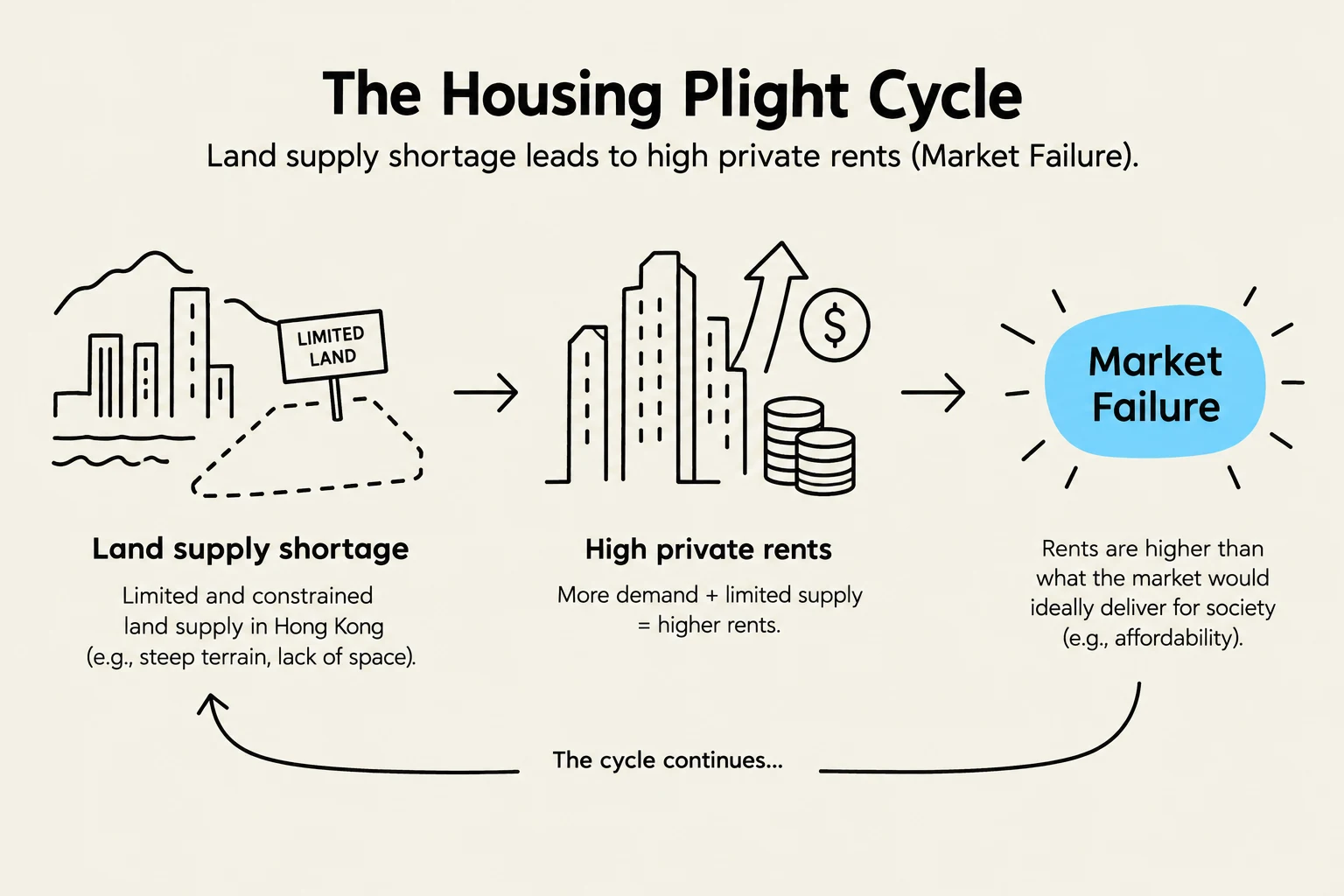
This diagram illustrates the housing plight cycle, where a shortage of land supply leads to high private rents and market failure, characterized by rents exceeding societal affordability. The cycle is depicted as a continuous loop.
The Clash of Rights: Property vs. Housing
At the heart of the SDU controversy lies a fundamental conflict between two sets of rights: the private property rights of the landlord and the human right to housing for the tenant. To understand this, we must view property rights as a "bundle of rights" consisting of two dimensions:
Vertical Rights of Ownership: The relationship between the owner and the resource. This includes the right to trade, manage, and use the property to generate income. From this view, a landlord may feel justified in sub-dividing a flat to maximize rental returns.
Horizontal Rights of Ownership: The relationship between the owner and other citizens. This includes the right to exclude others and make decisions regarding the property.
The conflict arises because the exercise of these rights can infringe upon the well-being of others. While a landlord uses their vertical rights to generate profit, the resulting sub-standard living conditions threaten the dweller's right to a safe and decent home.
Concept Check: Think of property rights like car ownership. A car owner has the right to use their vehicle, but they do not have the right to drive at excessive speeds or endanger pedestrians. Similarly, property owners are subject to building regulations to ensure they do not harm society.
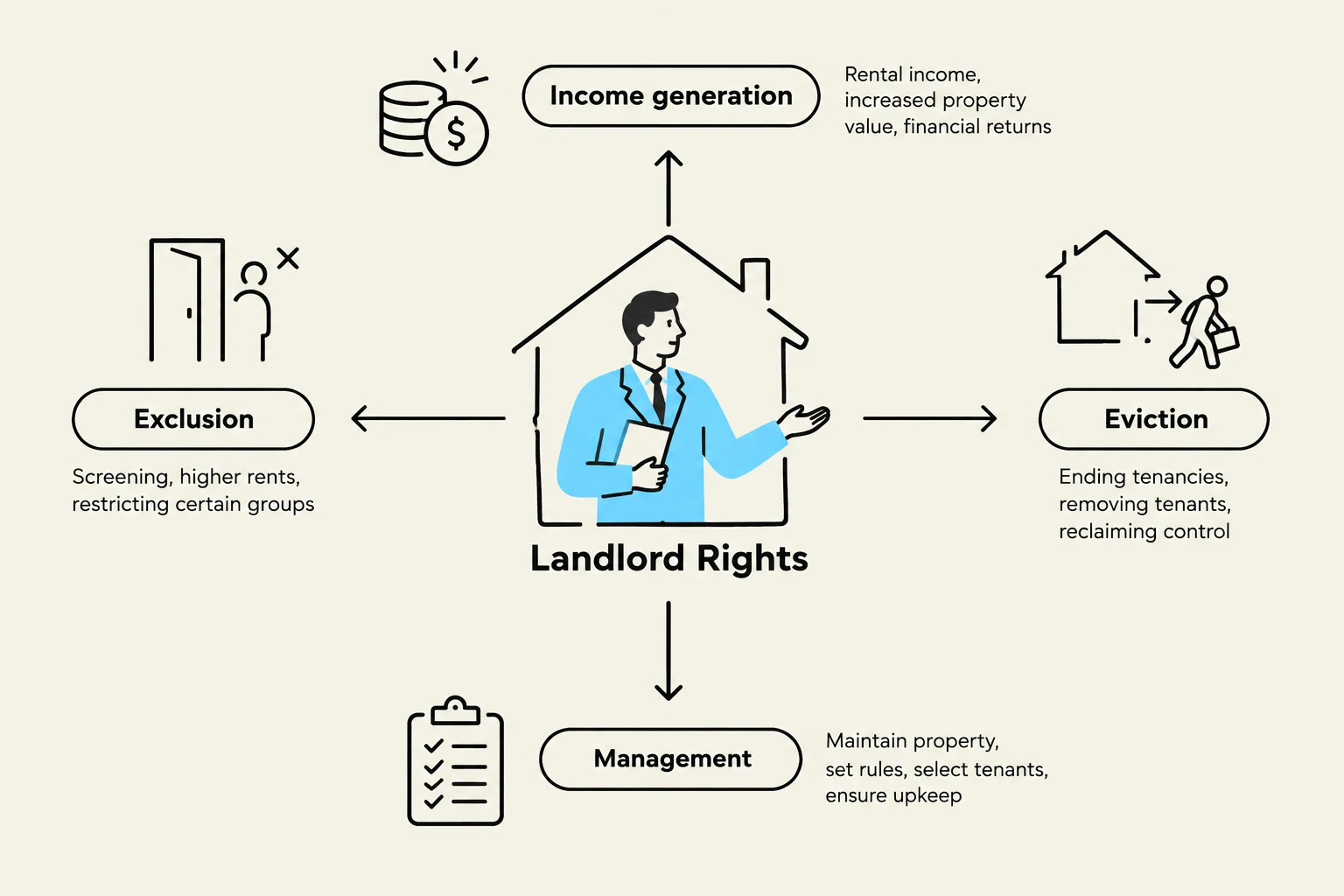
This diagram illustrates various aspects of landlord rights, including income generation, exclusion, eviction, and management.
Policy Responses: From Palliatives to Structural Solutions
Because many residents feel they have a "fake choice"—where the only alternatives to SDUs are even worse conditions like coffin homes or board-partitioned rooms—the government has moved from a "toleration policy" toward more active regulation and supply-side solutions.
1. Regulatory and Tenancy Measures
To address the asymmetry in landlord-tenant relations—where many tenants lack stamped tenancy agreements and face "forced" evictions or unreasonable rent hikes—new measures have been introduced. The 2022 tenancy and rent control ordinance provides four-year tenure protection and limits rent increases. Furthermore, the Basic Housing Unit (BHU) regulatory regime, set to take effect in March 2026, will require SDUs to meet minimum standards for area, height, ventilation, and safety to be legally let out.
2. Increasing Supply: Transitional and Light Public Housing
To provide "genuine" alternatives to SDUs, the government is focusing on rapid-build solutions:
Transitional Housing: NGO-led projects using short-term vacant land to provide accommodation for those in inadequate housing.
Light Public Housing: A government-led approach using Modular Integrated Construction (MIC) to build approximately 30,000 units over five years, targeting those on the PRH waiting list for three years or more.
3. Community Support
Recognizing that physical housing is only part of the solution, "Community Living Rooms" (such as the Hung Hom pilot project) provide shared living spaces—including kitchens, study rooms, and laundry facilities—to alleviate the cramped conditions of SDU life.
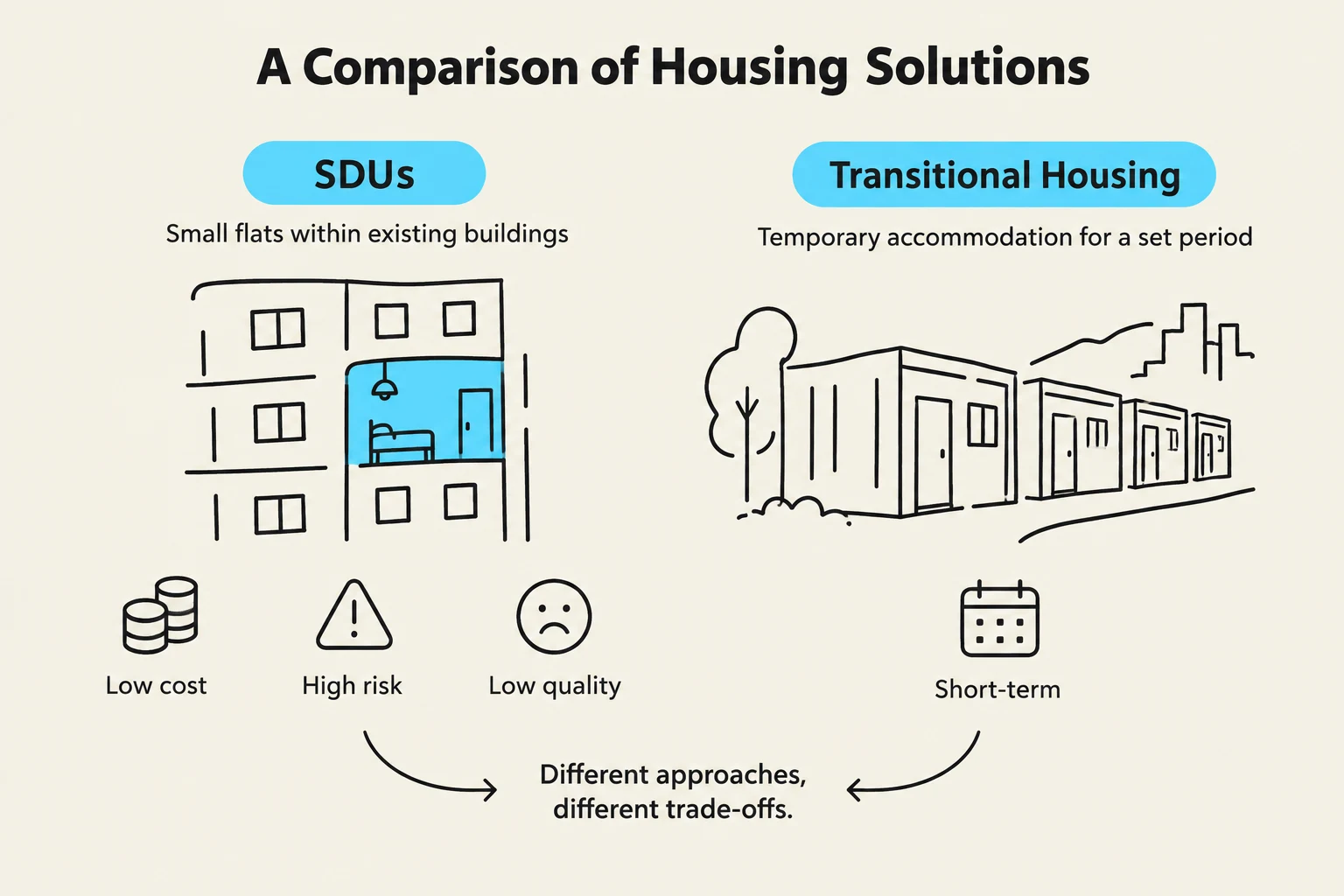
A comparison of Self-Detached Units (SDUs) and Transitional Housing, highlighting their respective characteristics and trade-offs.
Ultimately, while tenancy controls and community spaces act as important palliatives, they only treat the symptoms. The long-term solution to the SDU problem remains the expansion of the public rental housing supply, providing the "genuine alternatives" necessary so that residents are no longer forced to choose between unaffordability and unsafe living conditions.
Keep reading for free.
Create an account to finish this reading and make it part of your study routine.