Psychology is defined as the scientific study of the mind and behavior. While early thinkers like Socrates, Plato, and Aristotle explored the human mind through philosophy, modern psychology relies on a structured, objective approach to ensure that findings are reliable, transparent, and replicable. To move beyond mere intuition or observation, psychologists use the scientific method—a standardized process designed to produce justified knowledge while minimizing the influence of researcher bias.
The Foundation: From Questions to Hypotheses
The scientific journey does not begin in a vacuum; it starts with curiosity. The first step is asking a question about a specific phenomenon, such as whether personal space can reveal aspects of an individual's personality.
Once a question is established, researchers must gather information by reviewing existing knowledge. This involves two critical components:
Previous Research: Examining studies conducted by others on similar concepts.
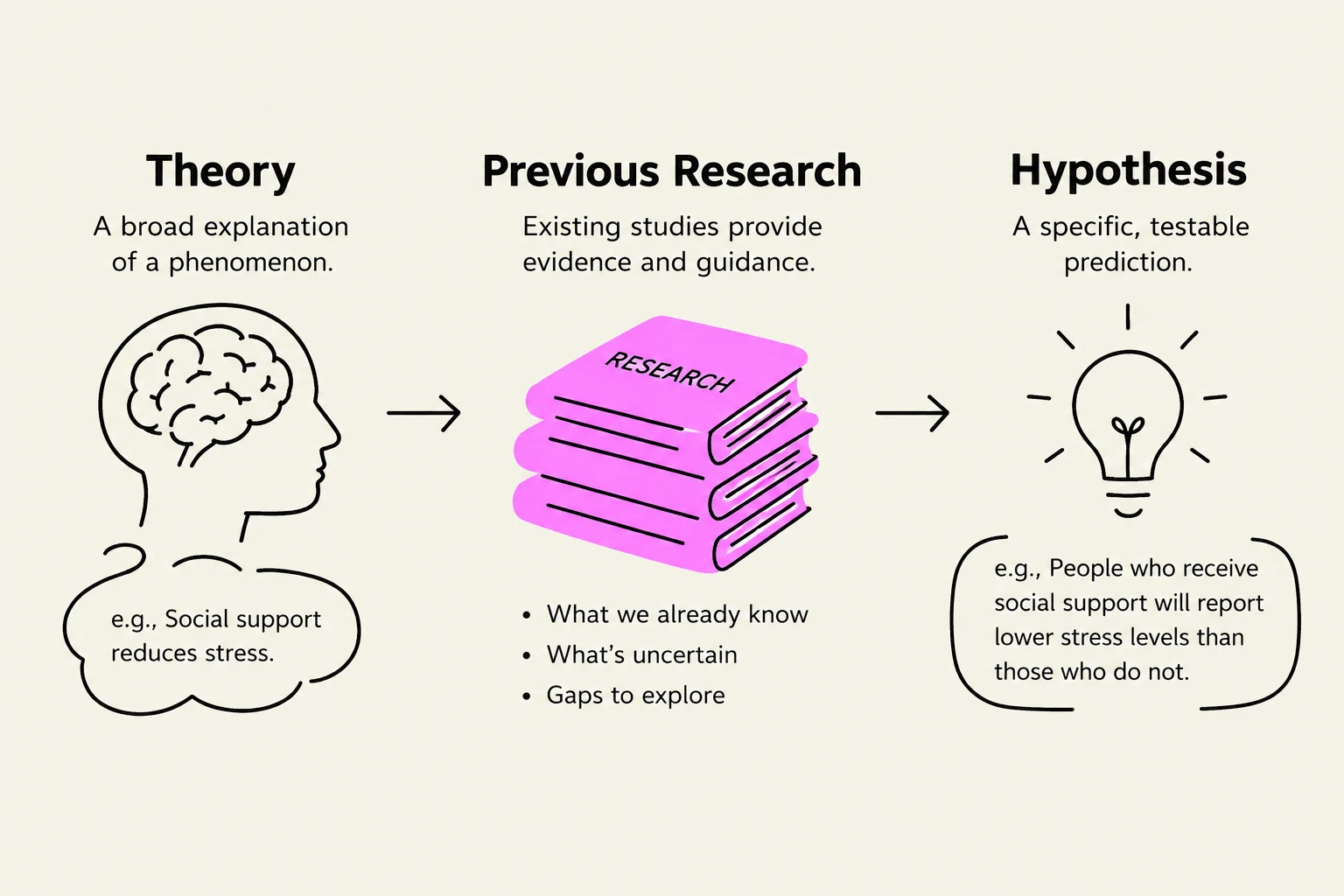
Theory: Developing or utilizing a set of principles that explains how and why certain variables are related to one another.
A theory provides the "map" for the investigation. From this map, researchers derive a hypothesis. A hypothesis is a testable prediction that flows logically from established theories or prior research findings.
Exam Tip: Remember that a theory is a broad explanation of many phenomena, whereas a hypothesis is a specific, narrow prediction that can be tested in a single study.
This diagram illustrates the scientific method, showing the progression from theory and previous research to forming a testable hypothesis, with an example related to social support and stress reduction.
Measuring Relationships: Correlational Design
When researchers want to observe how two things change together without necessarily intervening, they use a correlational design. In this context, variables are any characteristics, events, or behaviors that the researcher is interested in studying.
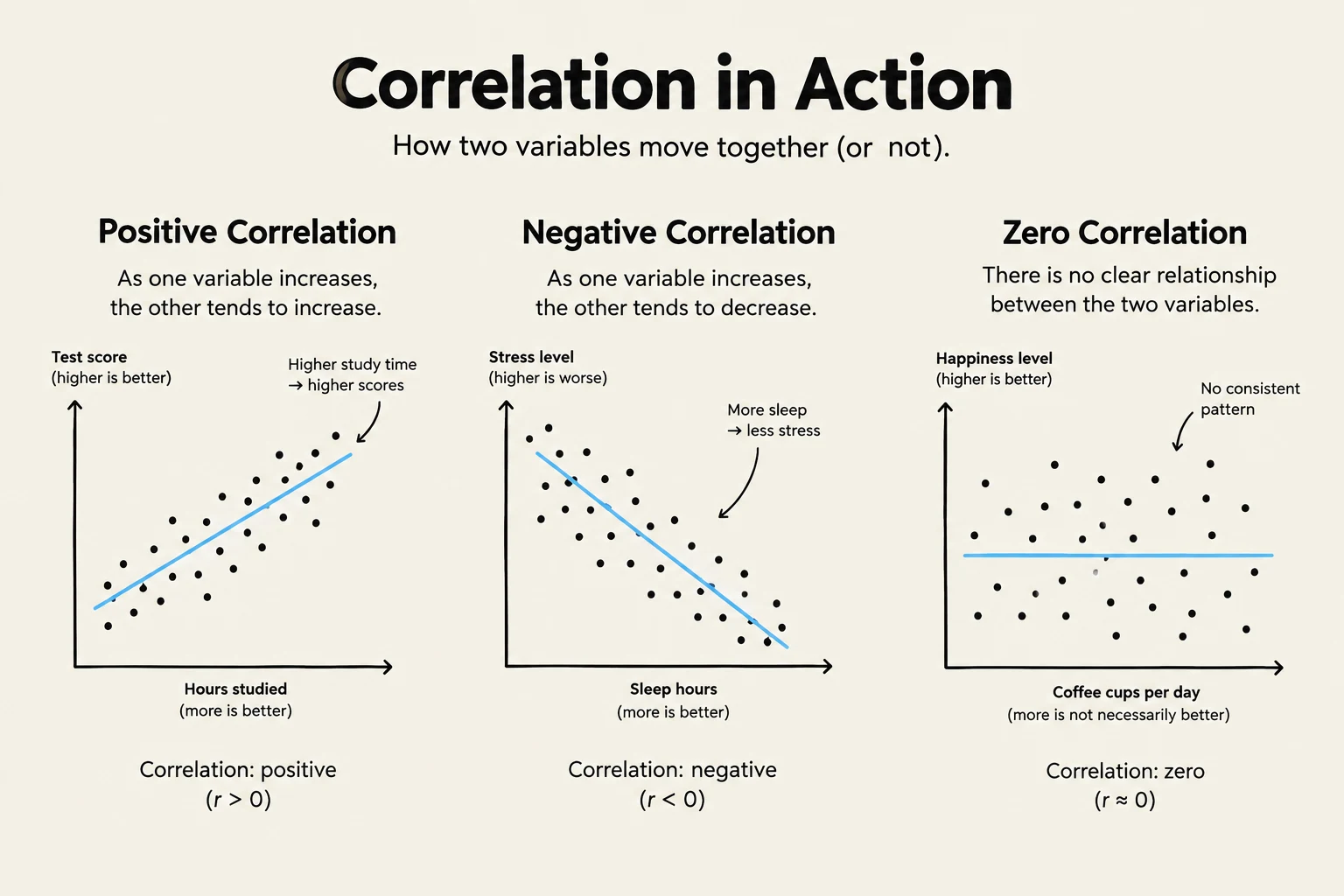
Correlational research is used to determine the degree of association between variables. This association is measured by the correlation coefficient, a numerical value that ranges from −1 to +1.
A positive correlation means both variables move in the same direction (as one increases, the other increases).
A negative correlation means they move in opposite directions (as one increases, the other decreases).
This illustration demonstrates the concepts of positive, negative, and zero correlation using scatter plots. Positive correlation shows that as one variable increases, the other tends to increase. Negative correlation shows that as one variable increases, the other tends to decrease. Zero correlation indicates no clear relationship between the two variables.
The Golden Rule: Correlation is Not Causation
One of the most important distinctions in psychological science is that correlation is not causation. Just because two variables are related does not mean that one causes the other.
For example, there is a positive correlation between ice cream sales and violent crime rates—as one goes up, so does the other. However, eating ice cream does not cause crime; rather, a third factor (like hot weather) likely influences both.
Determining Cause and Effect: Experimental Design
To move beyond mere association and determine if one thing actually causes another, researchers must use an experimental design. This method involves manipulating one variable while holding all other factors constant.
In an experiment, there are two primary types of variables:
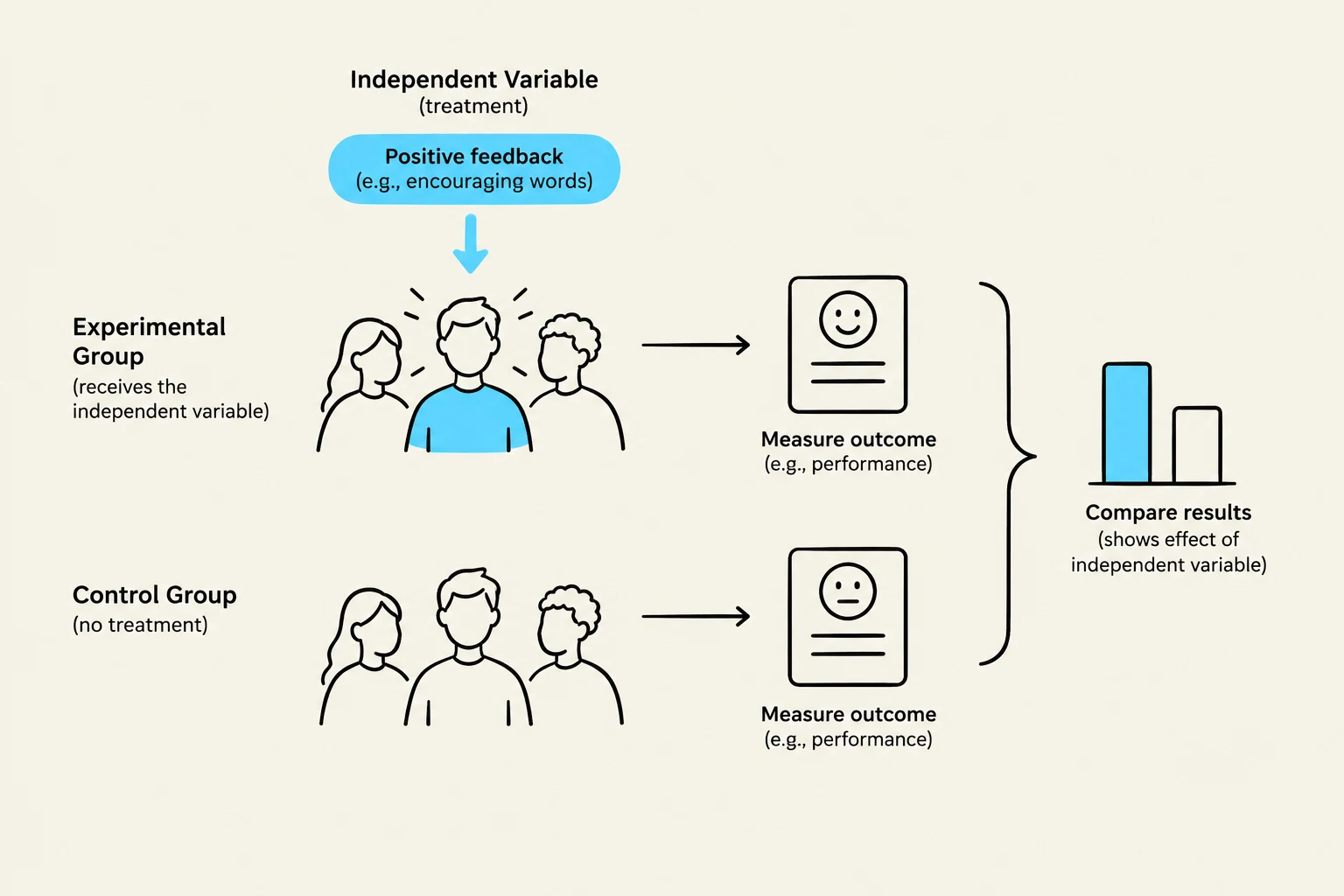
Independent Variable (IV): The factor that the researcher actively manipulates to see if it causes a change.
Dependent Variable (DV): The outcome or behavior that is measured; it "depends" on the manipulation of the independent variable.
Ensuring Accuracy through Control
To ensure the results are due to the independent variable alone, researchers must manage several factors:
Random Assignment: Participants are assigned to groups by chance. This helps ensure that the groups are similar before the experiment begins.
Experimental vs. Control Groups: Participants exposed to the independent variable are placed in the experimental group, while those who are not exposed (and serve as a baseline) are placed in the control group.
Extraneous Variables: These are outside factors that are not being investigated but could unintentionally influence the dependent variable. If not controlled, these can ruin the validity of the experiment.
Example: The Study Group Experiment
Imagine you want to know if studying in a group improves test scores:
Independent Variable: The study setting (group vs. alone).
Dependent Variable: The test scores.
Experimental Group: Students who study in a group.
Control Group: Students who study alone.
Extraneous Variables: Differences in sleep, prior knowledge of the subject, or the difficulty of the room's lighting.
This diagram illustrates a basic experimental design comparing an experimental group receiving a treatment (positive feedback) with a control group that does not. The outcome is measured for both groups and the results are compared to determine the effect of the independent variable.
Analysis and the Path to Publication
Once the data is collected, researchers enter the final stages of the scientific method: analyzing results. This analysis typically falls into two categories:
Quantitative Research: Focuses on numerical data and statistical analysis.
Qualitative Research: Focuses on non-numerical data, such as descriptions or meanings.
The final step is publishing the findings. Before a study is accepted into the scientific community, it must undergo the peer-review process. During this stage, other experts in the field scrutinize the research for accuracy, methodology, and integrity, ensuring that only high-quality, valid knowledge is added to the collective understanding of psychology.
Keep reading for free.
Create an account to finish this reading and make it part of your study routine.