Explore the scientific method, from observation and causal questions to hypothesis formulation, prediction, and controlled experiments. Learn about alternative testing methods like mathematical models and meta-analyses, and understand the importance of variables and potential pitfalls like confounding and publication b
In the study of life, scientists do not simply collect facts; they engage in a structured process to uncover the mechanisms that drive the natural world. This process, known as the scientific method, is a systematic way of investigating phenomena, testing ideas, and building reliable knowledge. By moving from simple observations to complex mathematical models or large-scale data analyses, biologists can transition from describing what is happening to explaining why it is happening.
The Foundation: Observation and the Causal Question
Every scientific investigation begins with an observation—noticing a pattern or a phenomenon in the natural world. For example, a researcher might notice that certain organisms appear more frequently in specific environments or under certain weather conditions.
However, an observation alone is not science. To move forward, a researcher must formulate a causal question: a question that seeks to identify the underlying cause of the observed pattern. Instead of merely noting that "worms are more abundant on rainy mornings," a scientist asks, "What factor causes the increase in worm abundance during rain?".
Formulating Hypotheses and Predictions
Once a causal question is established, the researcher proposes a hypothesis. A hypothesis is a proposed explanation for the observed phenomenon. It is a tentative answer to the causal question that can be tested.
Crucially, a hypothesis must be followed by a prediction. While the hypothesis is the "why," the prediction is the "if-then" statement that describes what should happen in a specific test if the hypothesis is true. A good prediction is often quantitative and directional; for instance, instead of saying "wetness affects worms," a researcher might predict, "If moisture increases, then the number of worms per square meter will increase".
Exam Tip: When reaching a scientific conclusion, you do not compare the hypothesis to the results. Instead, you compare the actual results to the prediction to see if the evidence supports the hypothesis.
This diagram illustrates the scientific method, starting with an observation, formulating a causal question, developing a testable hypothesis, and designing an experiment to test a prediction.
Controlled Experiments: Manipulating Variables
The most powerful way to test a hypothesis is through a controlled experiment. In a well-designed experiment, a researcher manipulates one specific factor to observe its effect on a biological system while keeping all other potential influences constant.
To understand how this works, we must distinguish between different types of variables:
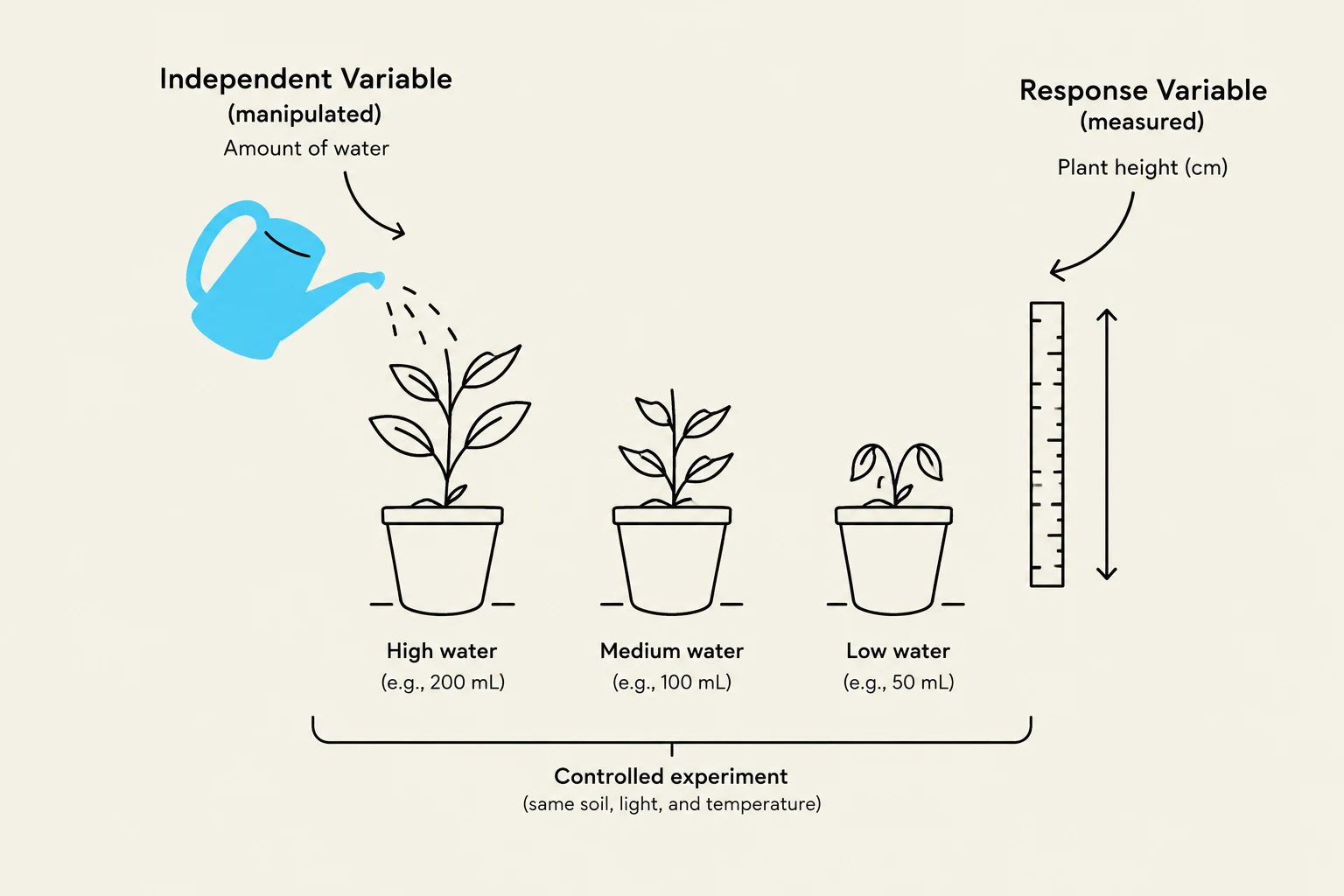
Independent Variable: The factor that the researcher intentionally changes or manipulates (e.g., the amount of water provided to a plant).
Dependent Variable (or Response Variable): The factor that is measured in response to the manipulation (e.g., the height of the plant).
Controlled Variables: Other factors that must be held constant to ensure that the change in the response variable is actually caused by the independent variable.
If an experiment fails to hold these other factors constant, it becomes a confounded experiment. In a confounded experiment, the change in the independent variable also causes changes in other variables, making it impossible to determine which one actually produced the observed effect.
This diagram illustrates a controlled experiment investigating the effect of different amounts of water (independent variable) on plant height (response variable), while keeping soil, light, and temperature constant.
Alternative Testing Methods: Models and Meta-Analyses
Not all biological questions can be answered with a traditional "wet lab" experiment. For example, testing why an airliner crashed or simulating global climate change might be too dangerous, expensive, or physically impossible. In these cases, scientists use other methods:
Mathematical Models
A model is a mathematical representation of a biological process used to explore how different variables interact. Models allow researchers to test hypotheses by comparing quantitative predictions against actual data. For example, a model might explore how "handling time" (the time an animal spends processing food) affects the total amount of food an animal can consume.
Models can be incredibly useful because they are inexpensive and can test complex dynamics, but they are also subject to the researcher's biases and may produce meaningless results if they are poorly constructed.
Meta-Analyses
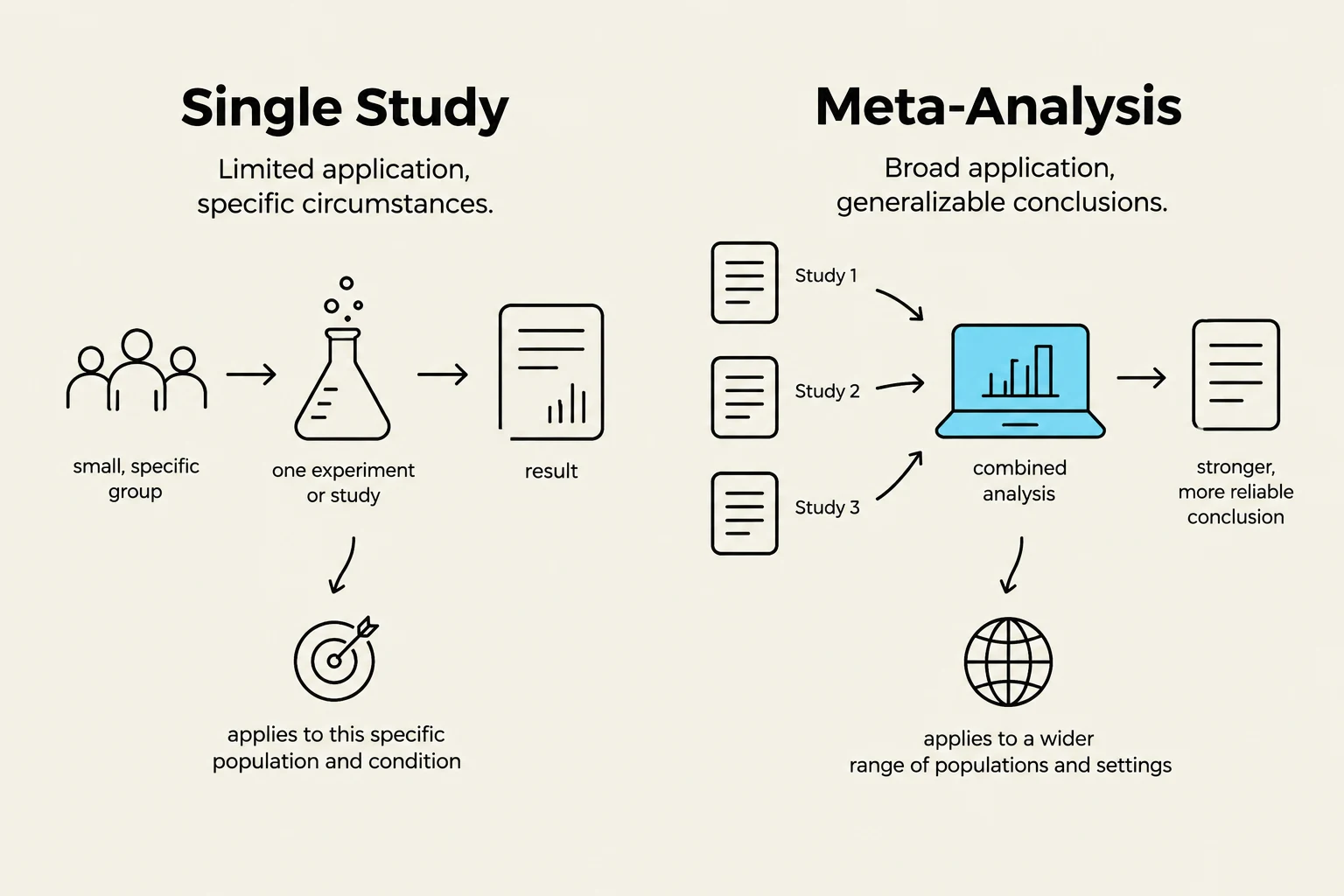
When a single study is too limited in scope, scientists use a meta-analysis. A meta-analysis is not a simple literature review; it is the statistical aggregation and analysis of data from many different research studies. By combining results from dozens of studies, researchers can calculate an effect size (or standardized difference), which provides a much broader and more robust understanding of a biological phenomenon.
However, meta-analyses face a significant challenge known as publication bias (or the "File Drawer Problem"). Because journals are more likely to publish studies with positive, significant results and "shelve" studies that show no effect, a meta-analysis may systematically overestimate the true biological effect.
This diagram illustrates the difference between a single study and a meta-analysis. A single study involves a small group and one experiment, leading to a result that applies to a specific population. A meta-analysis combines results from multiple studies for a broader application and more reliable conclusion.
Summary Table of Testing Methods
Method
Best Used For...
Main Limitation
Controlled Experiment
Isolating specific causal mechanisms
Can be difficult to replicate real-world complexity
Observational Test
Studying things in their natural state
Cannot easily prove causation (only correlation)
Mathematical Model
Exploring theoretical mechanisms and complex dynamics
Can be abstract or biased by modeler assumptions
Meta-Analysis
Gaining a broad, high-power view of a topic
Vulnerable to publication bias
Keep reading for free.
Create an account to finish this reading and make it part of your study routine.