


How do we know what we know? In biology, we often move from observing a phenomenon to explaining its underlying cause. This transition from "what is happening" to "why it is happening" is the heart of the scientific method. By examining one of the most famous experiments in biological history—the Hershey-Chase experiment—we can see how rigorous testing allows scientists to distinguish between competing ideas and move closer to the truth.
The Foundation: Descriptive vs. Causal Questions
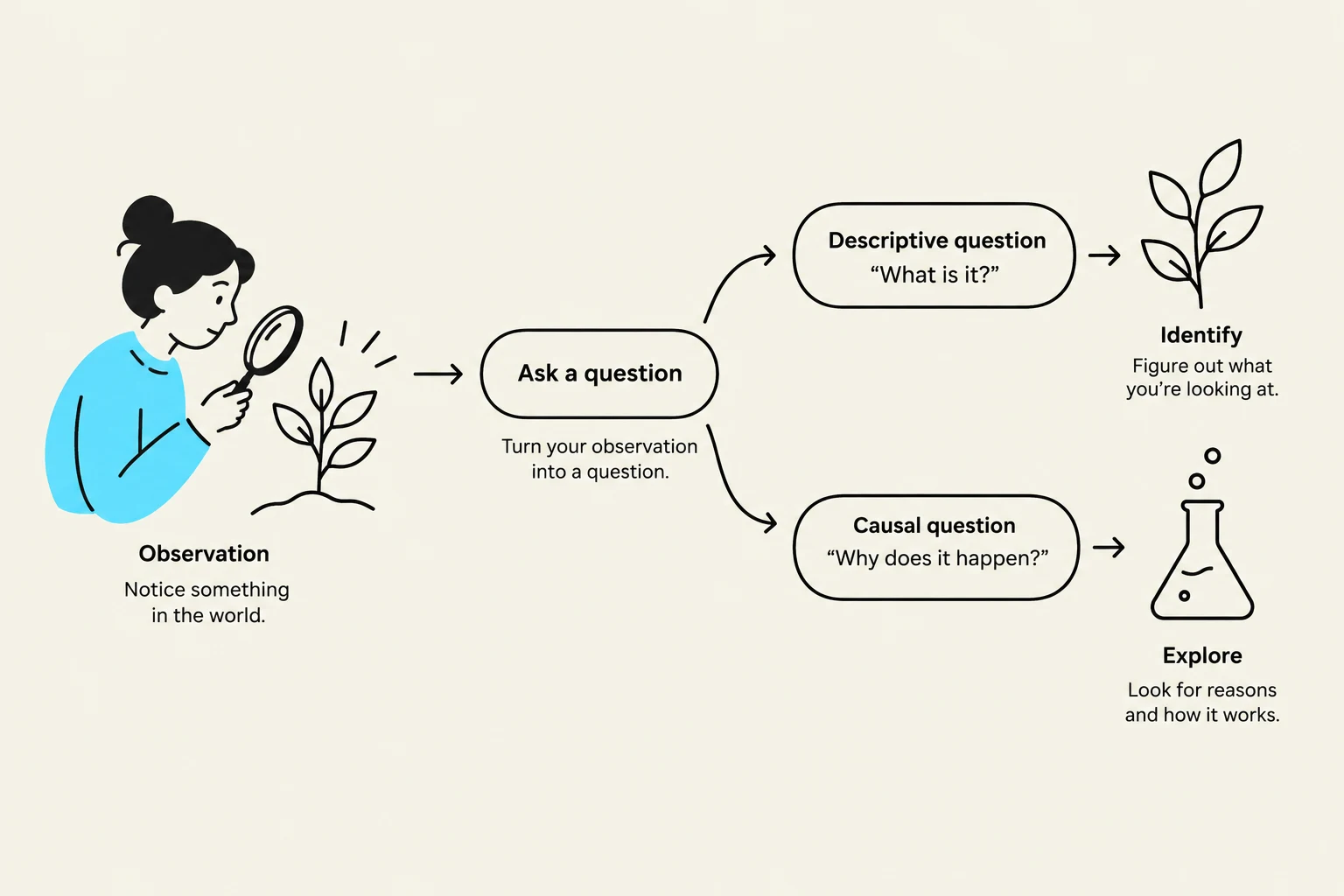
The scientific process typically begins with an observation. Once an observation is made, researchers generally approach it from one of two angles: descriptive or causal.
A descriptive question asks "what is it like?" or "how many?" For example, "What is the shape of DNA?" or "How does the density of maple trees compare between urban and rural wood lots?". These questions aim to characterize a system without necessarily explaining the mechanism behind it.
A causal question asks "why?" or "how does this happen?". These questions seek to identify the mechanism or reason behind an observation, such as "What caused the algal bloom in Lake Erie?". To answer a causal question, scientists must propose a hypothesis: an explanation for a puzzling observation.
The Properties of a Scientific Hypothesis
Not all explanations are scientific hypotheses. For an idea to be useful in science, it must meet specific criteria.
- Testability: A hypothesis must be testable. This doesn't just mean you can "imagine" a test; it means you can design an experiment that produces new information—information that is not already contained within the hypothesis itself. For example, if you hypothesize a houseplant died because of a ghost, you cannot test it because ghosts are not detectable or measurable within the physical-chemical world.
- Logical Consistency: Science must obey the laws of logic. This includes the law of non-contradiction (nothing can be both and not- at the same time). A hypothesis that is logically impossible (like a "square circle") or physically impossible (like a cow jumping over the moon) is not a viable scientific pursuit.
- Rationale and Scope: A good hypothesis should account for known properties of the world and be supported by a strong rationale.
Keep reading for free.
Create an account to finish this reading and make it part of your study routine.
Continue reading freeAlready have an account? Log in
Updated