The Science of Yield: Manipulating Reproduction in Agriculture
Explore how scientific advancements in manipulating plant and animal reproduction have improved agricultural yield and quality, while also examining the risks of monocultures and their impact on biodiversity and food security.
Agriculture is far more than just planting seeds or raising animals; it is the complex cultivation and breeding of plants, animals, and fungi to provide food, biofuels, textiles, and timber. As the global human population continues to grow, the demand for these resources increases, placing immense pressure on our food systems. To ensure long-term survival and food security, agriculture must be sustainable.
Modern scientific knowledge has revolutionized how we meet these demands. By understanding the fundamental principles of how organisms reproduce, humans have moved from passive observers to active manipulators of biological processes. This article evaluates how scientific advancements in the manipulation of plant and animal reproduction have improved quality and yield, while also examining the significant risks these practices pose to biodiversity.
Selective Breeding and Inheritable Traits
For tens of thousands of years, humans have practiced selective breeding, even before the formal discovery of genetics. This technique relies on the fundamental biological principle that certain characteristics are inheritable—meaning they can be passed from parent to offspring.
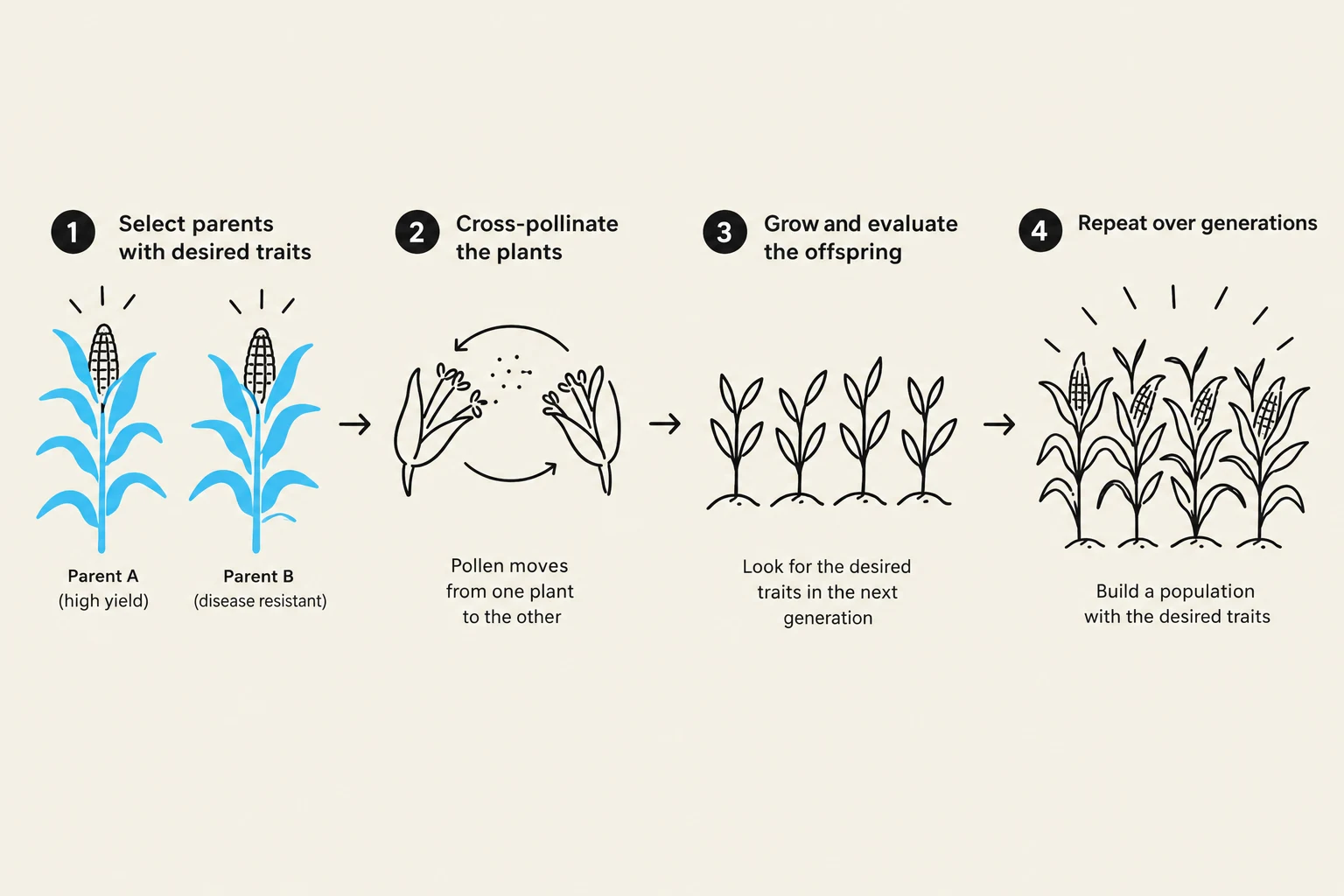
In selective breeding, farmers identify specific "desirable" traits, such as higher milk production in cows or larger kernels in corn. They then mate individuals that exhibit these traits, selecting the best offspring to serve as the next generation of parents. This cycle continues until the desired characteristic becomes a reliable feature of the entire population.
Worked Example: Corn Evolution
Compare ancestral corn to modern corn. Through generations of selective breeding for higher yield, modern corn has developed significantly larger cobs with more rows of larger kernels, providing much more caloric value per plant than its wild ancestors.
This diagram illustrates the process of selective breeding in plants, showing how desired traits can be developed over generations through cross-pollination and evaluation of offspring.
While selective breeding is a slow, generational process, scientific advancements have allowed for much faster manipulation of livestock through artificial insemination. This process involves collecting semen from a male with superior traits and manually inserting it into the uterus of a female that is sexually receptive (in heat).
This technique is made possible by a deep scientific understanding of the reproductive systems of various species. The benefits are substantial:
Geographic Reach: Semen can be frozen and shipped globally, allowing a high-quality male in one country to improve the genetics of a herd in another.
Efficiency: Farmers can synchronize and schedule breeding, ensuring a quick turnaround and higher yields of meat and milk.
Specific Traits: In Belgium, approximately 50% of Belgian Blue cows are bred this way. These cows possess 40% more edible muscle mass, primarily lean meat, and produce high-protein milk.
Manipulating Plant Reproduction
Plants offer a diverse range of reproductive manipulation techniques, from manual pollination to the physical joining of tissues.
Pollination and Hybridisation
Artificial pollination involves the manual transfer of pollen from anthers to a stigma. This is essential when natural pollinators are unavailable. For instance, vanilla plants require hand pollination because their natural pollinator, the tiny Mexican melipona bee, is becoming extinct.
Hybridisation, or cross-breeding, occurs when two different species or varieties are mated to produce offspring with unique, advantageous combinations of traits. A classic example is the mule—a hybrid of a horse and a donkey—which often possesses superior strength and endurance compared to its parents.
Grafting and Cuttings
To manipulate plant growth without changing genetics, scientists use asexual propagation techniques:
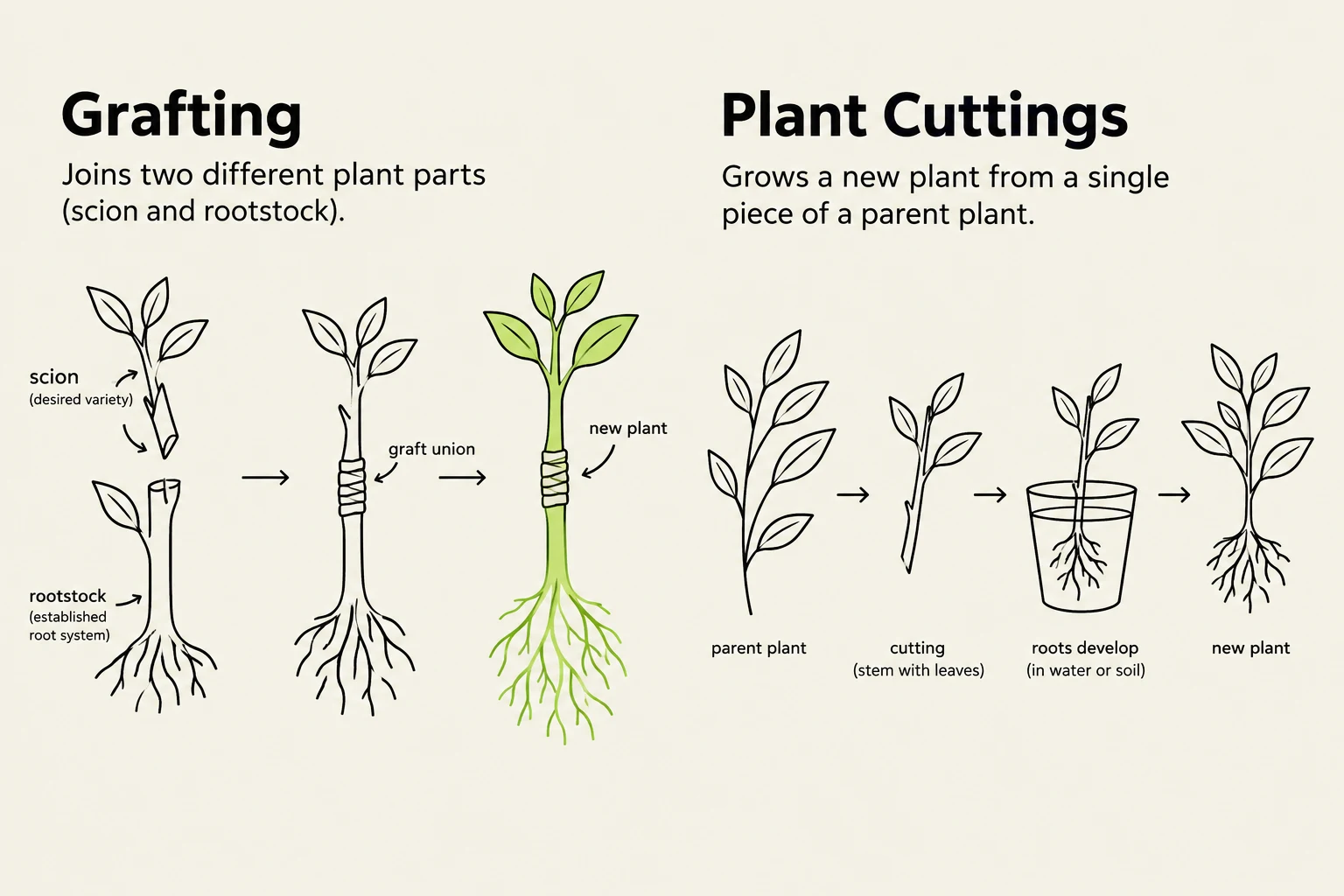
Grafting: This involves joining a "scion" (a healthy growth from one plant) onto a "stock" (the root system of another). This relies on knowledge of plant cell division and growth hormones. It allows for commercial advantages, such as growing both lemons and oranges on a single tree.
Cuttings: By using rooting hormones on a section of a stem, farmers can grow identical "daughter" plants from a single parent. This is a highly efficient way to create large numbers of genetically identical plants for commercial sale.
Diagrams illustrating the processes of grafting and plant cuttings for propagation.
The Danger of Monocultures: A Risk to Sustainability
While these manipulations significantly increase yield and quality, they introduce a dangerous biological vulnerability: the creation of monocultures. A monoculture occurs when a population has very little genetic variation because humans have consistently selected for only a few "ideal" traits.
In modern large-scale agriculture, many crops are grown in massive plots of identical varieties to ensure a consistent product. However, scientific knowledge of natural selection tells us that variation is the key to survival. In a diverse population, some individuals will likely possess a mutation or trait that allows them to survive an environmental change or a new disease. In a monoculture, if one plant is susceptible to a disease, every plant in the field is likely susceptible.
Historical Case Study: The Great Famine of Ireland
In the mid-1800s, Irish farmers relied almost exclusively on a single variety of potato called the "lumper". Because these potatoes were propagated vegetatively (cloning), there was almost no genetic variation. When a fungal disease struck in 1845, it wiped out the entire crop across the country. This lack of biological diversity led to the death of an estimated 1 million people and forced millions more to emigrate.
Conclusion
Scientific knowledge has had a massive impact on agriculture, enabling us to produce more food more efficiently than ever before. However, the same knowledge that allows us to manipulate reproduction also warns us of the risks. To maintain a sustainable food supply, we must balance the drive for high-yield monocultures with the biological necessity of genetic variation to protect our crops and livestock from future environmental shifts.
Keep reading for free.
Create an account to finish this reading and make it part of your study routine.