The Science of Climate Change: Mechanics, Drivers, and Global Challenges
Explores the fundamental mechanics of global warming, including the Earth's radiation balance and the role of greenhouse gases. It details the anthropogenic drivers of climate change, such as CO2 and methane emissions, and discusses the socio-economic challenges, including externalities, risk management, mitigation, ad
Climate change is one of the most complex and pressing challenges facing modern civilization. It is not merely a matter of rising temperatures, but a fundamental shift in the Earth's energy balance that affects every biological and socio-economic system on the planet. While natural factors like solar activity and volcanic eruptions influence the climate, the scientific consensus is clear: human activities are the primary driver of current global warming.
Global Warming Mechanics
To understand climate change, we must first understand the Earth's radiation balance. The Earth's climate is maintained by a delicate equilibrium between the energy received from the sun and the energy radiated back into space.
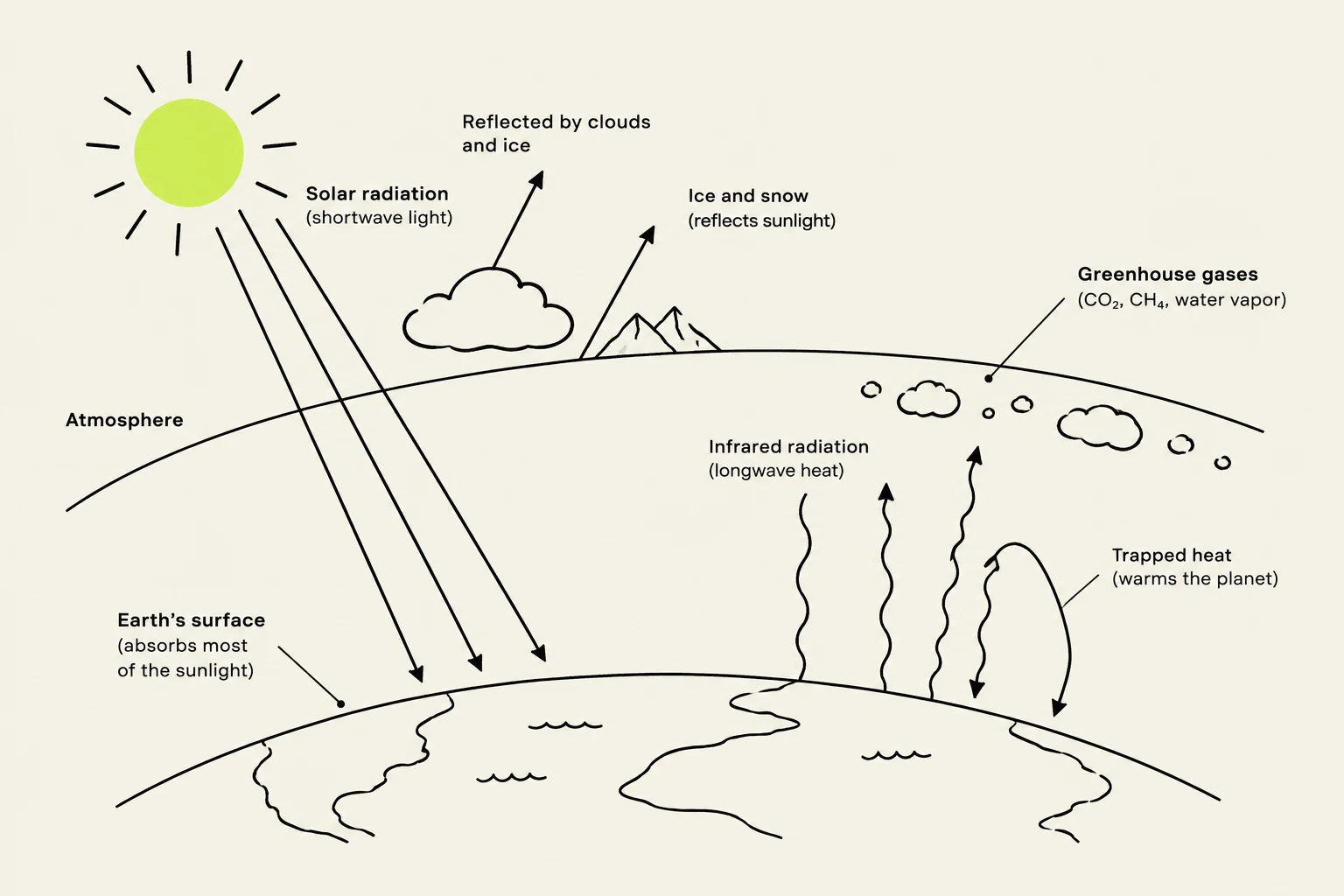
The sun radiates energy toward Earth at a rate of approximately 340 W/m2. About 107 W/m2 is reflected back immediately by clouds, aerosols, and the "albedo effect" (reflection from ice and snow). The remaining 235 W/m2 is absorbed by the Earth, warming the surface. To maintain equilibrium, the Earth must re-radiate this energy back into space.
However, certain gases in the atmosphere, known as greenhouse gases (GHGs), are "opaque" to specific wavelengths of infrared radiation. Instead of allowing all heat to escape, these gases trap approximately 180 W/m2 and re-radiate it back toward the surface. As the concentration of these gases increases, the Earth must reach a higher temperature to radiate enough energy to match the incoming solar radiation.
This diagram illustrates the greenhouse effect, showing how solar radiation interacts with the Earth's atmosphere and surface, and how infrared radiation is trapped by greenhouse gases, warming the planet.
The relationship between greenhouse gas concentrations and temperature is non-linear. This means we cannot simply predict outcomes through simple period-by-period increments; instead, we must account for feedback loops—such as melting ice reducing the albedo effect—which can accelerate warming in ways that are difficult to model with certainty.
Anthropogenic Drivers: The Greenhouse Gases
The Intergovernmental Panel on Climate Change (IPCC), specifically in its Sixth Assessment Report (2023), has concluded that human activities are unequivocally responsible for the warming of the atmosphere, oceans, and land. These "anthropogenic" influences are driven by the emission of several key greenhouse gases:
Carbon Dioxide (CO2): The most significant anthropogenic driver. Pre-industrial levels were around 280 ppm, but current levels have surpassed 400 ppm.
Methane (CH4): A highly potent gas, roughly 23 times more potent than CO2.
Nitrous Oxide (N2O): An extremely powerful GHG, approximately 296 times more potent than CO2.
These gases originate from various sectors. The energy supply (electricity and heat) is the largest contributor at 34%, followed by industry (24%), agriculture and land use (22%), and transport (15%).
This pie chart illustrates the breakdown of global greenhouse gas emissions by sector, with energy supply being the largest contributor at approximately 73%.
Socio-Economic Challenges: Externalities and Risk
Climate change represents what economists call "the great global externality". An externality occurs when the cost of an activity (like burning fossil fuels) is not borne by the producer or consumer, but by society at large in the form of environmental damage.
Managing this involves a difficult inter-temporal problem: the economic costs of taking action are felt in the short term, while the benefits are realized in the long term. This is complicated by the delayed consequences of inaction and the inherent uncertainty regarding scientific and socio-economic feedback loops.
Our response to these risks is often dictated by social attitudes:
Risk-averse preferences: A preference for guarantees over uncertain high returns.
Risk-seeking preferences: Taking higher risks to achieve above-average returns.
Risk-neutral preference: A state of risk insensitivity.
Exam Tip: While behavioral studies suggest that societies are collectively risk-averse, there is a significant disconnect in how this is applied to climate change, where collective action often lags behind the perceived necessity of avoiding catastrophic risk.
Mitigation, Adaptation, and Climate Justice
To address the crisis, two primary strategies must be employed: mitigation (reducing the sources of emissions) and adaptation (adjusting to the changes that are already inevitable).
However, these actions cannot be viewed in isolation from global development. This brings us to the principle of Climate Justice and the framework of Common but Differentiated Responsibilities and Respective Capabilities (CBDR-RC). This principle acknowledges that while all nations must participate in climate action, the burden should be distributed based on:
Historical contributions to total emissions.
Current emission levels.
Incomes and development levels.
Technological ownership and financial resources.
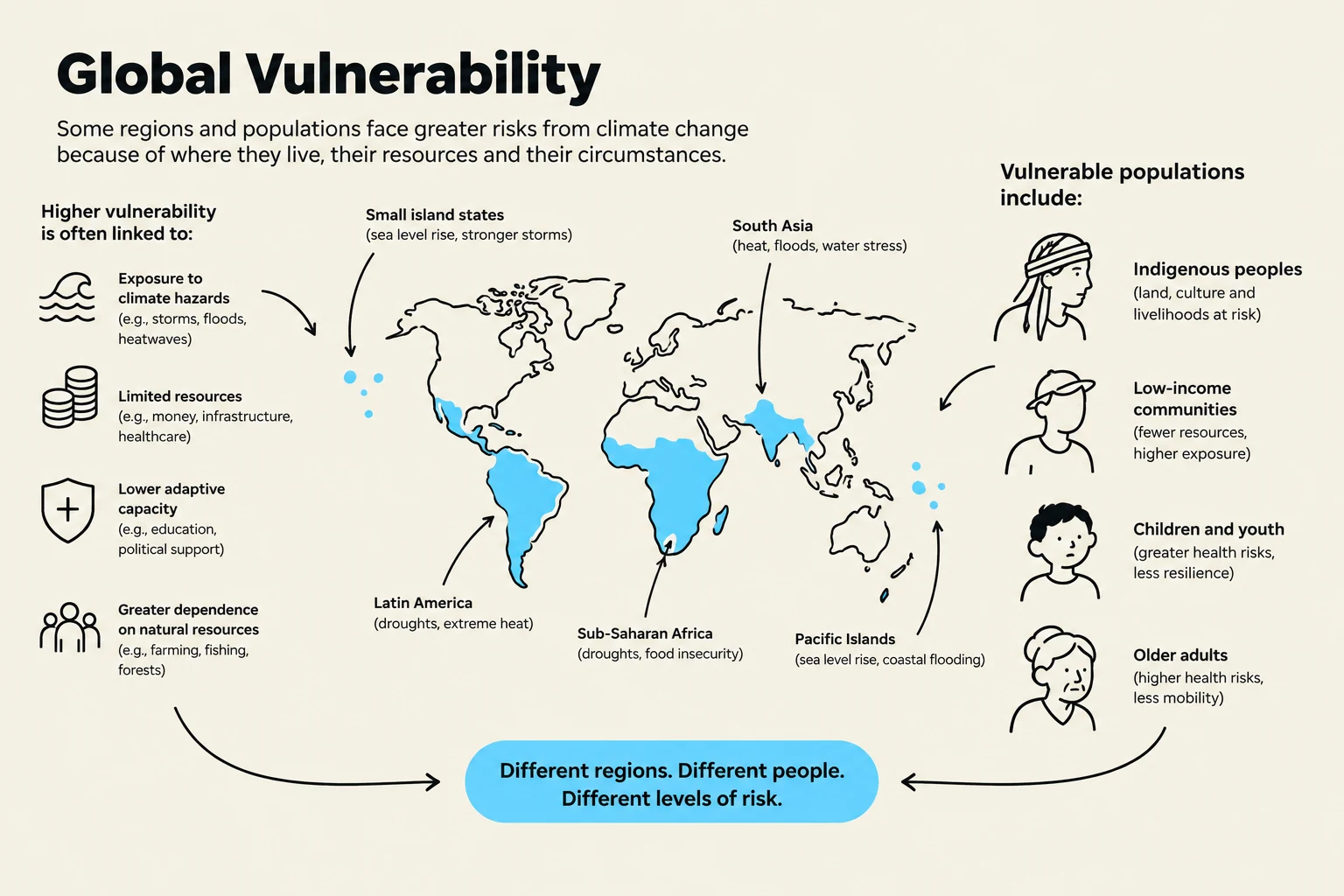
The impacts of climate change are not distributed equally. Vulnerability is a function of exposure and adaptive capacity. For example, small island states and Sub-Saharan Africa face the highest GDP-share losses because they have high exposure to hazards like sea-level rise and droughts, but low capacity to build expensive defenses.
This infographic illustrates global vulnerability to climate change, highlighting regions and populations at higher risk due to factors like limited resources, exposure to climate hazards, and lower adaptive capacity. It also identifies specific vulnerable populations such as indigenous peoples, low-income communities, children and youth, and older adults.
As we look to the future, the goal is to prevent CO2e concentrations from reaching levels (such as 550 ppm) that would lead to temperature increases beyond human tolerance limits. Achieving this requires a coordinated global effort that balances economic stability with the urgent need for environmental preservation.
Keep reading for free.
Create an account to finish this reading and make it part of your study routine.