The Science of Brewing: Malting, Mashing, and Fermentation
Explore the biochemical processes of malting, mashing, and fermentation in brewing. Understand the roles of enzymes, starch conversion, and yeast in transforming barley into ethanol and carbon dioxide. Learn about analytical techniques like spectrophotometry and dilution factors used in monitoring sugar concentrations.
The production of beer is a complex biochemical journey that transforms simple barley seeds into a carbonated, alcoholic beverage. This transformation relies on a series of controlled biological and chemical stages: malting, mashing, and fermentation. By manipulating temperature, pH, and enzymatic activity, brewers convert complex starches into simple sugars, which are then consumed by yeast to produce ethanol and carbon dioxide.
Malting and Kilning
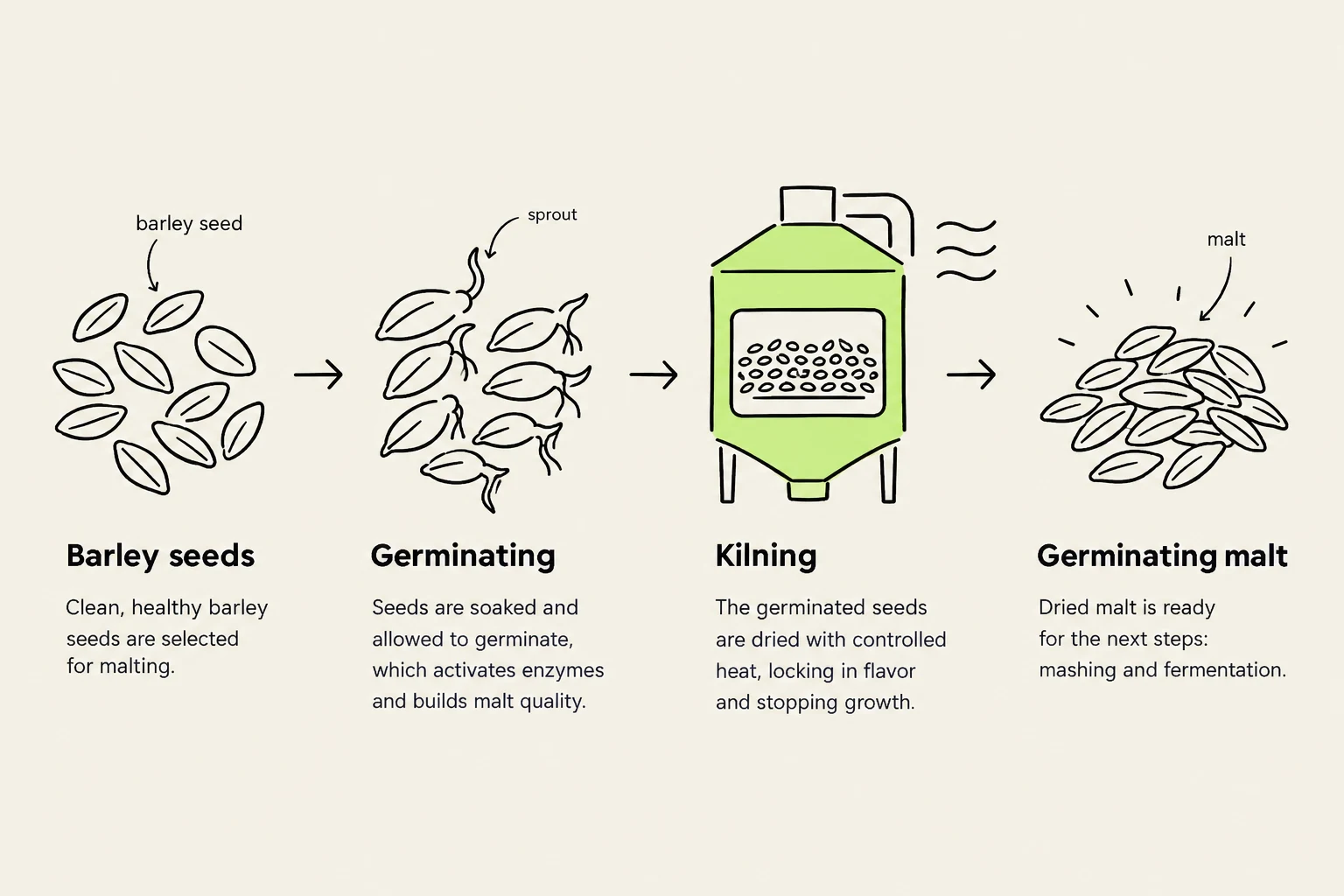
The process begins with barley seeds. In its natural state, a seed contains large amounts of starch, which the plant intends to use as energy for growth. To harness this energy for brewing, we must first trigger the seed's biological machinery through malting.
During malting, the barley is soaked in water to encourage germination. As the seed begins to grow, it produces specific proteins called amylase enzymes. These enzymes are the "molecular scissors" required to cut up the starches later in the process. Once the necessary concentration of enzymes has been reached, the germination process must be stopped so the seed doesn't actually grow into a full plant.
This is achieved through kilning, a process of heating and drying the grain. Much like baking clay in a kiln, this high heat kills the seed and halts all biological activity. After kilning, the dried barley is crushed to prepare it for the next stage.
This diagram illustrates the process of malting barley, from barley seeds to germinating malt, including the stages of germination and kilning.
Mashing: Breaking Down Starches
Mashing is the stage where the crushed barley is mixed with water to activate the enzymes produced during malting. The primary objective of mashing is to break down complex carbohydrates, known as starches, into simple, fermentable reducing sugars.
The Chemistry of Starch
To understand mashing, one must understand the structure of the starches involved. Starches are polysaccharides—long chains of glucose molecules linked together by glycosidic linkages. There are two main types of starch in barley:
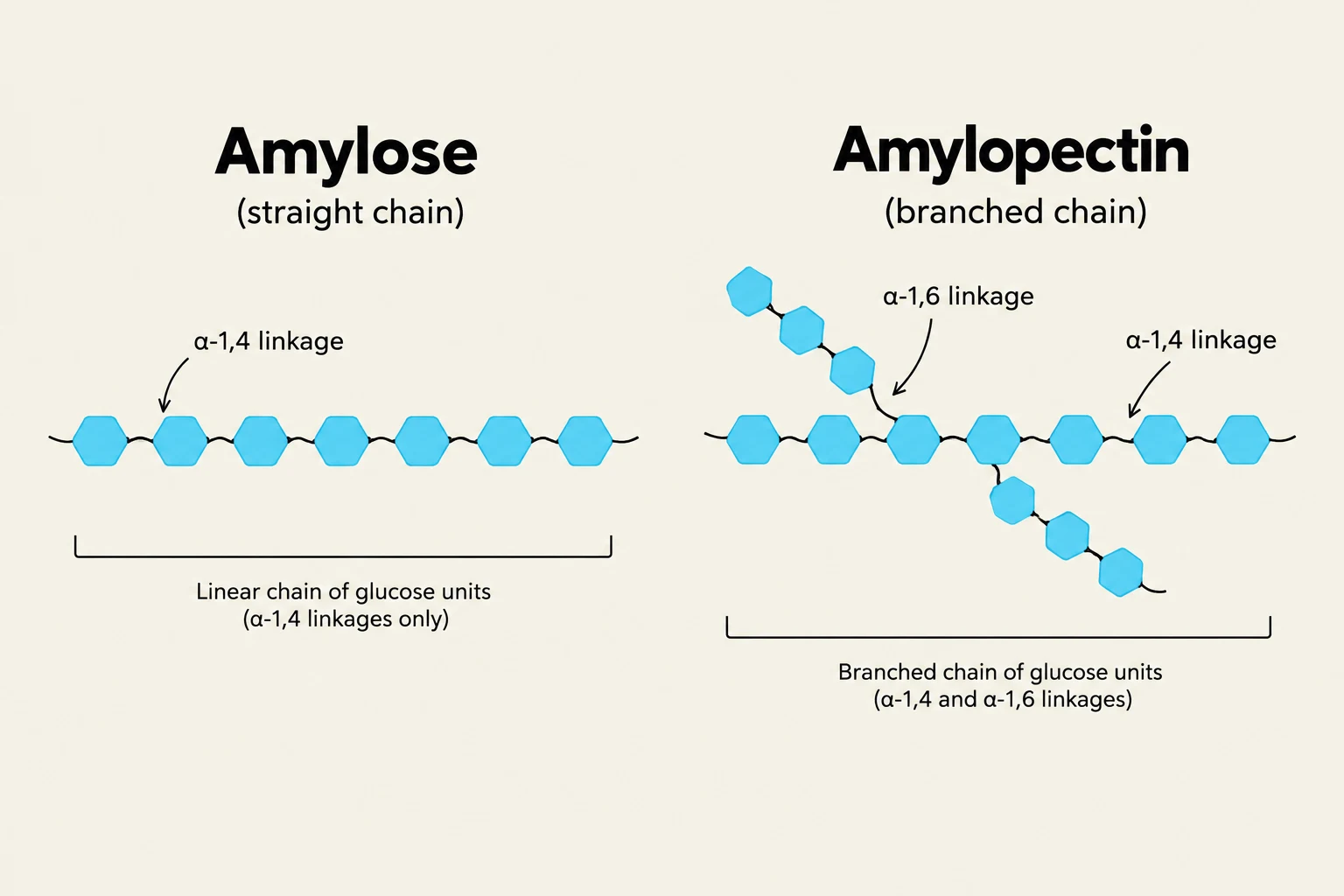
Amylose: A straight-chain polysaccharide where glucose units are connected primarily by α-1,4 glycosidic linkages.
Amylopectin: A branched polysaccharide. While it also uses α-1,4 linkages for its chains, it contains α-1,6 glycosidic linkages at the points where branches occur.
In these chains, the carbons are numbered 1 through 6. The carbon at position 1 is known as the reducing end, while the ends of the chains that do not have a free carbon 1 are called non-reducing ends. Because amylopectin has branches, every branch point creates a new non-reducing end, providing more "starting points" for certain enzymes.
The Role of Amylase Enzymes
Two specific enzymes facilitate the breakdown of these starches, and they behave differently based on the environment of the mash:
α-amylase: This enzyme acts randomly along the starch chains, cutting them at various points. It is most active at higher temperatures and higher pH levels.
β-amylase: This enzyme is more precise; it clips glucose units two at a time starting from the non-reducing ends. However, β-amylase cannot bypass the branch points created by α-1,6 linkages. It is favored by lower temperatures and lower pH levels.
Exam Tip: If a question asks which enzyme is responsible for "random" cleavage versus "systematic" cleavage from the ends, remember: α is random/high temp/high pH, and β is systematic/low temp/low pH.
Diagram illustrating the structural differences between amylose (a straight chain of glucose units linked by alpha-1,4 glycosidic bonds) and amylopectin (a branched chain of glucose units linked by alpha-1,4 and alpha-1,6 glycosidic bonds).
Fermentation: From Sugar to Alcohol
Once mashing is complete, the liquid (now called wort) is filtered to remove the spent grain. Next, yeast is added to the liquid.
Yeast performs fermentation, a biological process where the microorganisms consume the simple sugars produced during mashing. It is important to note that yeast can only ferment the smallest, simple sugars; larger, unreacted starches remain in the solution.
The chemical result of this process is the production of ethanol (alcohol) and carbon dioxide (CO2). For every single molecule of glucose (C6H12O6) consumed, the reaction produces two molecules of ethanol and two molecules of carbon dioxide.
We can verify this by looking at the carbon balance. Since glucose has 6 carbons:
Two molecules of ethanol (C2H5OH) provide 2×2=4 carbons.
Two molecules of carbon dioxide (CO2) provide 2×1=2 carbons.
Total: 4+2=6 carbons, matching the original glucose molecule.
Analytical Concepts in the Lab
To monitor the progress of brewing, scientists use specific analytical tools to measure sugar concentrations.
Spectrophotometry and Absorbance
A spectrophotometer is used to measure the concentration of reducing sugars in a sample. This is done by measuring absorbance—how much light the solution absorbs at a specific wavelength. In these assays, absorbance is directly proportional to the concentration of the sugar; as the concentration increases, the absorbance increases.
The Dilution Factor
Often, a sample is too concentrated to be measured accurately by a spectrophotometer. In these cases, we use a dilution factor to reduce the concentration. The dilution factor is defined as the ratio of the initial volume to the final volume:
Dilution Factor=VfinalVinitial
Worked Example:
If you have a sample and you want to perform a ten-fold dilution (a dilution factor of 1/10) to reach a final volume of 200μL, how much starting solution do you need?
Using the relationship:
Vinitial=Vfinal×Dilution FactorVinitial=200μL×101=20μL
To complete the solution, you would add 180μL of water to your 20μL of starting solution to reach the final 200μL volume.
Keep reading for free.
Create an account to finish this reading and make it part of your study routine.