This reading explains the critical role of inclusive economic and political institutions in fostering long-term prosperity and sustainable economic growth, contrasting them with extractive institutions that concentrate wealth and power.
When we observe the vast differences in wealth between nations, we often look at natural resources, geography, or culture. However, modern economic theory suggests that the most critical driver of long-term prosperity is not what a country has, but how its institutions are structured. Institutions—the "rules of the game" in a society—determine whether economic activity leads to sustainable progress or merely temporary surges in production.
Understanding Inclusive Institutions
Inclusive institutions are designed to spread economic opportunity across a broad segment of the population. Rather than concentrating wealth and power in the hands of a small elite, these institutions create a framework where many people can participate in economic life.
The foundation of economic inclusion rests on several key pillars:
Protection of Rights: Ensuring that individuals own the fruits of their labor and property.
Enforcement of Contracts: Providing a reliable legal system so that parties can trade with confidence, knowing that agreements will be honored.
Market Accessibility: Creating conditions that allow new firms to enter the market and compete fairly.
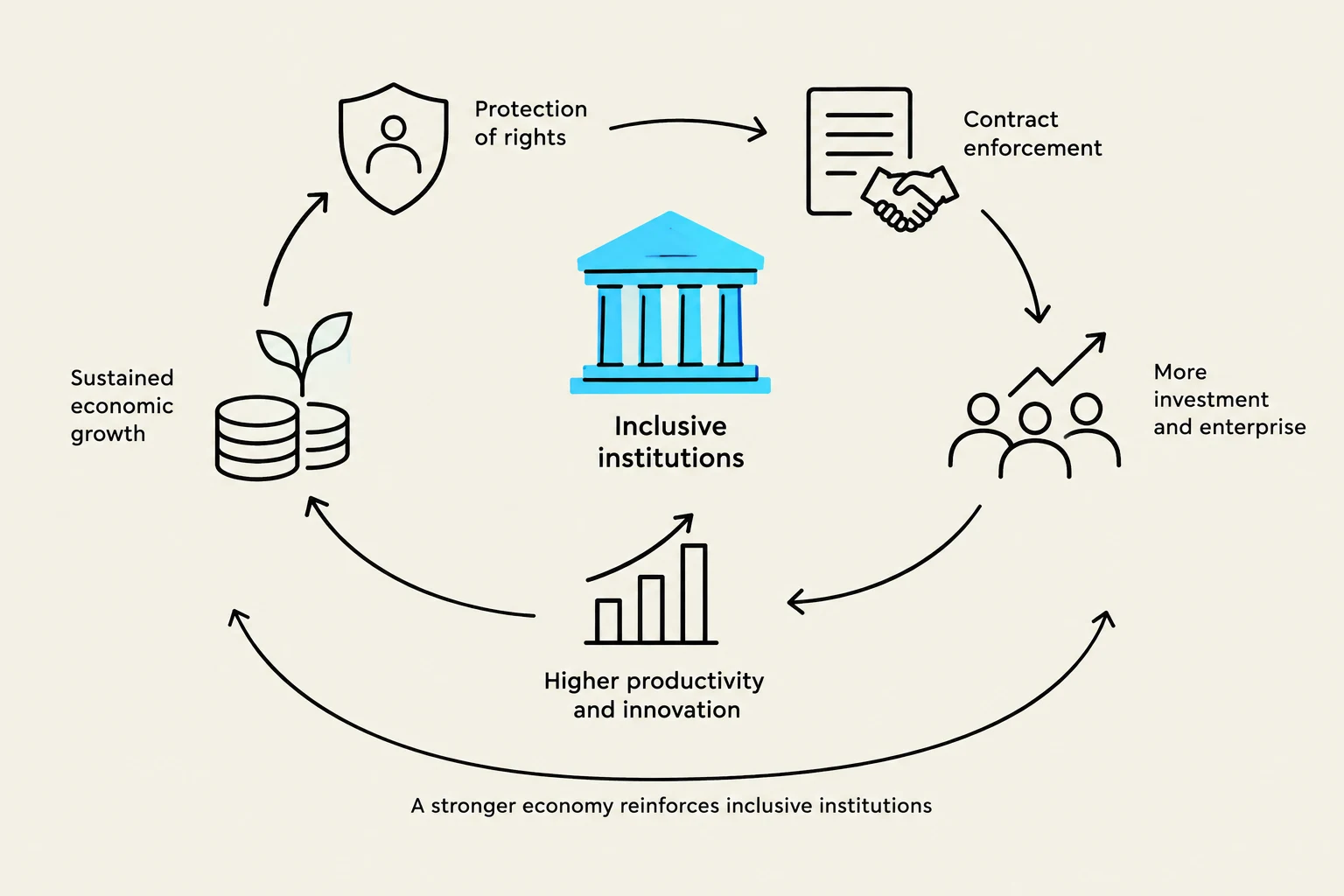
When these pillars are in place, the economy benefits from several reinforcing mechanisms. Investors face predictable returns on their capital, which encourages long-term planning rather than short-term exploitation. Furthermore, because the system rewards talent regardless of social status, it encourages education and the acquisition of specialized skills, allowing the abilities of a much larger portion of the population to be utilized.
This diagram illustrates the cyclical relationship between inclusive institutions and economic growth, highlighting key factors such as protection of rights, contract enforcement, investment, productivity, and innovation.
Exam Tip: If asked to define "economic inclusion," focus on the structural requirements: the protection of property rights, the enforcement of legal contracts, and the removal of barriers to market entry.
Innovation and Productivity
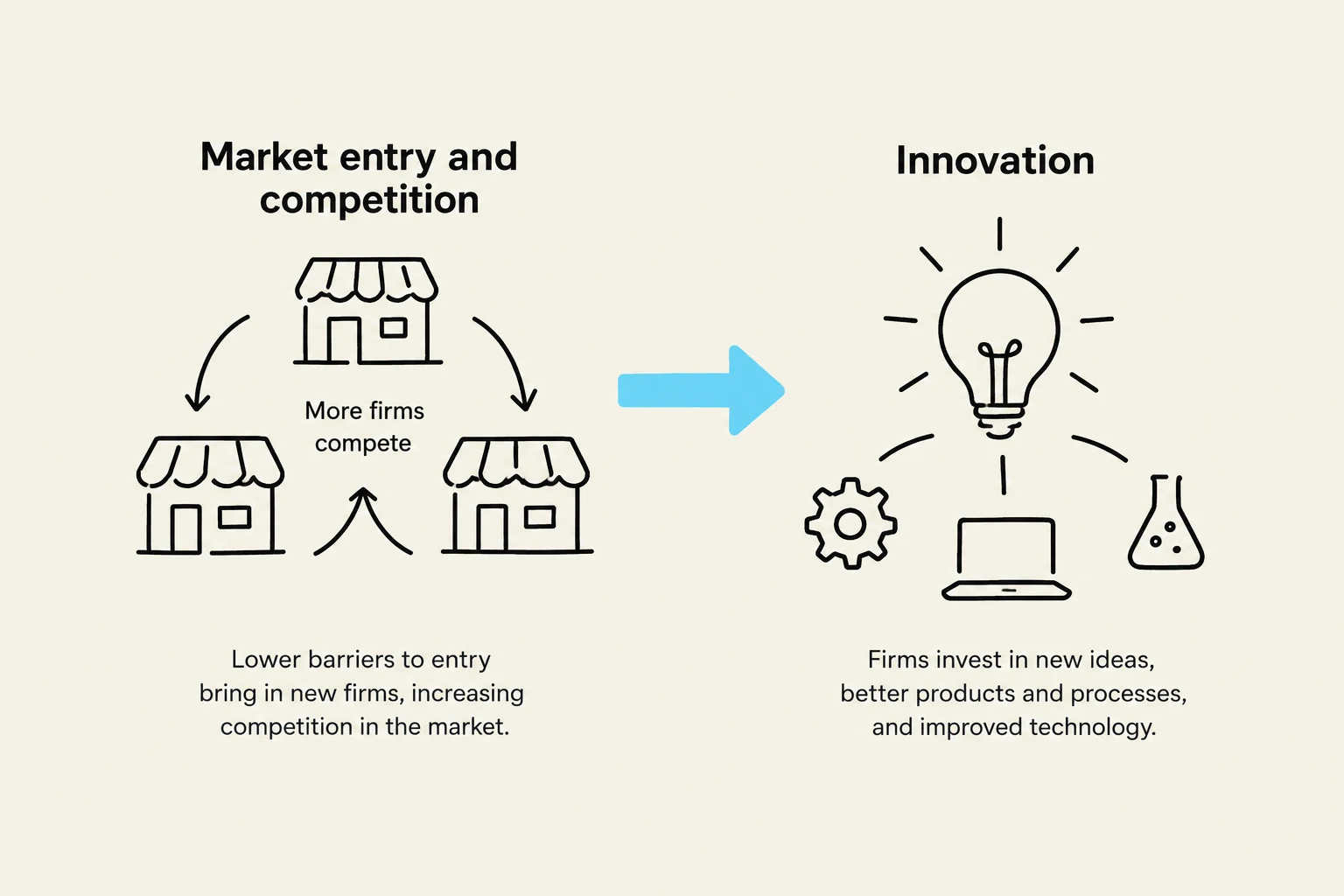
The ultimate goal of inclusive institutions is to foster continuous innovation and increases in productivity. In an inclusive system, competition is not just a feature; it is a driver of progress. When new firms can enter the market easily, they are incentivized to find more efficient ways of producing goods or to invent entirely new products to gain an edge over incumbents.
This creates a virtuous cycle:
Competition drives firms to innovate.
Innovation increases the productivity of labor and capital.
Higher productivity leads to higher wages and more resources for further education and technology.
This diagram illustrates the relationship between market entry, competition, and innovation. Lower barriers to entry lead to more firms competing, which in turn encourages firms to invest in new ideas, products, processes, and technology.
The Dynamics of Extractive Institutions
In contrast to inclusive systems, extractive institutions are designed to extract incomes and wealth from one subset of society to benefit a different subset (usually a political or economic elite).
While these institutions are often associated with stagnation, they are not incapable of generating growth. There are two primary ways extractive regimes can achieve economic expansion:
Resource Reallocation: Rulers may use their power to shift resources from low-productivity sectors (like subsistence agriculture) toward higher-productivity activities that they can more easily control or tax (such as heavy industry).
Hybrid Models: An extractive political regime may allow certain "inclusive" aspects of the economy to function—such as limited market competition—to boost the overall wealth of the state, provided it does not threaten the rulers' control.
Historical Examples of Extractive Growth
The Soviet Union: The state achieved significant growth by forcibly shifting massive amounts of resources from the agricultural sector into industrial production.
South Korea: During its authoritarian period, South Korea utilized state support and economic incentives to drive rapid industrialization.
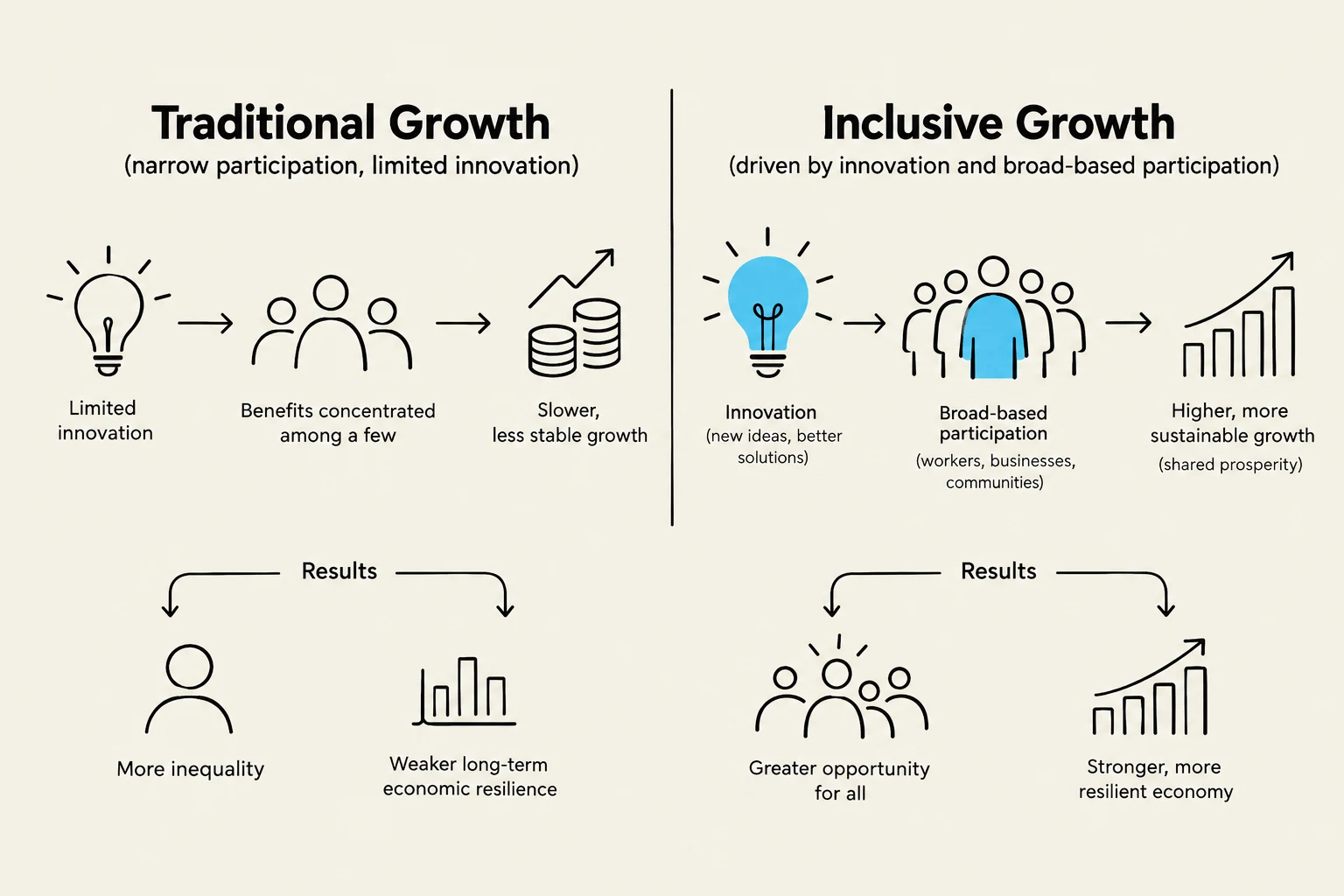
This diagram contrasts traditional growth, characterized by limited innovation and concentrated benefits, with inclusive growth, driven by innovation and broad-based participation, leading to shared prosperity and a more resilient economy.
Why Extractive Growth is Fragile
It is a common misconception that rapid growth under an authoritarian or extractive regime is a sign of institutional health. However, economists warn that such growth is often temporary and unsustainable.
The fundamental limitation is that resource reallocation is not a substitute for innovation. While a government can move workers from a farm to a factory, it cannot easily manufacture the creative destruction and technological breakthroughs that come from a free, competitive, and inclusive society.
Furthermore, extractive growth faces two major risks:
The Power Trap: Rulers often block technological or social changes that might increase productivity but also threaten their political monopoly or control over resources.
Inequality: Because the institutions are designed for extraction, the benefits of growth are rarely distributed widely, which can lead to social instability.
In summary, while extractive institutions can "jump-start" an economy through sheer force of reallocation, only inclusive institutions provide the stable, innovative, and productive foundation required for long-term, sustainable economic growth.
Keep reading for free.
Create an account to finish this reading and make it part of your study routine.