The Rise of Sustainable Capitalism and Consumer Influence
Explores the shift towards sustainable capitalism driven by Millennials and Gen Z, focusing on their economic influence, consumer choices, and the impact of social and environmental concerns on corporate practices.
For decades, the traditional model of capitalism was straightforward: companies aimed to maximize profits, and consumers made decisions based on a simple triad of price, quality, and convenience. However, a fundamental shift is occurring in the global marketplace. Driven by a heightened awareness of global crises, younger generations—specifically Millennials and Generation Z—are rewriting the rules of engagement. They are no longer just looking at what a product does for them; they are looking at what the company does for the world.
Redefining the Goal: What is Sustainable Capitalism?
At the heart of this movement is the concept of sustainable capitalism. Traditionally, there was a perceived tension between economic growth and environmental protection—the idea that to make money, one must exploit resources. Modern thinkers and younger consumers are challenging this dichotomy.
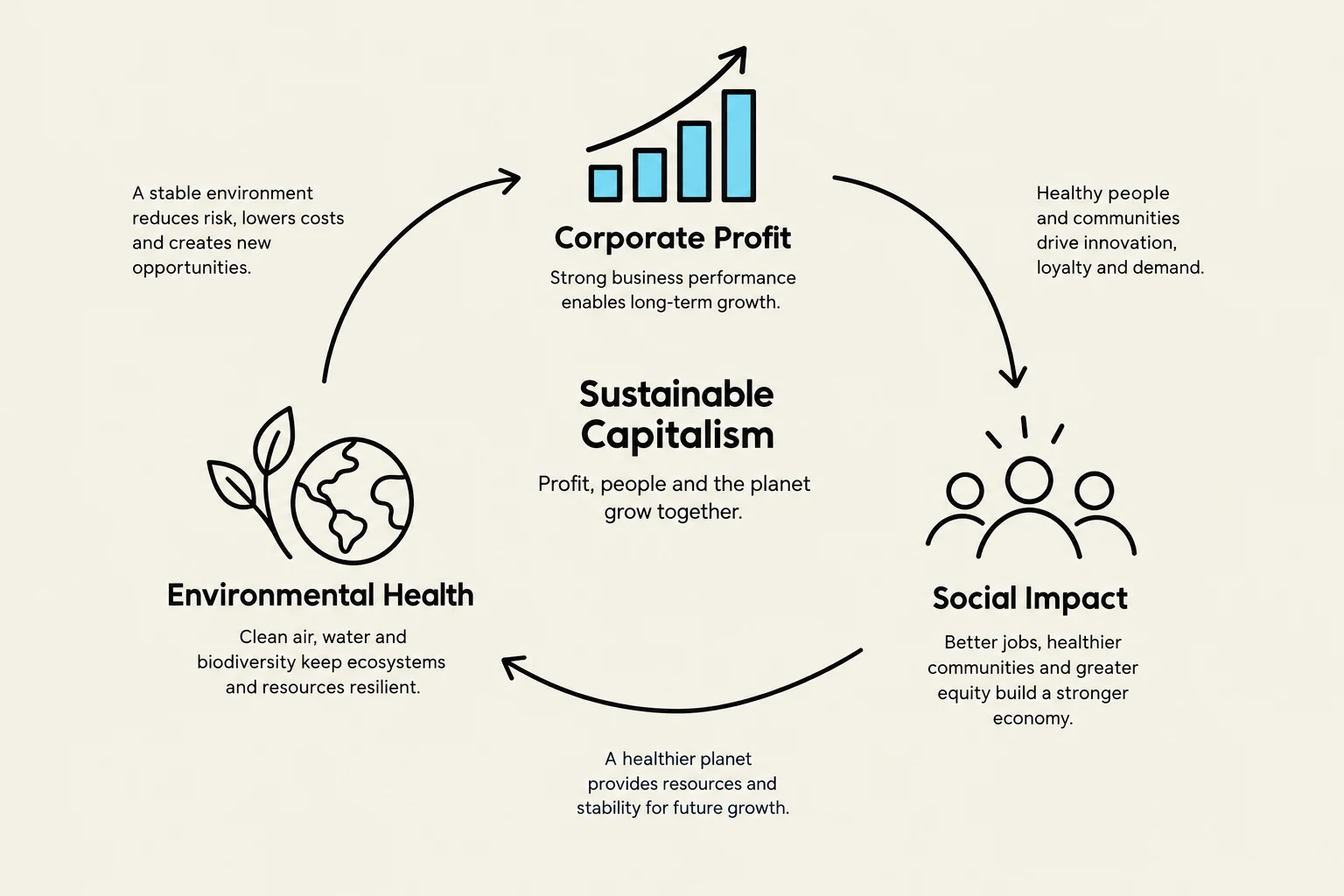
Sustainable capitalism suggests that capitalism and environmental protection do not have to work against each other. Instead, companies that protect the environment and support their local communities can create long-term value for themselves while simultaneously benefiting society. In this model, "value" is not just a line item on a balance sheet; it includes the health of the ecosystem and the stability of the social fabric.
This diagram illustrates the concept of Sustainable Capitalism, showing the interconnectedness of Corporate Profit, Social Impact, and Environmental Health, and how they contribute to a stable and growing economy.
Study Tip: When discussing economic models, remember that "Sustainability" in a business context refers to the ability of a system to maintain its functions and processes over the long term without depleting the resources it relies upon.
The Power of Economic Influence and Consumer Choice
The primary engine driving this change is the economic influence wielded by younger cohorts. While an individual purchase might seem insignificant, the collective power of millions of consumers can shift entire industries.
Millennials and Gen Z are increasingly scrutinizing their consumer choices through a lens of ethics. They are asking: Where is my money going?. This scrutiny manifests in several ways:
Direct Purchasing: Choosing brands that use recycled materials or fair-trade labor.
Investment Patterns: Directing capital toward funds that prioritize ESG (Environmental, Social, and Governance) criteria.
Brand Advocacy: Using social media to amplify the voices of responsible companies or boycott those that fail ethical standards.
By choosing to support socially responsible companies, these generations provide those businesses with the necessary resources to grow. This creates a "race to the top," where businesses are encouraged to adopt more responsible practices simply to remain competitive and attract the next generation of customers.
This diagram illustrates the impact of consumer choices on economic influence, corporate shifts, and ultimately, social impact, highlighting the move towards sustainability.
Addressing the Urgency: Social and Environmental Impact
The motivation behind this shift is not merely ideological; it is existential. The looming threat of climate change serves as a massive catalyst for this behavioral change. Younger generations recognize that individual actions, while important, are insufficient to solve global-scale problems alone.
Instead, they look to the systemic level. They focus on the social and environmental impact of corporate operations, such as:
Carbon Footprint: How much a company contributes to greenhouse gas emissions.
Resource Management: How efficiently a company uses water, land, and raw materials.
Labor Rights: The fairness and safety of the working conditions within their supply chains.
By targeting these specific areas, consumers attempt to steer the massive machinery of global capitalism toward solutions for climate change rather than contributors to it.
The Challenge of Authenticity: Avoiding "Greenwashing"
As the demand for sustainability grows, so does the temptation for companies to engage in deceptive practices. One of the most significant hurdles for the modern consumer is distinguishing between genuine commitment and "greenwashing"—the practice of using sustainability as a mere marketing strategy.
To navigate this, consumers must look beyond flashy advertisements and investigate deep-seated corporate policies. A company might claim to be "eco-friendly" because they use paper straws, while simultaneously ignoring massive pollution in their manufacturing plants.
This diagram contrasts greenwashing, which involves superficial marketing claims, with genuine sustainability, which focuses on real actions and measurable impact across marketing, claims, operations, and trust.
Exam Note: If asked to define the role of the consumer in modern capitalism, emphasize the transition from "passive recipient of goods" to "active participant in value creation" through ethical decision-making.
Conclusion
Millennials and Gen Z are positioned at a unique historical crossroads. They possess the growing economic influence necessary to demand a more responsible form of capitalism. By aligning their spending and investing with their values, they are not just buying products; they are voting for the kind of world they want to inhabit. If this trend continues, the result could be a more prosperous, equitable, and environmentally stable world for all future generations.
Keep reading for free.
Create an account to finish this reading and make it part of your study routine.