Examines the shift in British imperial policy after the French and Indian War, focusing on the end of salutary neglect, new taxes like the Sugar Act and Stamp Act, and the resulting debate over representation and the rights of Englishmen.
In 1763, the British Empire stood at a crossroads of triumph and crisis. The conclusion of the French and Indian War had removed the French from mainland North America, leaving Great Britain as the dominant power on the continent. For the American colonists, this victory was a moment of intense patriotism; having participated in a glorious military success, many felt they had fully proven themselves as "English". However, this victory brought with it a massive national debt and a fundamental shift in how the British government managed its overseas territories. What began as a celebration of imperial unity would, within thirteen years, dissolve into a revolution fueled by disputes over law, taxation, and the very definition of liberty.
The End of Salutary Neglect
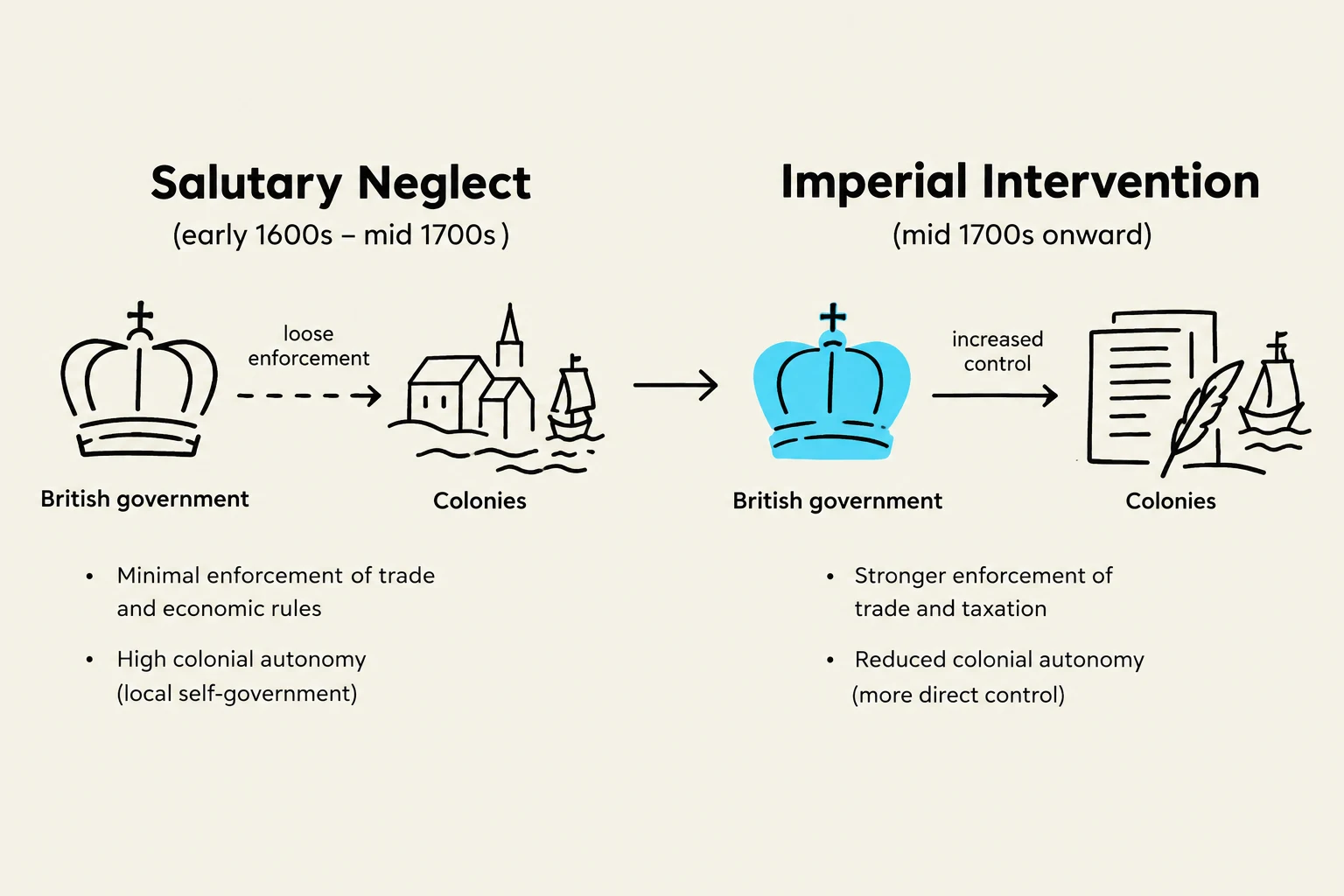
For decades, the relationship between Great Britain (the metropole) and the North American colonies (the periphery) had been defined by a policy of "Salutary Neglect". During this era, while the Navigation Acts—laws designed to regulate colonial trade—technically existed, they were loosely enforced. This allowed colonial merchants to develop a degree of economic autonomy and a habit of "avoiding" strict British trade laws.
The French and Indian War changed everything. The conflict left Britain with an enormous debt, and Parliament began to question whether the colonists, who had benefited from the war's outcome, should contribute more to the empire's upkeep. To address this, Parliament transitioned from a hands-off approach to an interventionist posture with two primary goals: tightening control over trade to ensure compliance with the Navigation Acts and generating revenue to fund the British troops stationed in North America.
This diagram illustrates the shift in British policy towards its colonies from "Salutary Neglect" to "Imperial Intervention," detailing changes in governance and control.
A New Imperial Posture: Taxes and Enforcement
To achieve its objectives, Parliament implemented a series of legislative measures that fundamentally altered the colonial experience. These were not merely economic adjustments; they were perceived as direct challenges to colonial self-governance.
The Sugar Act (1764)
While the Sugar Act actually reduced tariffs on certain foreign sugars, its true impact was in its enforcement. Britain moved away from "looking the other way" and instead deployed more vigilant customs officials to search ships and warehouses. Crucially, smuggling cases were no longer handled in local colonial courts but in Vice Admiralty courts—Crown-controlled military courts that bypassed traditional colonial legal processes.
The Stamp Act (1765)
The Stamp Act represented a significant escalation because it was an "internal" tax. Unlike previous taxes that regulated external trade, the Stamp Act was designed specifically to raise revenue from activities within the colonies. Colonists viewed this as an infringement on their traditional legal prerogatives and their right to be governed by laws made by their own representatives.
The Quartering Act (1765)
Maintaining a standing army on the North American frontier was prohibitively expensive. To offset these costs, the Quartering Act required colonists to provide housing and provisions for British soldiers stationed in coastal cities. This fueled fears of a "standing army" being used not for protection, but as a tool for the Crown to bypass constitutional restraints and enforce unpopular policies.
Exam Tip: When analyzing colonial reactions to these acts, distinguish between external taxes (aimed at trade/customs) and internal taxes (aimed at direct revenue within the colony). The shift from external to internal taxation (like the Stamp Act) was a major trigger for colonial resistance.
The Debate Over Rights and Representation
As tensions rose, the central conflict became a philosophical one: What were the "Rights of Englishmen," and who had the authority to protect them?
The Argument for Parliamentary Supremacy
Legal thinkers like James Otis argued that the power of the British Parliament was "uncontrollable" and that colonists had a duty to obey its laws. Otis believed that the colonists' rights were actually derived from the authority of Parliament and the British Constitution. He suggested that if Parliament passed unconstitutional laws, the proper recourse was to wait for the "wisdom and justice" of Parliament to realize its mistake and repeal them, rather than engaging in treasonous resistance.
The Argument for Colonial Autonomy
Other leaders, most notably Patrick Henry, took a much more radical stance. Henry argued that because the original settlers came to Virginia as Englishmen, their rights were affirmed by royal charters. He emphasized a core principle of British liberty: that citizens should not be taxed unless they were represented in the body that imposes the tax. Henry went so far as to claim that any Virginian who complied with an unconstitutional tax imposed by Parliament was an "enemy to Virginia".
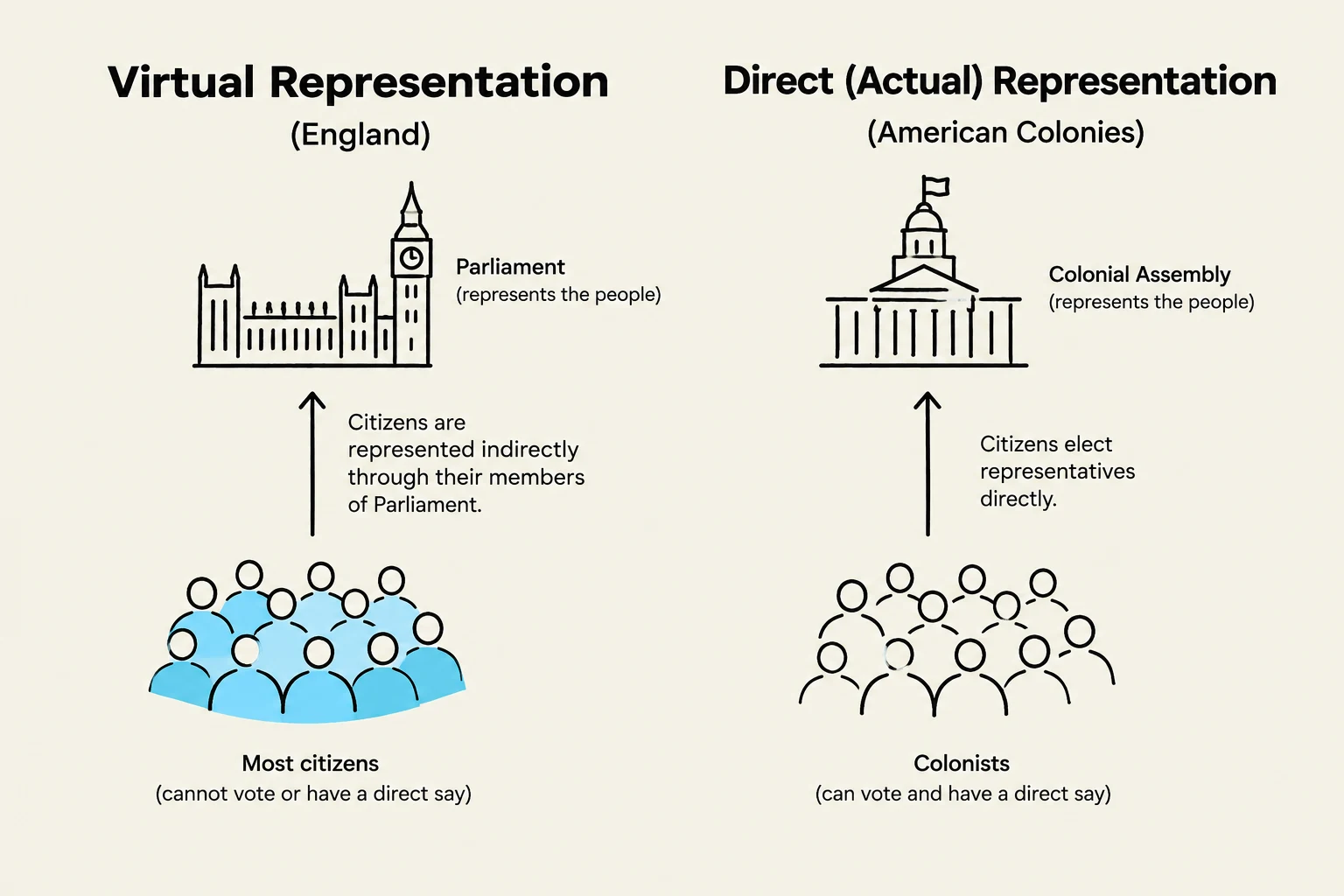
This diagram illustrates the difference between virtual representation in England, where citizens are represented indirectly through Parliament, and direct representation in the American Colonies, where citizens elect representatives directly.
Virtual vs. Direct Representation
The impasse between the colonies and Parliament often boiled down to a disagreement over how representation worked.
Virtual Representation: This was the standard in the British Empire. It held that members of Parliament represented the interests of the entire empire, even if specific citizens (like women, non-property owners, or colonists) did not have a direct vote.
Direct Representation: This was the standard in the American colonies. Colonial assemblies typically had much higher rates of participation; for example, roughly two-thirds of men in the colonies could vote for their local representatives, a much higher proportion than in England.
Feature
Virtual Representation (British View)
Direct Representation (Colonial View)
Mechanism
Parliament acts for the "general good" of all subjects
Representatives are elected by the people to act on their behalf
Voting Rights
Limited; most citizens do not vote
Broad; a high percentage of men vote in assemblies
Taxation Authority
Parliament has the right to tax all subjects
Only elected local assemblies can impose internal taxes
This fundamental disagreement over whether a person could be "represented" without a vote created a political deadlock. As merchants began to threaten nonimportation (boycotts) and the Stamp Act Congress met for the first time, the colonies began to move from individual protests toward a unified political identity. The transition from loyal British subjects to revolutionaries was not an overnight event, but a gradual erosion of trust caused by the collision of imperial necessity and colonial expectations of liberty.
Keep reading for free.
Create an account to finish this reading and make it part of your study routine.