The Renaissance and Renaissance Humanism: Reimagining Europe
Explore the Renaissance, a period of intellectual and artistic rebirth in Europe (1300-1600), driven by a return to classical traditions and the rise of Renaissance Humanism. Learn about patronage, the concept of Virtù, and the movement's influence on the Age of Exploration.
The period between 1300 and 1600 marks one of the most transformative eras in European history: the Renaissance. Characterized by an intellectual and artistic rebirth, this era saw Europeans consciously turning back to the traditions of the Greek and Roman periods to reimagine their society, their potential, and their place in the universe. This movement was not merely a revival of old styles, but a fundamental shift in how humans perceived their relationship with God, the world, and themselves.
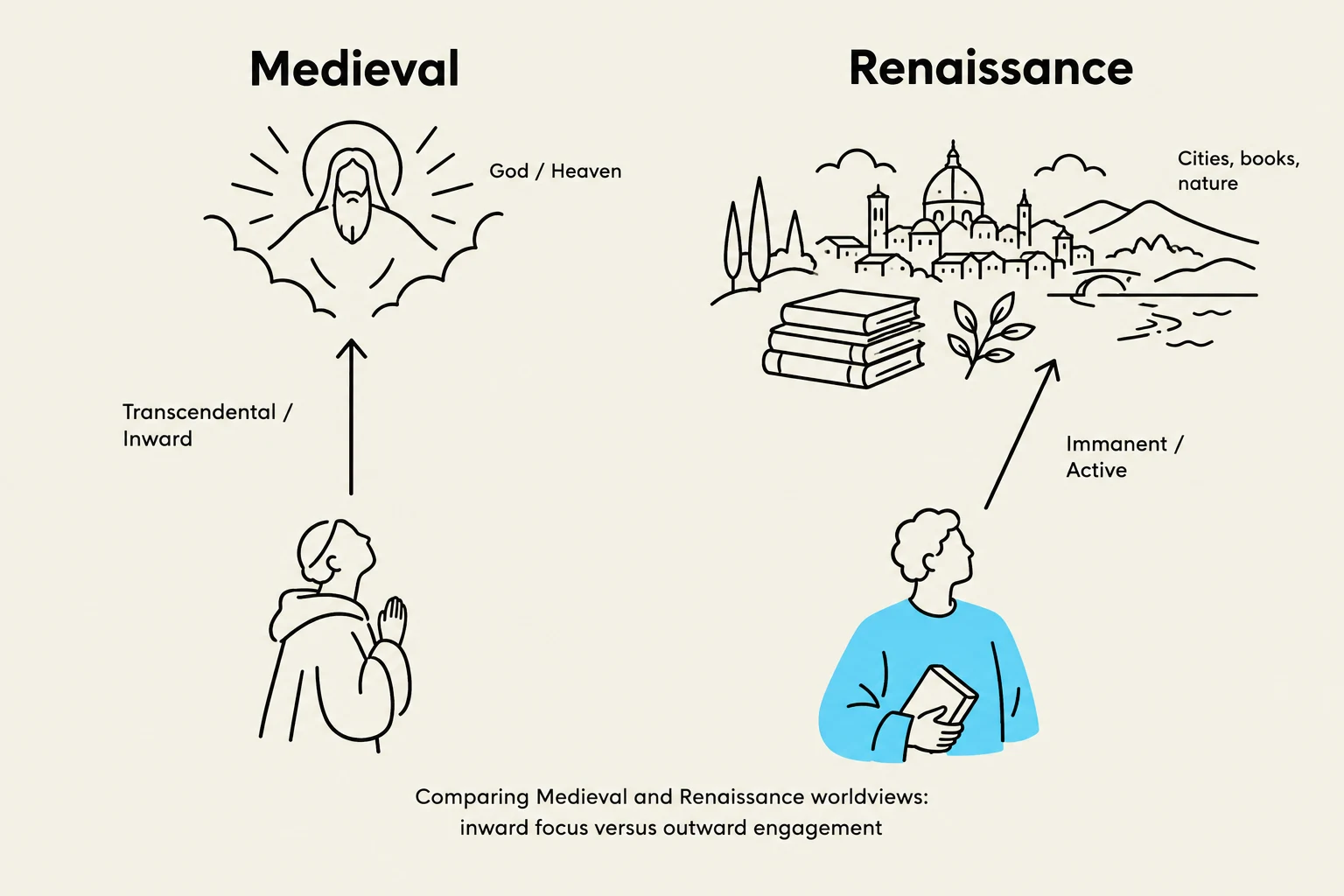
This diagram compares Medieval and Renaissance worldviews, illustrating the shift from an inward, God-focused perspective to an outward, active engagement with the world, encompassing cities, books, and nature.
The Renaissance: Rebirth and Patronage
The Renaissance began in Northern Italy, a region defined by independent republics. Unlike the centralized monarchies found elsewhere in Europe, these Italian city-states provided a unique environment where wealth and political influence were closely tied to cultural prestige.
The Role of Patronage
In these republics, wealthy individuals engaged in a competitive form of "patronage," supporting artists and scholars to win public support and solidify their social standing. Two cities stand out as primary centers of this activity:
Florence: This city was home to the famous Renaissance patron Cosimo de’ Medici (1389–1464), a powerful banker whose support helped fuel the city's artistic explosion.
Venice: As a major hub of trade, Venice offered a cosmopolitan environment and deep economic links that encouraged constant artistic endeavor.
The movement was further accelerated by geopolitical shifts. The Fall of Constantinople drove many Greek artists and scholars westward toward Venice, bringing with them precious manuscripts and classical knowledge that would fuel the intellectual fires of the era.
Renaissance Humanism and the Rediscovery of Learning
At the heart of this rebirth was Renaissance Humanism, an intellectual movement centered on the rediscovery of Greek learning. While medieval education had traditionally encouraged individuals to look inward to find God or to look beyond the physical world toward the afterlife, humanists proposed a radical alternative.
They argued that the ultimate aim of life was for individuals to act actively within this world and to find the divine within the world itself. This shift in focus led to several key developments:
Practical Skills: Humanists promoted the study of rhetoric, writing, and other practical skills necessary for civic life.
Human Potential: There was a new emphasis on building knowledge and exploring the vast potential of the human mind.
The Printing Press: The advent of the printing press played a crucial role in disseminating these new humanist ideas across the continent.
Study Tip: When comparing Medieval and Renaissance worldviews, remember the direction of focus. Medieval = Inward/Upward (transcendental); Renaissance = Outward/Active (immanent).
Virtù and the Renaissance Ideal
A central concept in the humanist toolkit was Virtù. Rather than meaning "virtue" in the modern moral sense, virtù signified an individual's ability to have a significant impact in their chosen field. It was the drive for individual achievement and the mastery of one's destiny.
This concept had profound social implications:
Masculinity: The idea of virtù became closely attached to the concept of Renaissance masculinity.
Gender Roles: While men were encouraged to pursue virtù in the public sphere, women were largely encouraged to focus on their own spirituality and the internal world of the home and family.
Artistic Expression: Art became a vehicle for these ideals. For example, Michelangelo’s David (1501–1504) is considered a masterpiece that captures both the ideal of virtù and the humanist belief that beauty is to be found within humankind and the natural world.
The Ideological Engine of the Age of Exploration
Renaissance Humanism did more than change art; it provided the ideological incentive for the Age of Exploration (15th to 17th century). By commanding individuals to "discover God's world," humanism gave explorers a sense of purpose that combined religious zeal with the pursuit of individual glory and virtù.
Drivers of Exploration
While humanism provided the intellectual spark, several other factors drove Europeans toward the sea:
Economic: The desperate desire for trade goods, particularly spices.
Religious: The desire to spread Christianity, aided by the momentum of the Reconquista.
Geopolitical: The Ottoman Empire's expansion pushed Europeans to find new maritime trade routes to bypass traditional land routes.
The Portuguese Lead and the Atlantic Slave Trade
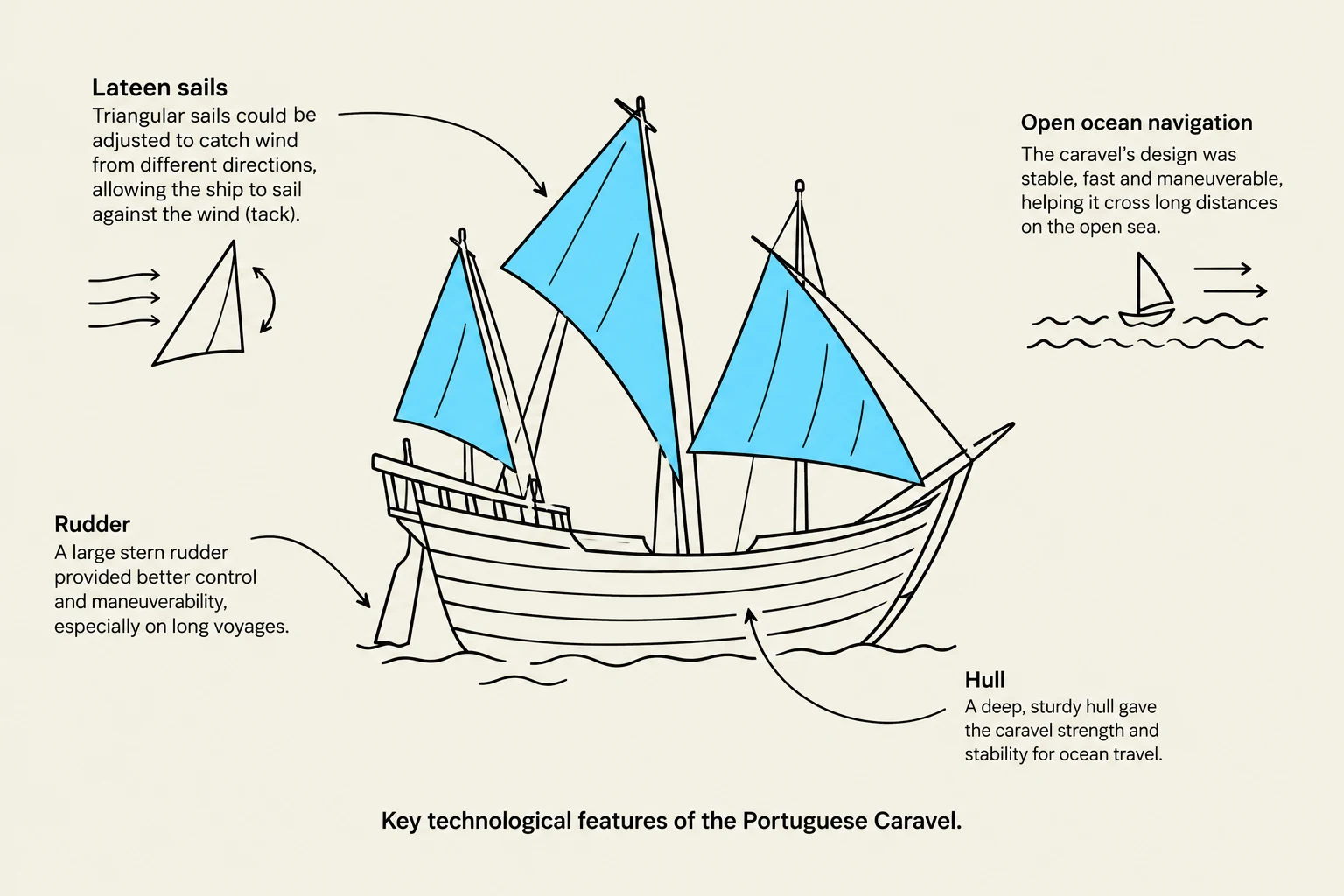
Key technological features of the Portuguese Caravel, including its lateen sails, rudder, hull, and suitability for open ocean navigation.
Portugal was a pioneer in this era. Under the influence of Prince Henry the Navigator, Portugal sought to create new trade routes to Africa and India, expand the science of cartography, and spread Christianity. Using new technologies like the Caravel (which borrowed Arabic design elements), the Compass (Chinese technology), and the Astrolabe (perfected by Arabic sailors), Portuguese explorers reached India via sea in 1498.
However, this expansion had a dark side. By occupying islands off the African coast, Portugal established Europe's first plantation colonies, using enslaved labor to grow sugar. This laid the foundations for the Atlantic Slave Trade and began to shape European perceptions of race.
Columbus and the Doctrine of Discovery
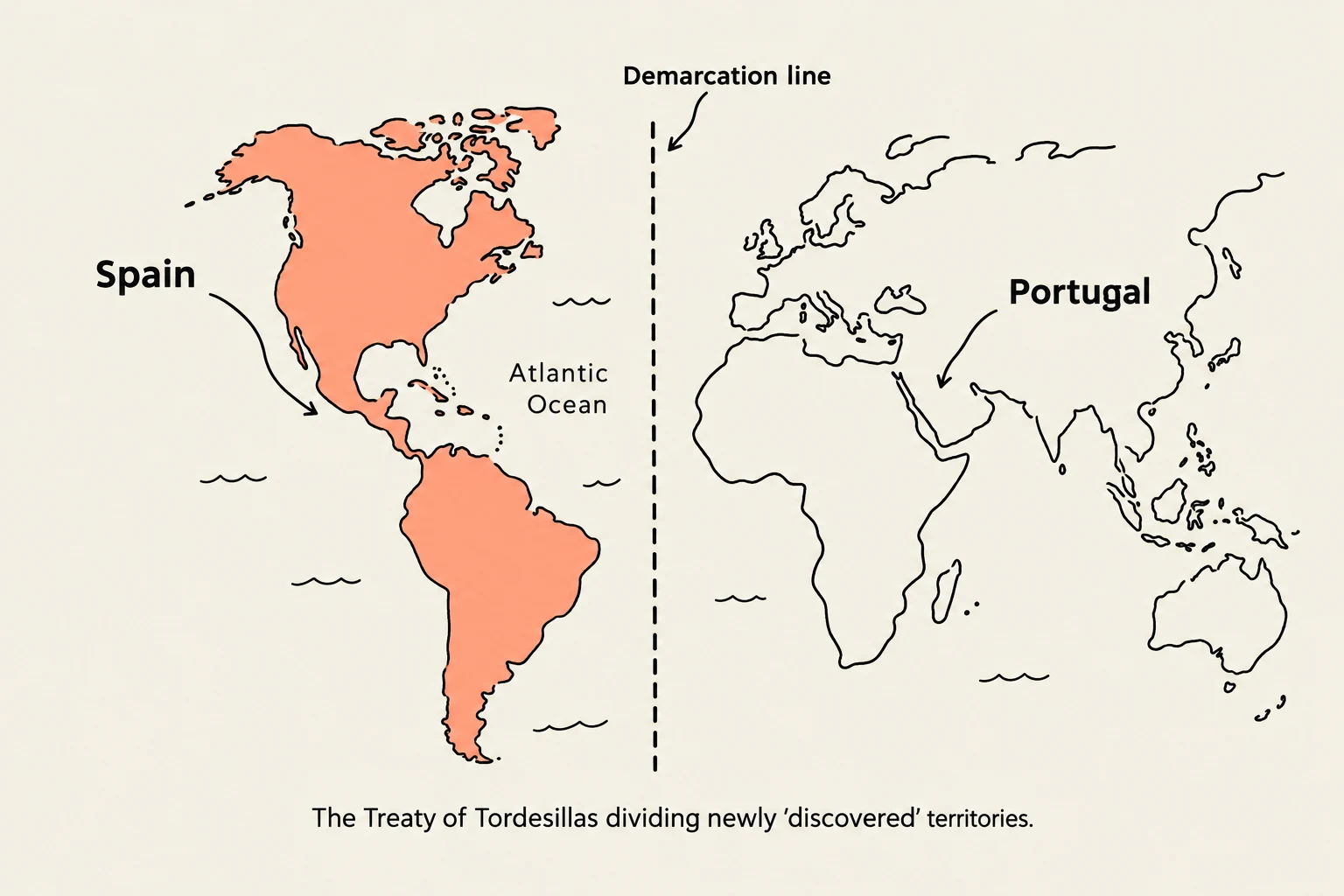
The Treaty of Tordesillas dividing newly 'discovered' territories between Spain and Portugal.
Motivated by a mix of Christianity, virtù, and greed, Christopher Columbus attempted to reach Asia by sailing west. When he reached the Americas in 1492, he claimed the territory for Spain and the Catholic Church.
This conquest was sanctioned by the Doctrine of Discovery, a series of papal bulls that provided the legal and moral justification for Christian forces to occupy lands held by non-Christians.
The Inter Caetera (1493): Issued by Pope Alexander VI, this decree gave Spain title to discovered lands in the Americas.
The Treaty of Tordesillas (1494): This agreement between Spain and Portugal effectively divided the "new" world between the two powers.
These doctrines ignored the rights and claims of Indigenous peoples and set a precedent for centuries of European colonization.
Keep reading for free.
Create an account to finish this reading and make it part of your study routine.