The Regional Middle Power Concept in International Relations
This content explains the concept of a regional middle power in international relations, distinguishing it from great powers and small states. It details the three pillars of regional influence: decisiveness in regional balance, deterrent capabilities (hard power), and soft power and ideological influence. The content
In the study of international relations, the global hierarchy is often viewed through the lens of "Great Powers"—the giants like the United States or China that shape the entire global order. However, the most dynamic shifts in geopolitics often occur not at the global level, but within specific geographic theaters. This is where the concept of the Regional Middle Power becomes essential. A regional middle power is not merely a "small version" of a superpower; rather, it is a state that possesses the specific capacity to influence the balance of power within its own neighborhood, utilizing a sophisticated mix of military deterrents and diplomatic influence.
Defining the Middle Power
To understand a middle power, one must distinguish it from both "Great Powers" and "Small States." While a Great Power seeks to dictate global norms, a middle power focuses on its immediate environment. A middle power is characterized by three primary pillars: the ability to influence regional balance, the possession of credible deterrent capabilities, and the skillful application of both hard and soft power.
Unlike small states, which often rely entirely on international law or the protection of a Great Power to survive, middle powers have enough agency to act as "swing players." They can choose to align with a superpower or form coalitions to prevent any single hegemon from dominating their region.
This diagram illustrates the hierarchical influence of different types of states in the global system, categorizing them as Great Powers, Middle Powers, and Smaller States, and showing their relationships with the world and each other.
Exam Tip: When asked to identify a middle power, look for "agency." If a state can independently alter the security landscape of its neighbors without waiting for permission from a superpower, it is likely operating as a middle power.
The Three Pillars of Regional Influence
1. Decisiveness in Regional Balance
The most critical function of a regional middle power is its role in the "balance of power." In any given region, there is often a tension between a dominant state (a hegemon) and the surrounding states. A middle power acts as a decisive factor in this equation.
If a hegemon becomes too aggressive, middle powers may form a "balancing coalition" to check that power. Conversely, they may engage in "bandwagoning," where they align with the hegemon to secure their own interests. The ability to shift the regional equilibrium is what makes these states "decisive".
2. Deterrent Capabilities (Hard Power)
A middle power cannot rely on diplomacy alone; it must possess the "teeth" to back up its claims. This is known as hard power. Deterrence is the ability to convince an adversary that the cost of attacking you (or your allies) is higher than any potential gain.
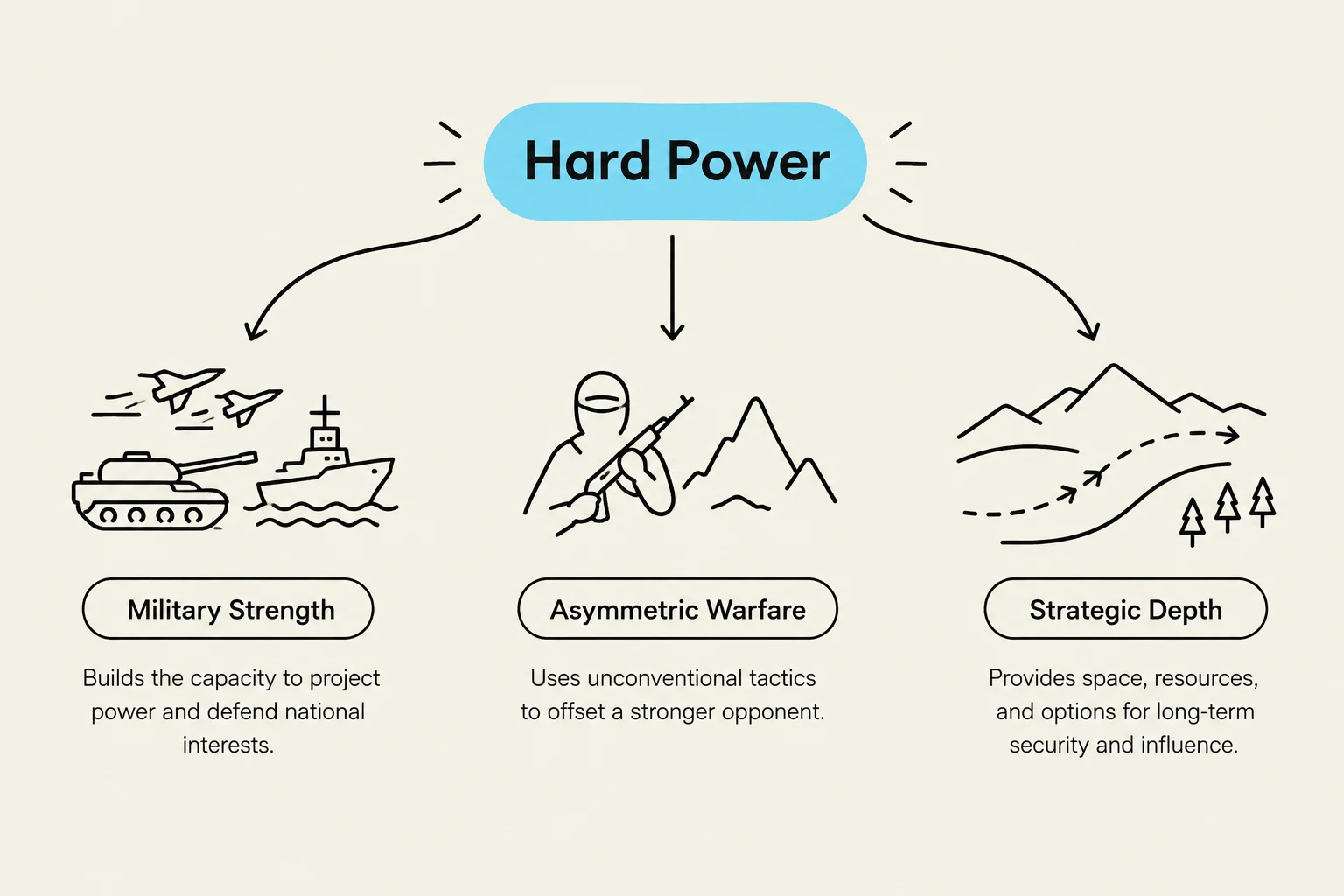
This deterrence is often achieved through:
Conventional Military Strength: Sufficient land, sea, or air forces to defend territory.
Asymmetric Capabilities: Using non-traditional methods, such as proxy networks or specialized technology, to offset a larger opponent's advantage.
Strategic Depth: The ability to project influence beyond one's own borders to create a buffer zone of influence.
This diagram illustrates the concept of "Hard Power" in international relations, breaking it down into three components: Military Strength, Asymmetric Warfare, and Strategic Depth.
3. Soft Power and Ideological Influence
While hard power prevents conflict, soft power wins influence. Soft power is the ability to get what you want through attraction rather than coercion. For a middle power, this might involve:
Cultural Diplomacy: Spreading national values, language, or media.
Economic Integration: Using trade agreements to make neighbors dependent on your economy.
Ideological/Sectarian Alignment: In some cases, middle powers use shared religious or political identities to build networks of influence across borders.
Case Study: The Logic of Regional Dynamics
To see these concepts in action, consider the dynamics in the Middle East. A state acting as a regional middle power does not just look at its own borders; it looks at the "security architecture" of the entire region.
For example, a middle power might use strategic depth—the practice of establishing influence in neighboring states—to ensure that conflicts are fought far from its own heartland. This is often achieved through a combination of hard power (military presence) and the mobilization of sectarian or political identities to create loyal networks.
By combining these elements, a middle power can effectively "punch above its weight," ensuring that even if it cannot dominate the world, it remains an indispensable player in its own backyard.
Summary Table for Revision
Feature
Middle Power Characteristic
Scope
Regional (not global)
Primary Goal
Maintain regional balance / Strategic depth
Hard Power
Deterrence via military or asymmetric means
Soft Power
Cultural, economic, or sectarian influence
Role
Decisive "swing player" in regional politics
Keep reading for free.
Create an account to finish this reading and make it part of your study routine.