An explanation of the objective reasonable person standard used in negligence cases to assess a defendant's conduct, including modifications for disabilities, age, and professional expertise.
In the law of torts, negligence is the most common cause of action, arising from careless conduct that causes harm to others. When a plaintiff sues a defendant for negligence, they must prove five elements: duty, breach, factual causation, proximate cause, and damages. At the heart of the "breach" element lies a fundamental question: Did the defendant's conduct fall below the required standard of care? To answer this, courts do not look at what the specific defendant was thinking, but rather at how a hypothetical, idealized individual would have acted in the same situation. This is known as the reasonable person standard.
This illustration depicts the comparison of conduct between a defendant and a reasonable person, highlighting the objective standard used in legal assessments.
The Objective Standard of Care
The reasonable person standard is an objective, external measure. Unlike subjective standards that might consider an individual's unique temperament, intentions, or mental state, the objective standard asks whether the defendant's conduct was blameworthy compared to an external benchmark: the "reasonably prudent person".
When evaluating a breach of duty, the jury or fact-finder must consider the foreseeable risk of the conduct and the gravity of potential harm. The goal is to determine if the defendant acted as a person of ordinary intelligence and prudence would have under similar circumstances.
Exam Tip: In a negligence analysis, always remember that "breach" is the comparison between the defendant's actual conduct and this objective standard. If the defendant was "trying their best" but their best was still below what a reasonable person would do, they have breached their duty.
Modifications to the Standard
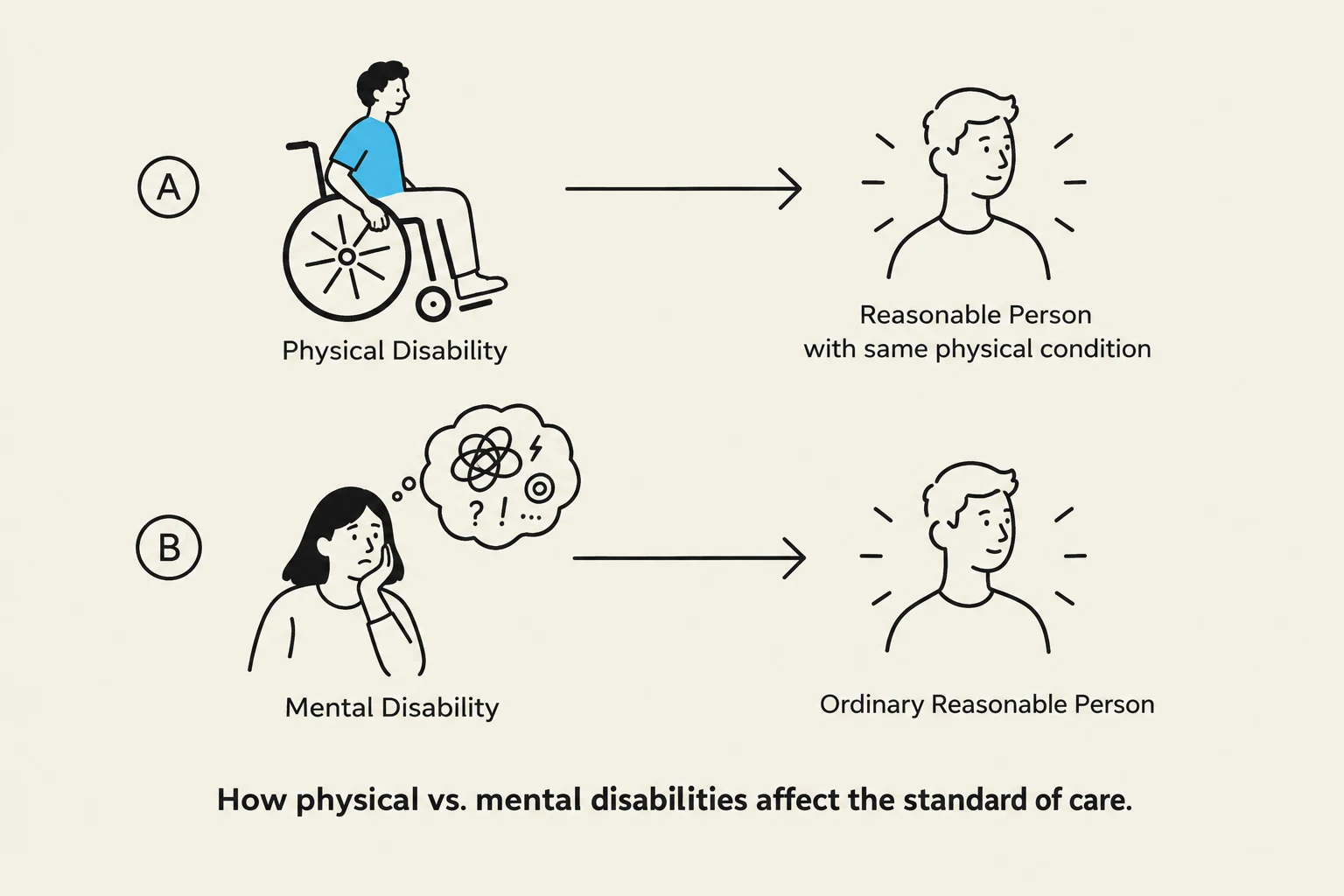
This illustration depicts how physical and mental disabilities are considered differently in the standard of care, comparing a "Reasonable Person with same physical condition" to an "Ordinary Reasonable Person" for mental disabilities.
While the standard is generally uniform, the law recognizes that certain physical or situational attributes change the context of what is "reasonable."
Physical Disabilities
The law makes a distinction between mental and physical attributes. An actor with a physical disability (such as blindness or paralysis) is held to the standard of a reasonable person with that same physical condition. For example, a blind person is not negligent for failing to see a hazard, but they are judged against what a reasonable blind person would do to navigate safely. However, a sudden, unforeseeable physical incapacitation (like a sudden seizure or fainting) is generally not considered negligence, provided the condition was not reasonably foreseeable.
Mental Disabilities
In stark contrast to physical disabilities, mental or emotional disabilities are generally not taken into account when applying the reasonable person standard. The law maintains a strict objective standard for mental capacity to ensure that individuals remain accountable for the damage they cause to others, preventing a "subjective" loophole that would make liability unpredictable.
Superior Attributes
Interestingly, the law treats "positive" attributes differently. While mental deficiencies are ignored, an actor's superior skills or talents are generally considered part of the circumstances when assessing their conduct. If a person possesses specialized knowledge or physical prowess, the standard may shift to reflect what a reasonable person with those specific advantages would do.
Special Expertise and Professionals
When an actor possesses specialized skills, the standard shifts from the "ordinary person" to a reasonable professional standard. A professional (such as a doctor or engineer) must meet the objective standard of care expected of a reasonably prudent person practicing that specific profession under similar circumstances. This is a national or professional standard rather than a local one; for instance, a doctor is judged against what a reasonably competent practitioner in that same class would do, regardless of their individual level of training.
Age and the "Adult Activity" Exception
This diagram illustrates the legal concept of the "adult activity exception" for children, where the standard of care shifts from that of a "reasonable child" to an "adult reasonable person" when a child engages in activities typically performed by adults, such as driving a car.
Children are treated differently than adults to account for their developmental stage. Generally, children are held to a blended standard: they are compared to a reasonable child of the same age, intelligence, and experience.
However, there is a significant exception: the adult activity exception. When a child engages in an activity that is inherently dangerous and typically reserved for adults—such as driving a car or operating a boat—the child is held to the adult reasonable person standard.
Common Carriers
Historically, some jurisdictions applied a heightened "utmost care" standard to common carriers (such as bus or train companies). However, modern legal trends have moved toward simplification. Many modern jurisdictions, including New York, have abolished this stratification in favor of a single, uniform reasonable care under the circumstances standard.
Summary Table of Standards
Actor Category
Applicable Standard
Ordinary Adult
Reasonable person of ordinary prudence
Physically Disabled
Reasonable person with the same physical condition
Mentally Disabled
Ordinary reasonable person (subjective state ignored)
Child
Reasonable child of similar age, intelligence, and experience
Child (Adult Activity)
Adult reasonable person standard
Professional
Reasonable professional in that field
Keep reading for free.
Create an account to finish this reading and make it part of your study routine.