


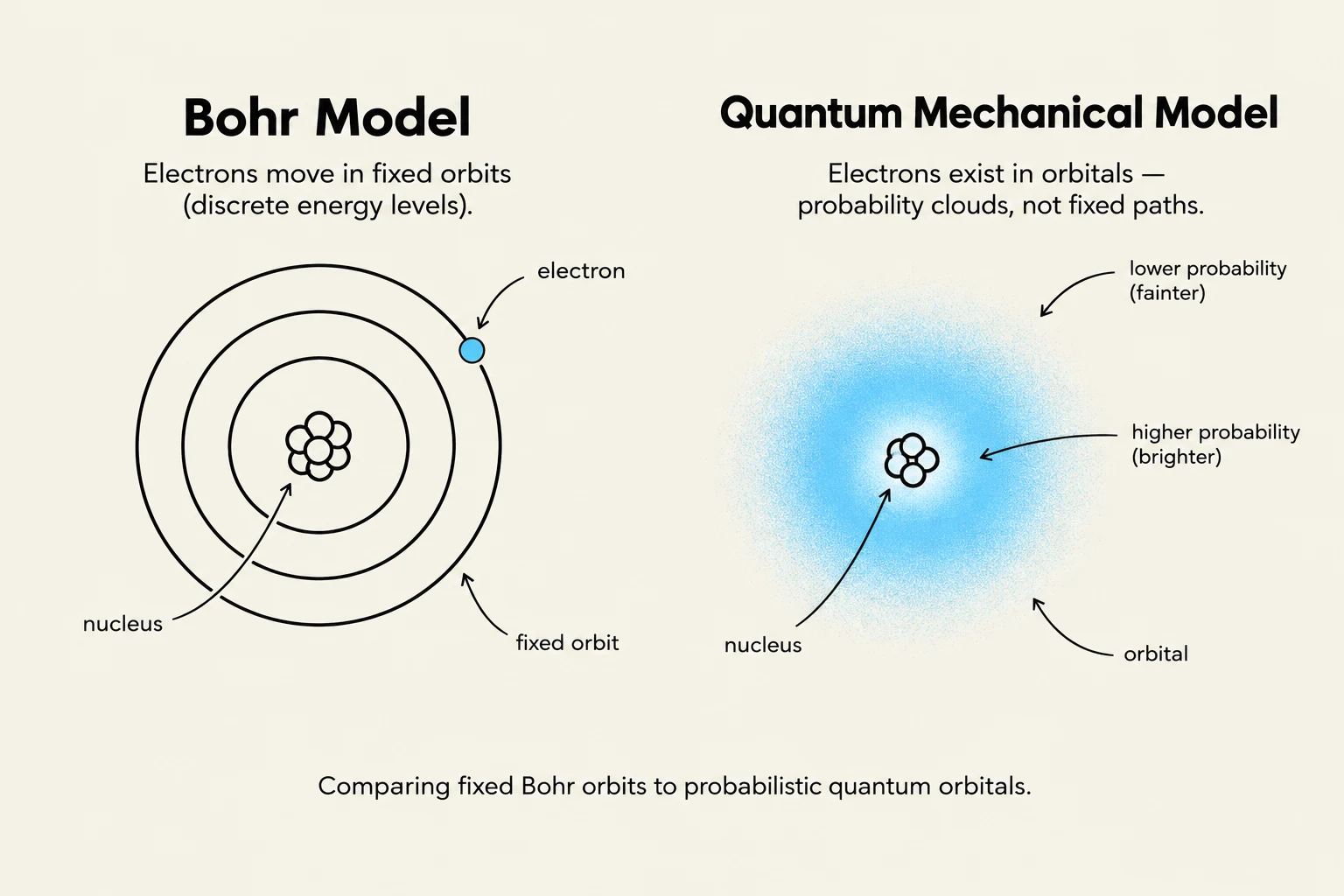
For decades, the Bohr model of the atom—which depicted electrons as tiny planets orbiting a nucleus in fixed, circular paths—served as the standard way to visualize atomic structure. However, as our understanding of physics deepened, we realized that the subatomic world does not follow the predictable rules of Newtonian mechanics. Instead, electrons behave in ways that defy our everyday intuition, leading to the development of the Quantum Mechanical Model. This model replaces certainties with probabilities and orbits with "orbitals," providing a much more accurate description of how matter is structured at its most fundamental level.
The Wave-Particle Duality
The foundation of the quantum model lies in a concept known as wave-particle duality. In classical physics, an object is either a particle (like a marble) or a wave (like a ripple in a pond). In the quantum realm, however, electrons exhibit characteristics of both.
When we measure an electron's position, it appears to act like a particle. Yet, when we observe its behavior over time or its energy states, it behaves like a wave. This wave-like nature means that an electron does not exist at a single, precise point in space. Instead, it is "delocalized," meaning its position is spread out over a region. This realization fundamentally changed how we view the atom: we can no longer say exactly where an electron is, only where it is likely to be.
Exam Tip: If a question asks about the difference between a Bohr orbit and a quantum orbital, remember: an orbit is a fixed path (like a track), while an orbital is a mathematical probability map (like a cloud).
Keep reading for free.
Create an account to finish this reading and make it part of your study routine.
Continue reading freeAlready have an account? Log in
Updated