An overview of the psychodynamic approach, including Freud's theories on the levels of consciousness, the tripartite structure of personality (Id, Ego, Superego), defense mechanisms, and psychosexual stages of development. It also discusses criticisms of the approach.
The psychodynamic approach is a psychological perspective that emphasizes the profound influence of early childhood experiences on an individual's mental and emotional state throughout their life. Central to this theory is the belief that much of human behavior is driven by forces within the unconscious mind—thoughts, memories, and desires that are inaccessible to our conscious awareness. By exploring these hidden depths, psychodynamic theorists aim to understand how internal conflicts and developmental milestones shape the adult personality.
The Levels of Consciousness
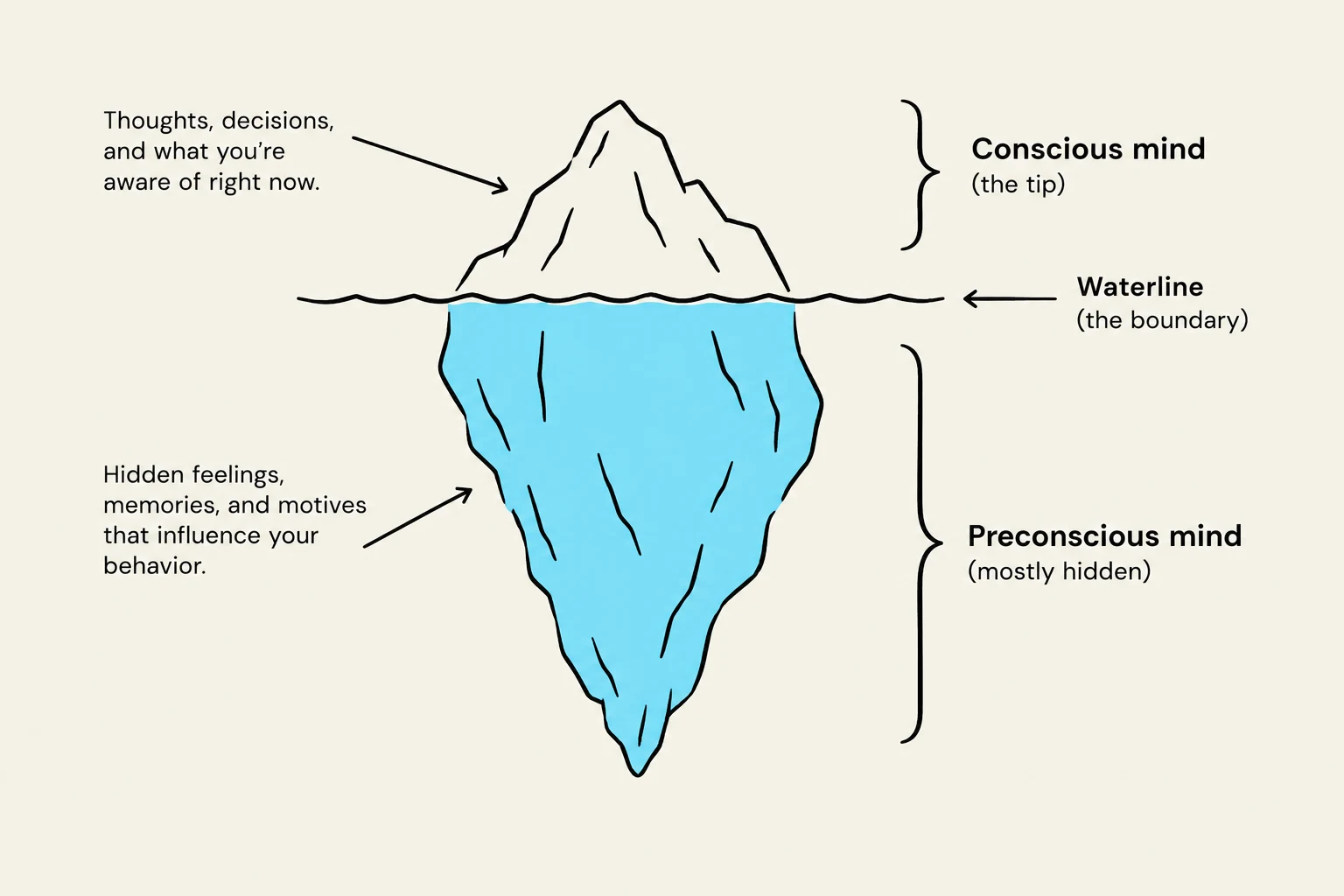
Freud used the metaphor of an iceberg to illustrate the different levels of the human mind. Just as most of an iceberg remains hidden beneath the water, the majority of our mental life occurs outside of our immediate awareness.
The mind is divided into three distinct levels:
The Conscious Mind: This is the "tip of the iceberg"—the part of the mind we are currently aware of, used to form our active thoughts.
The Preconscious Mind: Sitting just below the surface, this level contains information that is not currently in our awareness but can be easily retrieved. This is often where "Freudian slips" occur—accidental slips of the tongue that are believed to reveal a person's true, repressed feelings (e.g., saying "I loathe my husband" when intending to say "I love my husband").
The Unconscious Mind: This is the vast, hidden portion of the iceberg. It holds repressed memories, traumatic experiences, and primal desires that are often disturbing. While these thoughts are hidden, they can "push upwards" and manifest in our lives through dreams or certain behaviors.
This diagram illustrates the iceberg model of the mind, differentiating between the conscious, preconscious, and the hidden aspects of the mind that influence behavior.
The Tripartite Structure of Personality
Freud proposed that personality is not a single entity but a structure composed of three interacting parts: the Id, the Ego, and the Superego. These components develop at different stages of life and often work in tension with one another.
The Id: The Pleasure Principle
Present from birth, the Id is the most primitive part of the personality. It consists of pure erotic energy and primal drives, operating entirely on the pleasure principle—the demand for instant gratification of all needs and urges. Like a "spoilt child," the Id does not care about logic or social consequences; it simply wants what it wants, "now!".
The Ego: The Reality Principle
Developing around age two, the Ego acts as the rational mediator between the impulsive Id and the idealistic Superego. It operates on the reality principle, seeking to satisfy the Id's desires in socially acceptable and realistic ways. The Ego must balance the "wild impulses" of the Id with the strict moral demands of the Superego.
The Superego: The Morality Principle
Appearing around age five, the Superego represents the internalized sense of right and wrong, often learned from parents. It operates on the morality principle, acting like a disapproving teacher or a strict conscience. It strives for perfection and can induce feelings of guilt or self-blame when moral standards are not met.
Defence Mechanisms
Because the struggle between the Id and the Superego can be overwhelming, the Ego employs defence mechanisms to protect the psyche from anxiety. These mechanisms operate at an unconscious level and provide temporary relief from unpleasant realities, though they can be psychologically damaging in the long term.
Common defence mechanisms include:
Repression: Pushing distressing or unpleasant memories deep into the unconscious so they cannot cause anxiety.
Denial: Refusing to accept the reality of an unpleasant situation (e.g., insisting a partner isn't stealing from you despite evidence).
Displacement: Redirecting strong emotions from their original source to a neutral or uninvolved target (e.g., shouting at your children because you are angry at your boss).
Psychosexual Stages of Development
Freud suggested that personality is shaped through a series of five psychosexual stages. During each stage, the focus of pleasure shifts to a different part of the body.
Stage
Age
Focus of Pleasure
Potential Consequences of Unresolved Conflict
Oral
0–1
Mouth
Oral Fixation: Smoking, nail-biting, addiction, or being overly critical
If a child experiences trauma or dysfunctional upbringing during a stage, they may suffer from fixation, becoming "stuck" in that stage and manifesting specific adult behaviors.
A critical part of the Phallic stage involves the resolution of sexual conflicts:
Oedipus Complex: In boys, an unconscious desire for the mother and fear/hatred of the father.
Electra Complex: In girls, a similar process involving closeness to the father and rivalry with the mother.
Successful development requires navigating these complexes and identifying with the same-sex parent.
Exam Tip: Psychic Determinism
Be aware of the concept of psychic determinism. This is the idea that "there's no such thing as an accident". It assumes that all behaviors and even accidental slips are determined by unconscious forces, which critics argue negates the concept of free will.
Summary and Evaluation
The psychodynamic approach has significant implications for psychotherapy, helping individuals confront unconscious trauma. However, the theory faces several criticisms:
Lack of Scientific Rigor: Concepts like the Id and Ego are subjective and difficult to measure or test, making the theory unfalsifiable.
Methodological Issues: Freud relied on small-scale case studies (such as "Little Hans") rather than large, controlled experiments.
Alternative Explanations: Behaviors attributed to psychosexual fixation might instead be explained by social learning or neurodevelopmental factors, such as autism.
Despite these limitations, the approach remains a foundational element in the history of psychology, particularly in its emphasis on the importance of early childhood.
Keep reading for free.
Create an account to finish this reading and make it part of your study routine.