The Politics-Administration Dichotomy in Public Governance
An exploration of the theoretical separation between political decision-making and administrative implementation in public governance, examining its foundational principles, its importance for professionalism and neutrality, and the practical challenges that blur this distinction.
In the study of public governance, one of the most enduring and debated concepts is the distinction between the "will" of the state and the "execution" of the state. This is known as the Politics-Administration Dichotomy. At its core, the concept suggests that there should be a clear, functional separation between the political actors who set goals and the administrative officials who carry them out. While this distinction provides a framework for professionalizing the civil service, the line between these two spheres is often much thinner in practice than the theory suggests.
The Theoretical Foundation: Separating Will from Action
The politics-administration dichotomy emerged as a foundational principle in the late 19th and early 20th centuries, most notably championed by thinkers like Woodrow Wilson. The primary objective was to insulate the machinery of government from the "spoils system"—a practice where political winners rewarded supporters with government jobs regardless of competence.
The theory proposes a clean division of labor:
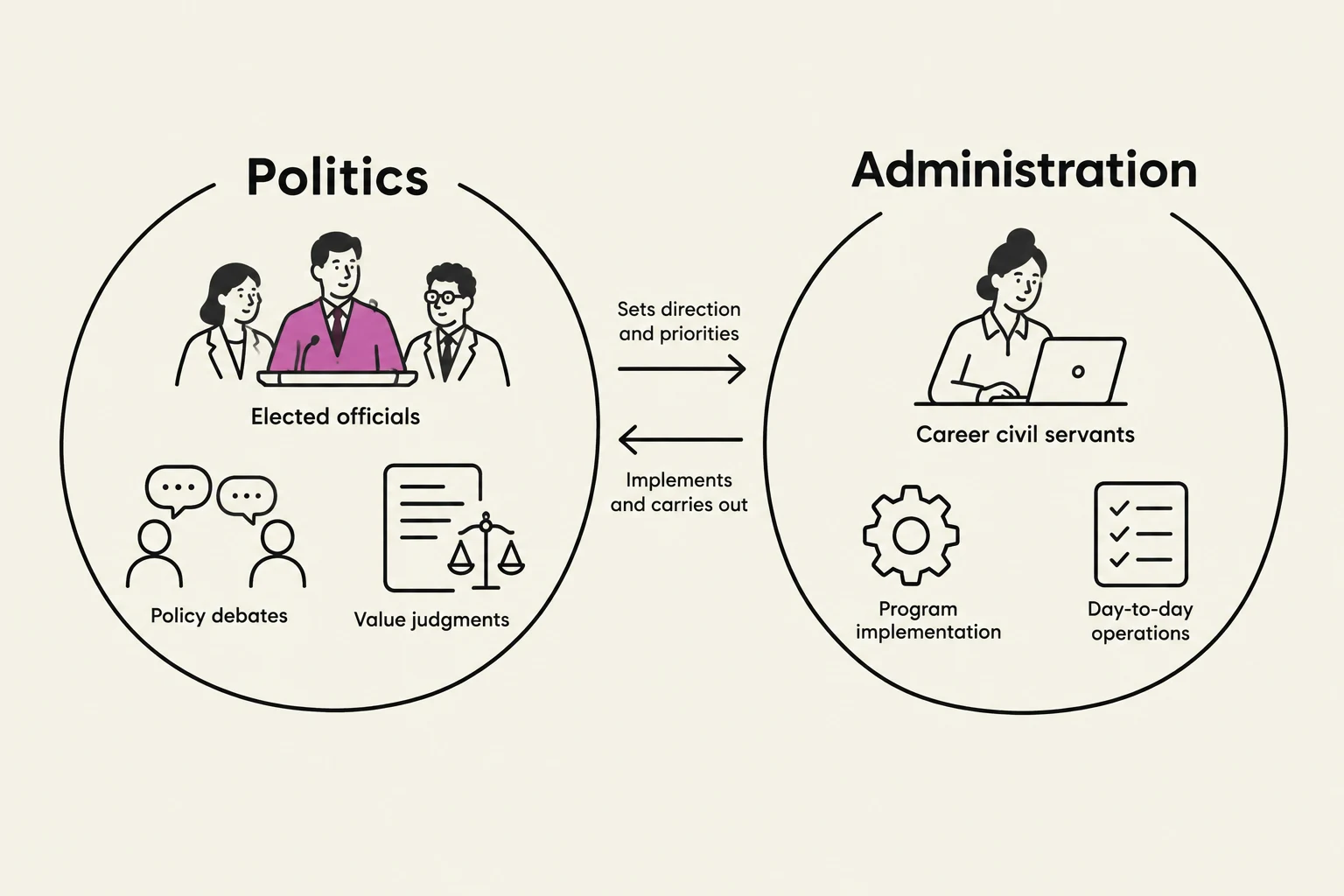
Politics: This sphere involves the determination of public policy, the expression of societal values, and the making of high-level decisions. It is characterized by debate, conflict, and the pursuit of ideological goals.
Administration: This sphere is tasked with the efficient, technical, and neutral implementation of those policies. It is characterized by expertise, hierarchy, and the application of scientific management principles.
The logic behind this split is that if administration is treated as a technical field—akin to engineering or medicine—it can operate with maximum efficiency without being corrupted by the shifting winds of partisan politics.
This illustration depicts the relationship between politics and administration, showing how elected officials set direction and priorities, while career civil servants implement and carry out these directives through day-to-day operations and program implementation.
Exam Tip: When discussing the dichotomy, remember that the theory is not saying politics and administration are unrelated, but rather that they should be functionally separate to ensure competence and prevent corruption.
Why the Dichotomy Matters: Professionalism and Neutrality
The theoretical separation serves several critical functions in a modern democracy. First, it promotes meritocracy. By separating the administrative function from political patronage, governments can ensure that the people managing public funds and services are selected based on expertise rather than political loyalty.
Second, it fosters neutrality. A professional bureaucracy is expected to serve the government of the day with equal vigor, regardless of which political party holds power. This continuity is essential for the stability of the state during transitions of power.
Finally, it allows for specialization. As modern governance becomes increasingly complex, the "technical" side of government requires deep expertise in fields like economics, public health, and environmental science—skills that are often distinct from the skills required for political campaigning and legislative negotiation.
The Blurred Reality: Why the Split Fails in Practice
While the dichotomy is a useful pedagogical tool, scholars and practitioners have long noted that in the real world, politics and administration are deeply intertwined. The "clean break" envisioned by theorists rarely survives contact with reality for several reasons.
1. Discretionary Power in Implementation
When a legislature passes a law, the text is often broad and ambiguous. The specific details of how that law is applied are left to administrative agencies. This "administrative discretion" means that bureaucrats are not just following orders; they are effectively making policy decisions through their interpretation of rules and regulations.
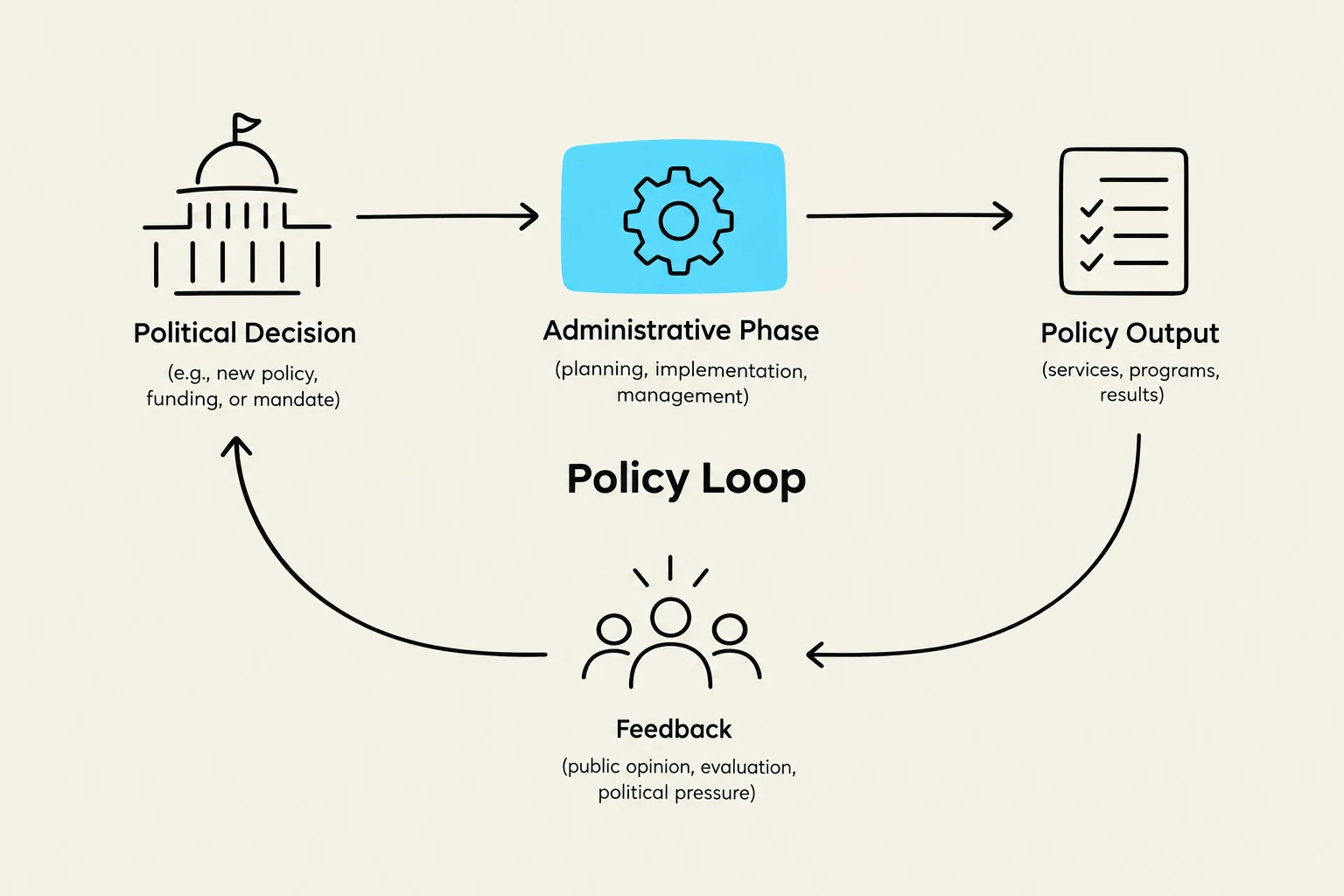
This diagram illustrates the policy loop, a cyclical process involving political decisions, administrative phases, policy outputs, and feedback.
2. The Expertise Gap
Politicians are generalists, while administrators are specialists. When a complex issue arises—such as managing a pandemic or regulating a new financial technology—politicians must rely heavily on the information and recommendations provided by bureaucrats. In this way, the "experts" in the administration often set the boundaries of what is politically possible, thereby exerting significant political influence.
3. Political Pressure and Bureaucratic Influence
The relationship is a two-way street. While politicians attempt to control the bureaucracy through budgets and oversight, bureaucrats can influence politics through their control of information, their ability to delay implementation, or their role in advising officials.
Summary of the Tension
To understand the modern state, one must view the relationship between politics and administration not as a line, but as a spectrum of interaction.
Feature
Politics (The "Will")
Administration (The "Execution")
Primary Actor
Elected Officials
Civil Servants / Bureaucrats
Core Function
Setting Goals & Values
Implementing Processes
Key Driver
Ideology & Public Will
Efficiency & Expertise
Nature of Work
Conflictual & Debated
Technical & Routine
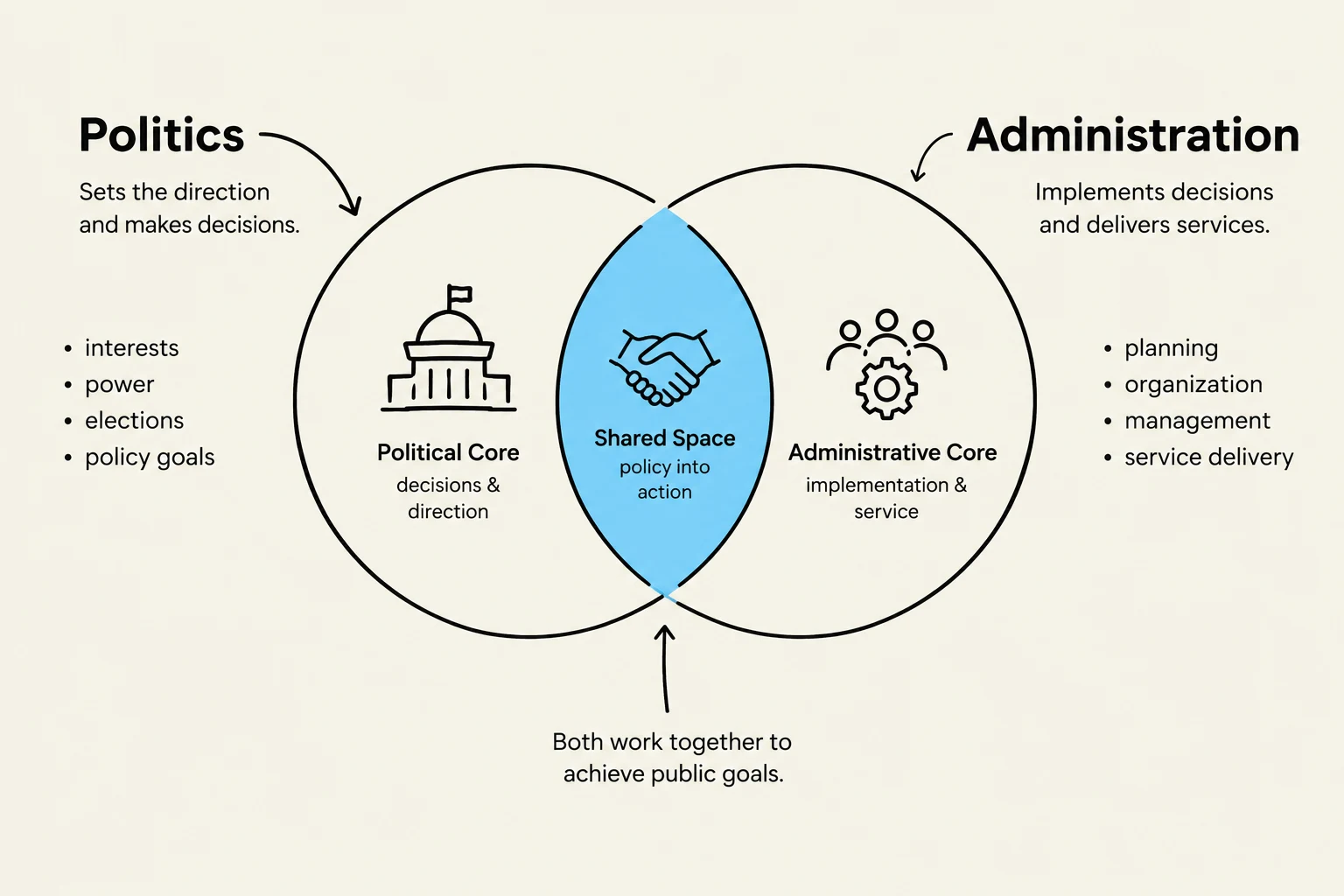
This diagram illustrates the relationship between politics and administration, showing how the political core sets direction and the administrative core implements decisions to achieve public goals through a shared space for policy into action.
In conclusion, while the Politics-Administration Dichotomy remains a vital concept for understanding the ideal of a professional, merit-based civil service, it serves more as a normative goal than a descriptive reality. The modern administrator is rarely a neutral machine; they are an active participant in the shaping of public life.
Keep reading for free.
Create an account to finish this reading and make it part of your study routine.