Explores the relationship between light's energy and wavelength, how UV radiation damages DNA, and its connection to cell cycle mutations, melanoma, and sun protection factors.
Light is a fundamental form of electromagnetic radiation that exhibits a dual nature, behaving as both a wave and a particle. While we experience light primarily through sight, the electromagnetic spectrum encompasses a vast range of energies that interact with biological systems in profound ways. Understanding the relationship between light's energy and its wavelength is essential to understanding how sunlight can fundamentally alter the blueprint of life: our DNA.
The Physics of Light: Energy and Wavelength
To understand how UV light damages cells, we must first understand the physics of the electromagnetic spectrum. Light is characterized by its wavelength (λ), which is defined as the distance between two adjacent wave crests.
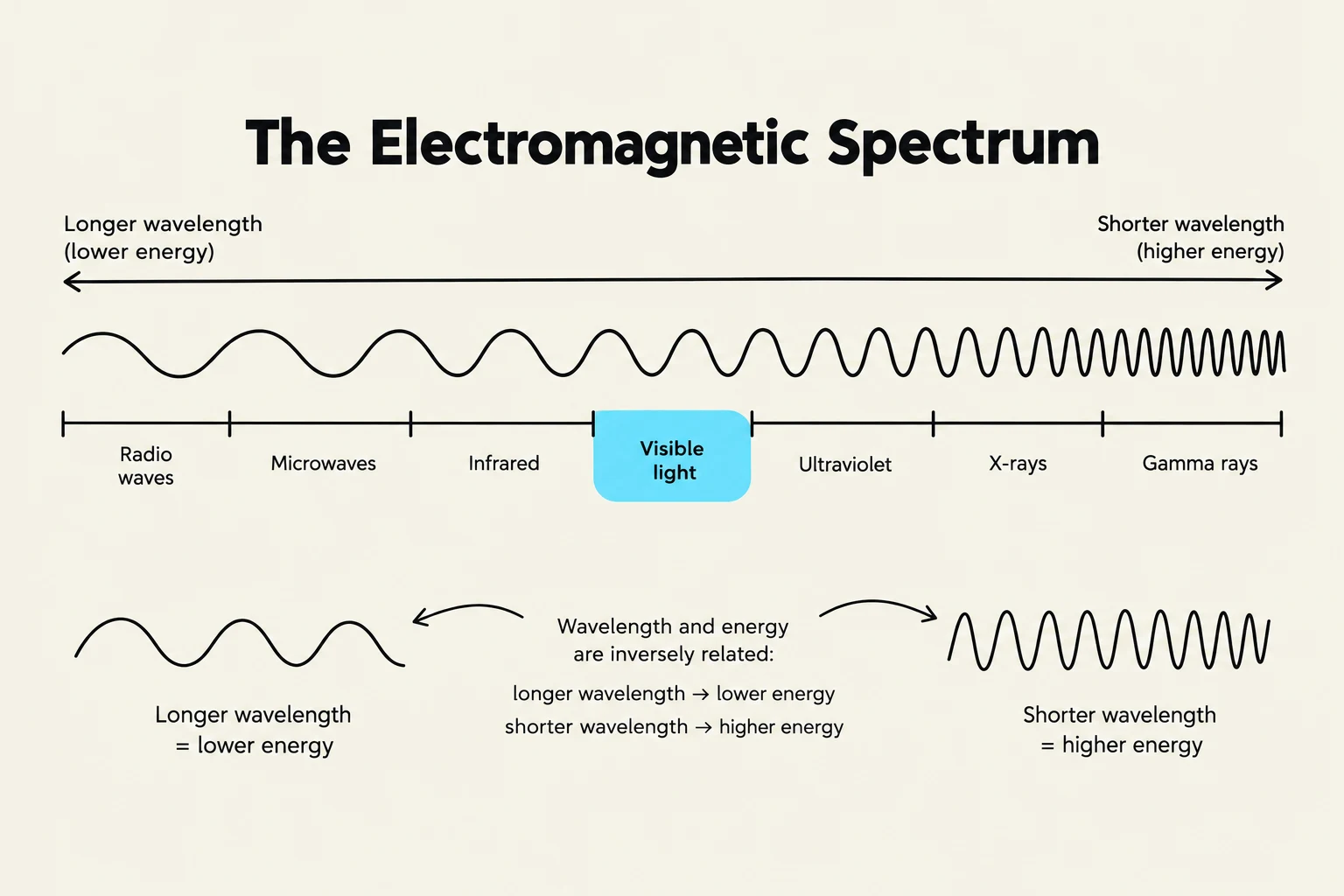
The most critical concept in this study is the energy-wavelength relationship. The energy of a light wave is inversely proportional to its wavelength. This means:
Shorter wavelengths correspond to higher energy waves.
Larger wavelengths correspond to lower energy waves.
The spectrum is divided into several regions. Visible light (380–750 nm) is the narrow band detectable by the human eye. Beyond the visible spectrum lies ultraviolet (UV) light (200–400 nm). Because UV light has shorter wavelengths than visible light, it possesses significantly higher energy—enough to damage biological molecules like proteins and nucleic acids (DNA).
The electromagnetic spectrum illustrates the range of electromagnetic radiation, ordered by wavelength and energy. Longer wavelengths correspond to lower energy, while shorter wavelengths correspond to higher energy. The spectrum includes radio waves, microwaves, infrared, visible light, ultraviolet, X-rays, and gamma rays.
Categorizing Ultraviolet Radiation
Not all UV light is created equal. Based on their specific wavelengths, UV rays are categorized into three types, each with different levels of energy and biological impact:
UVC (200–290 nm): These are the shortest wavelength UV rays and therefore possess the highest energy. While they are the most dangerous, they are largely absorbed by the Earth's ozone layer and do not reach our skin in significant amounts.
UVB (290–320 nm): These rays have intermediate energy levels and are the primary cause of sunburns.
UVA (320–400 nm): These are the longest wavelength UV rays in the UV spectrum, meaning they have the lowest energy of the three. However, they are highly effective at penetrating the deeper layers of human skin and are a significant factor in the development of cancer.
Exam Tip: If asked which UV light has the most energy, the answer is UVC due to its shortest wavelength. However, remember that UVB and UVA are the types we must most concern ourselves with because they reach the Earth's surface.
UV Damage, Mitosis, and Melanoma
The biological danger of UV light lies in its ability to induce mutations in DNA. When UV radiation strikes a cell, it can damage the molecular structure of nucleic acids.
The Role of the Cell Cycle and Mitosis
Cells undergo a cell cycle, a series of events leading to cell division and the duplication of DNA (DNA replication) to produce two daughter cells. A key stage of this cycle is mitosis, where the cell divides its chromosomes to produce two identical nuclei.
If UV light causes a mutation in the DNA during or before mitosis, that error can be passed on to daughter cells. Over time, the accumulation of these mutations can disrupt the regulation of the cell cycle:
Proto-oncogenes (which normally regulate growth) can become super-active, turning into oncogenes.
Tumor suppressor genes (which normally stop uncontrolled growth) can become non-functional.
From Mutations to Melanoma
When the cell cycle loses its regulatory control, it can lead to a malignant tumor—a mass of abnormal cells whose growth cannot be controlled by regular mechanisms and which may spread to other parts of the body.
One specific and dangerous outcome of UV damage is melanoma. This is a type of skin cancer that originates in the melanocytes, which are the specialized cells in the skin responsible for producing melanin. While melanin acts as a natural sunscreen (providing roughly an SPF of 2) by accumulating as a tan, it cannot fully protect against all UV damage. Melanoma is often characterized by dark spots that may be larger than a mole or have jagged edges.
This diagram illustrates how UV light can damage DNA, leading to mutations that can cause melanoma cancer cells.
Protection: Sunscreen and SPF
To mitigate the risks of UV radiation, we use sunscreen. Sunscreen can be categorized as either inorganic or organic. The effectiveness of sunscreen is measured by the Sun Protection Factor (SPF), which indicates how much longer a person can stay in the sun without burning compared to wearing no protection.
To calculate your protected time, you can use the following logic:
Protected Time=Unprotected Burn Time×SPF
Worked Examples:
Example 1: If you normally burn after 20 minutes of sun exposure and apply an SPF 30 sunscreen:
20 minutes×30=600 minutes (10 hours)
You should be able to stay in the sun for 10 hours without burning.
Example 2: If you normally burn after 5 minutes and apply an SPF 25 sunscreen:
5 minutes×25=125 minutes (2 hours and 5 minutes).
Keep reading for free.
Create an account to finish this reading and make it part of your study routine.